
It's common knowledge by now: to stay well and keep your weight in check, you need to eat a balanced, varied diet. Most of us know a few basic rules — fruit and veg are good, burgers and chips are best avoided — but that's only the broad picture. So how do you actually eat a balanced diet? What does a healthy meal look like? How much carbohydrate, protein and fat should you be having, and what are your energy — and therefore calorie — needs? Today we're taking a closer look at healthy eating, because getting to grips with the fundamentals is already a big step towards better health and wellbeing.
Every day, the food we eat supplies our bodies with carbohydrate, protein, fat, vitamins, minerals, fibre, trace elements and water. These nutrients don't work in isolation — they interact with one another. Eating a balanced diet, then, is less about hunting down the 'perfect' food and more about combining the right ones.

Depending on your age, how physically active you are and your sex, there are reference intakes for what you should eat each day, worked out to give the body everything it needs — neither too much nor too little. These figures vary widely with precise age, weight, activity levels, pregnancy and health status: there is no single value that applies to a whole category. Personalised guidance can be drawn up with a healthcare professional, based on your build and your lifestyle.
Which brings us to the second point: what exactly is a calorie? The food we eat gives us energy, in an amount that varies from one food to another. The calorie is the unit used to measure the energy value a food provides: fat delivers 9 kcal per gram, carbohydrate 4 kcal per gram and protein 4 kcal per gram.
As a rough indication, and with no universal value, food composition tables such as Ciqual give, per 100 g and depending on the product, its preparation and cooking method: chips at around 290 kcal; cooked pasta around 115 kcal; cooked white rice around 120 kcal; a raw apple around 45 kcal; a raw tomato around 20 kcal; plain yoghurt around 56 kcal…
A closer look at protein, fat and carbohydrate
Carbohydrate: more commonly, sugar. Digestible carbohydrate is broken down into glucose and then absorbed; how quickly that happens depends on the food, its structure and how much fibre it contains. In practice, the aim is to favour complex carbohydrates and fibre-rich foods: wholegrains, pulses (lentils, chickpeas, kidney beans) and whole fruit. Complex carbohydrates are found in wholegrains (brown rice and wholemeal pasta in particular), pulses (kidney beans, chickpeas, lentils, split peas and so on), peas and green beans. Sugary, refined products — sweets, white bread and pastries — are for occasional consumption.
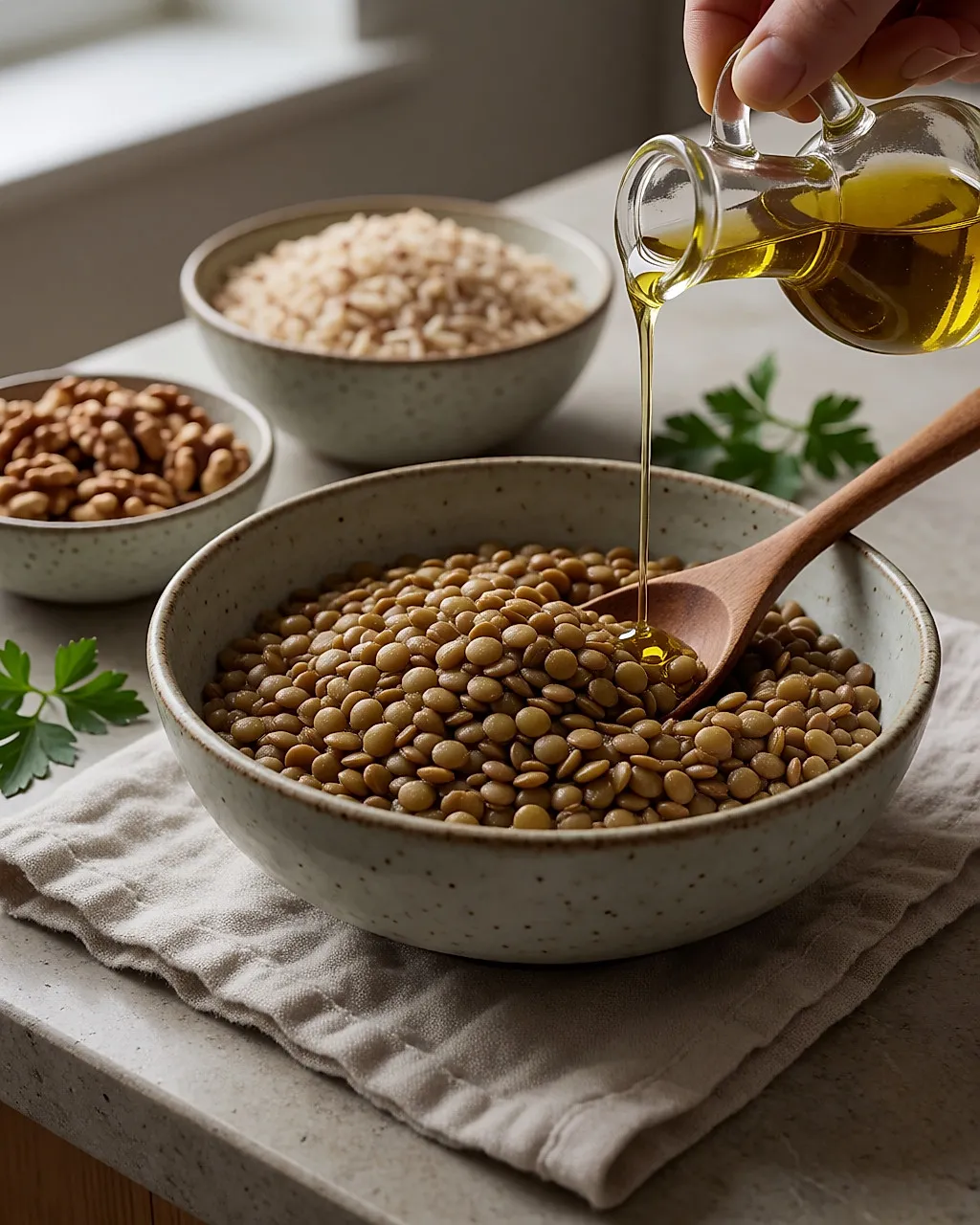
Protein: when we talk about protein, we usually mean animal protein — the kind found in meat, fish and dairy products. But protein can come from plants too. Cereals and pulses (lentils, dried beans, chickpeas and so on) contain it as well. For a balanced diet, the advice is to vary your sources of protein and give more space to plant proteins, since they don't deliver the same benefits as animal sources.
Fat: more commonly, dietary fat. Here too, it can be of animal or plant origin. And while we tend to wage war on fat, it's worth knowing that it is partly responsible for how well our brain works… That said, we favour unsaturated fats: they can improve the lipid profile, whereas saturated and trans fats can worsen it; cholesterol remains one factor among others (genetics, lifestyle), and interpreting it is a matter for a health professional. Where do we find these good fats? Among the unsaturated fats are omega-3 and omega-6: these polyunsaturated fatty acids are found in rapeseed, walnut, hazelnut, sesame and sunflower oils, in walnuts, flaxseed and oily fish… Olive oil, meanwhile, mainly provides monounsaturated fats, such as oleic acid.
So what exactly makes a balanced plate? A balanced meal needs not only to contain protein, carbohydrate and fat, but also to be properly proportioned in each of them. And what counts as the 'right' balance shifts from meal to meal.
At breakfast, for example, you need more carbohydrate (especially complex, fibre-rich carbohydrate) than protein or fat. At lunch, the needs are different: you still want more carbohydrate, but protein comes next, then fat. At dinner, while carbohydrate remains essential, protein also takes centre stage. There's no single official split: these proportions vary from person to person and are only a rough guide.
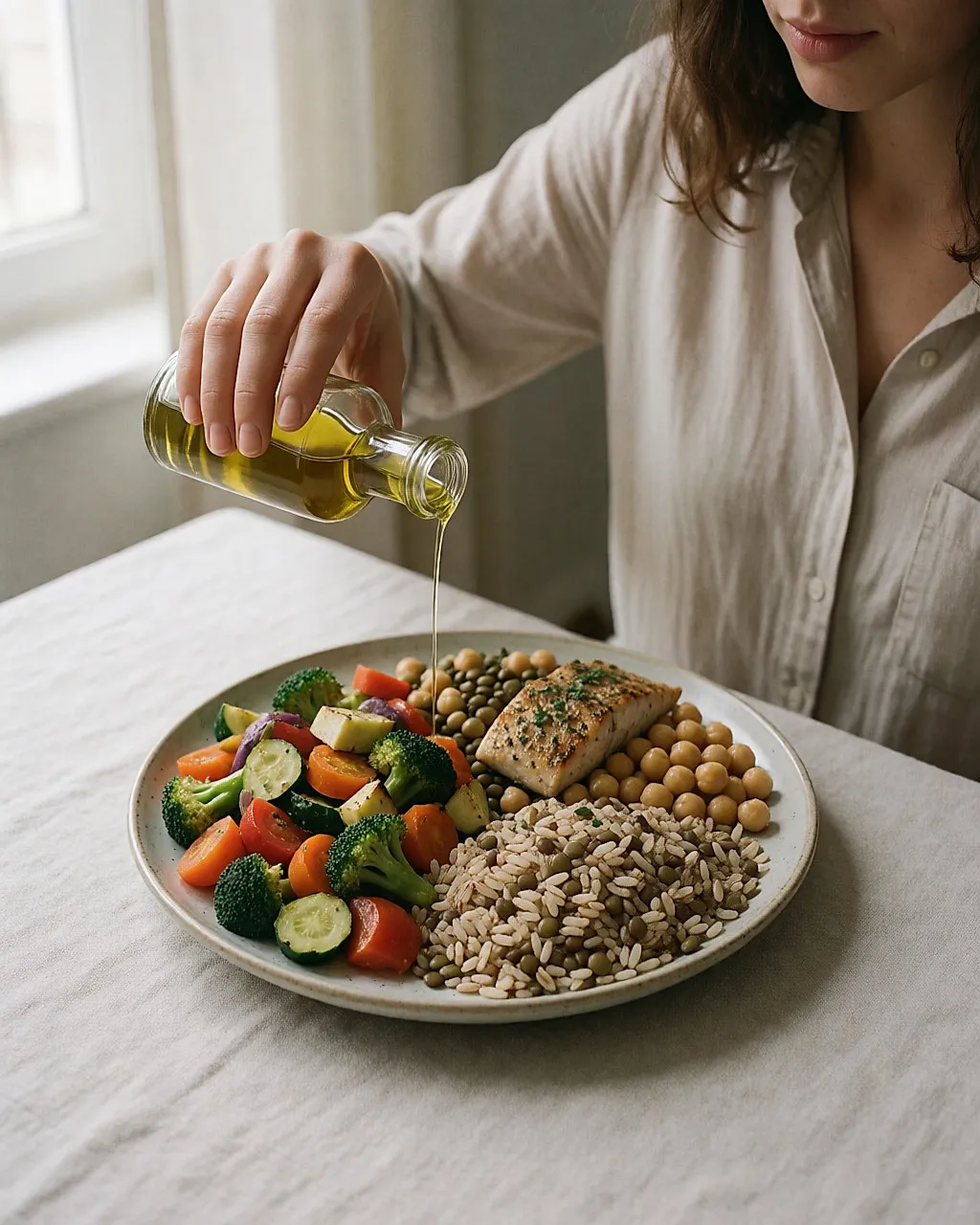
When it comes to putting a plate together, a simple rule helps: half vegetables, a quarter starchy carbohydrates (wholegrain where possible) and a quarter protein. A little good-quality fat, and a piece of fruit for dessert. This works for lunch as much as for dinner.

To snack or not to snack? Snacking gets a bad press, when the real issue is what we choose to snack on. If you're hungry, a snack is a good thing: it curbs the picking before the evening meal. The ideal snack is a dairy product, a piece of fruit and a cereal bar, or a little bread.
And as for fruit and veg, how much exactly? The guidance is five portions a day — the familiar 5 A Day — with a portion being roughly 80 g. And 80 g is half a banana, a decent slice of melon, half an apple or pear, a fruit compote, a bowl of soup, half an orange, a fruit juice — with a maximum of one glass of fruit juice a day, with no added sugar, keeping in mind that whole fruit is preferable… To that we can add that different preservation methods don't have equivalent effects: so favour fresh fruit and veg, plain frozen, or tinned with no added salt or sugar, and don't count on them all being interchangeable.
What's a healthy weight? To get a rough idea, we use the BMI (body mass index), designed to assess a person's build from their height and weight, and to flag situations that carry risk. Working it out is simple: divide your weight by your height squared. For example: if you weigh 58 kg and are 1.65 m tall, that gives you 58 / (1.65 × 1.65) = 21.3.
A chart then gives you a read on where you stand: a BMI below 18.5 = underweight; 18.5 to 24.9 = healthy weight; 25 to 29.9 = overweight; 30 or above = obesity. Treat it as a guide, never a verdict: BMI says nothing about muscle mass, how fat is distributed or your overall fitness. If in doubt, it's a healthcare professional you talk to — not a set of scales.
Sources
- ANSES (the French national agency for food, environmental and occupational health and safety) — the Ciqual food composition table and its reference intakes for vitamins and minerals.
- Santé publique France — the national nutrition and health programme (PNNS), 'Manger Bouger'; official recommendations on fruit and vegetables.
- World Health Organization (WHO) — the recommendation to eat at least 400 g of fruit and vegetables a day.

Comments
Your opinion matters: rate the article, react and reply to comments.
Comments are moderated; AI-assisted comments are flagged. Text emoticons (8-), :-), <3…) are automatically shown as images.