

What coat gets you through a rainy day without making you feel as if you gave up the moment you left the house? The trench, obviously. Except the ones catching the eye right now don't sit like classics any more: broader shoulders, thicker cotton, a skate logo where you'd expect a neat button placket. So is it a genuinely good idea, or fancy dress?
The wardrobe veteran takes to the street
The trench coat descends from First World War soldiers' raincoats, and it has kept a very practical brief ever since: keep out the rain, move with the body, offer pockets that actually earn their place. No wonder a skate capsule chose it as a playground. A streetwear label needs pieces that take the pavement, standing commutes and days that start under November rain—and the trench has been doing that for a century.

So what changes isn't the function but the silhouette. It's longer, broader, the belt dropped or swapped for webbing, and a coat once associated with the establishment becomes a pavement piece. The move is clever: a trench is recognisable in a second, which lets a capsule put its stamp on it without writing a novel. And for you, it's a relatively comfortable way into a world that, worn as a full look, asks for more nerve than most wardrobes can supply.
Fabric is the question to ask before you look at colour
A trench is first and foremost a tightly woven cotton gabardine: a cloth with body, a collar that stands to attention and a crisp, satisfying rustle when you shake it. Run your palm over the fabric and pinch it: if it feels soft and shiny, it won't hold its shape, and a limp trench quickly starts to look like a rain smock.
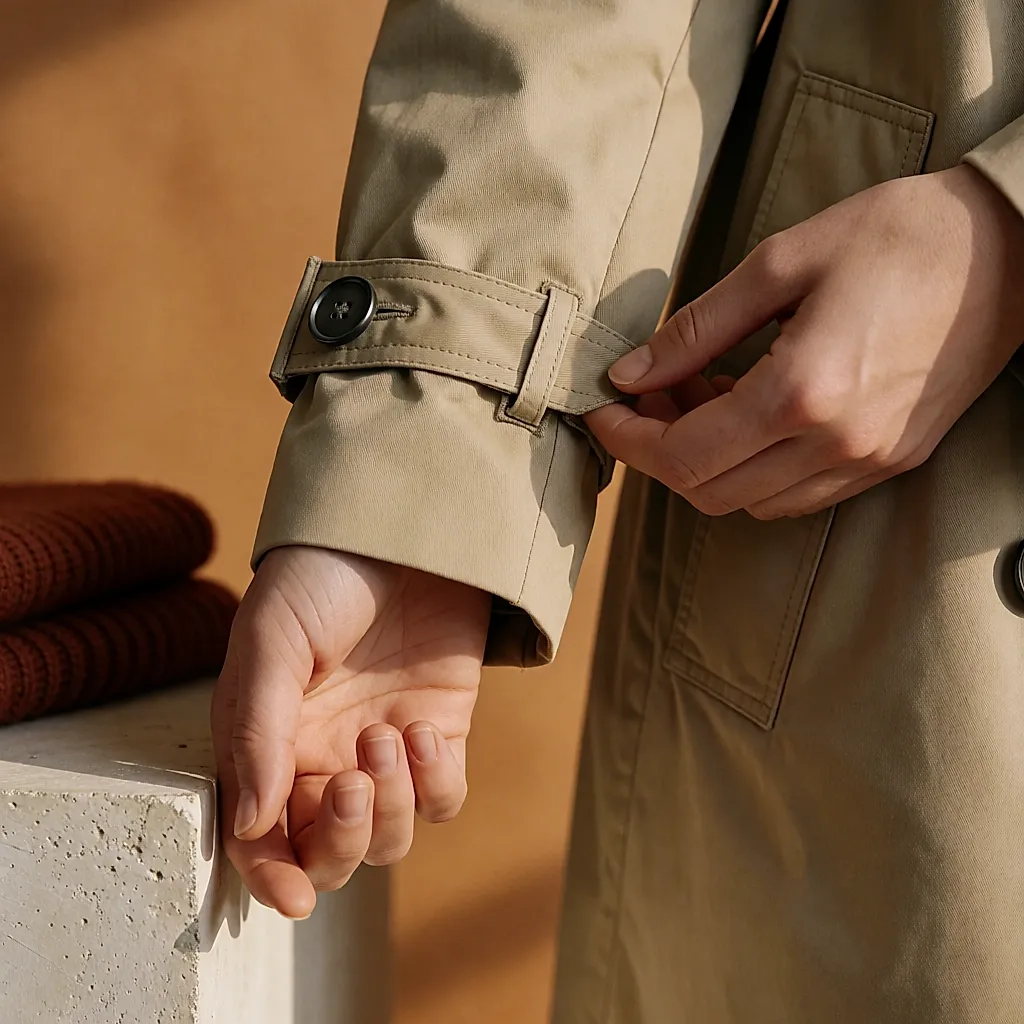
Second check: the label. Turn it over and look at the synthetic fibre content. A small percentage can help a coat hold its shape, but a majority polyester will leave your back clammy by the second leg of your commute. As for the lining, cotton breathes, while viscose slips more easily over a thick knit; a removable lining, where you find one, can add several weeks to the coat's useful season.
And if you're buying an archive piece, remember that wear is something you choose in person, never from a distance. A patina at the elbows is character; a yellowed lining and tired shoulder seams mean an alterations bill.
Drape has to be judged standing up, never on the hanger
On a hanger, every trench looks good. Standing up, it gets harder. Length decides everything: below the knee, the coat starts to wear you; above it, the leg has room to breathe and the coat works with wide jeans as well as a midi skirt. If you're under 1.6m, a style that stops mid-thigh or a belt moved higher changes the picture completely—there's no magic rule, you simply check it in the mirror with your arms raised.

Then come the details, and this is where the capsule has fun. The back half-belt stays (good—it gives structure), as do the shoulder epaulettes; welt pockets sometimes become patch pockets, mother-of-pearl buttons give way to matte metal, and the collar opens wider. The decision is yours: do these nods genuinely appeal, or are they selling you a coat you'd have preferred plain?
What the capsule says about the wardrobe
A trench in a skate capsule is an entry point, quite literally: the least risky piece in the collaboration, the one you can wear to the office on Tuesday and at the weekend without looking as if you've put on a uniform. Collaborations know this, which is exactly why they bring out their classics rather than their most extreme pieces.
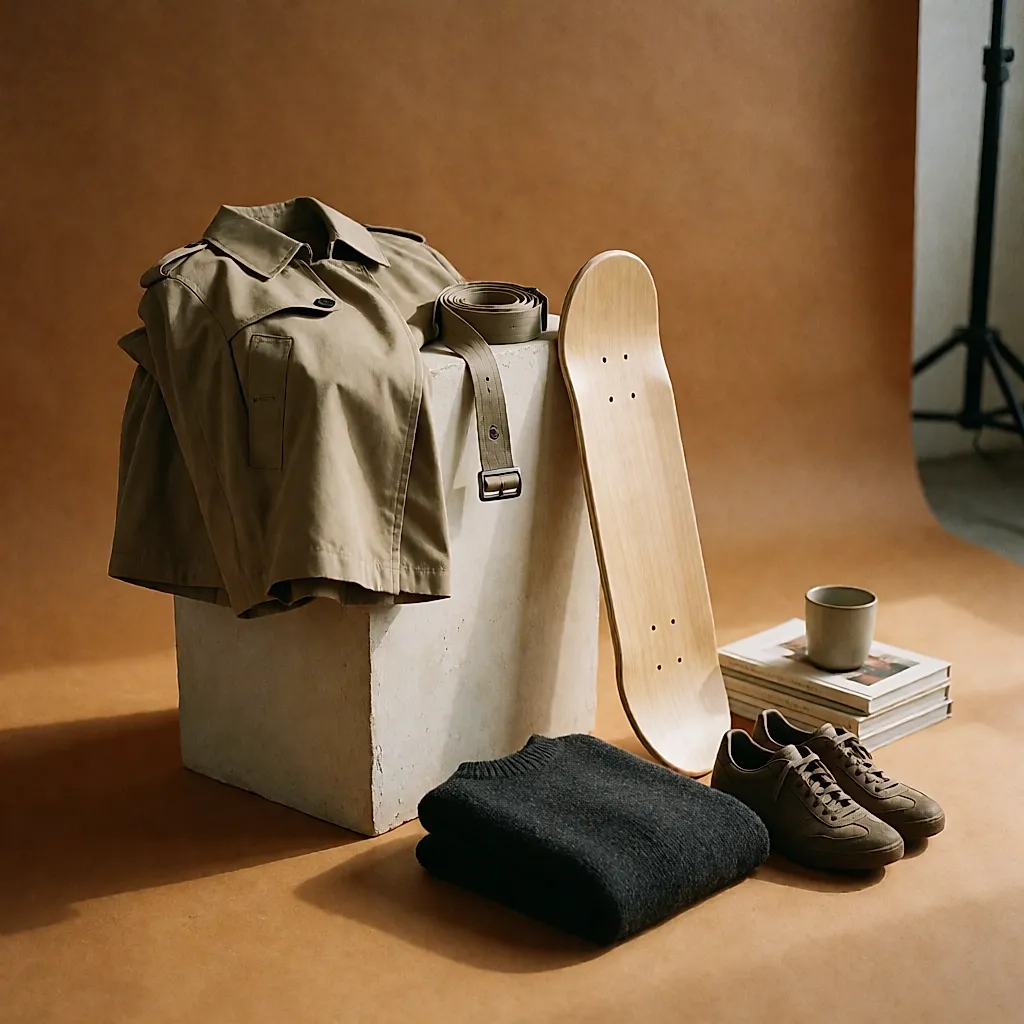
This ritual says something fairly accurate about our wardrobes: the street no longer enters from outside; it comes in through the wardrobe's back door. An overcoat, a shirt, a leather jacket—streetwear codes now slip into shapes our mothers already wore. The trade-off is the full look, which dates quickly. One piece, two at most, and the rest in basics: that's the combination that lasts three winters.
Budget
Expect to pay roughly £100 to £220 for a streetwear capsule trench in heavy cotton, and more like £260 to £600 if the fabric is more refined or it's made in Europe. With vintage and archive, the range is dizzying: from around £70 in charity shops to £350-plus at a specialist reseller, depending on condition, size and rarity. For a trench from a heritage house, you're on another floor entirely, often beyond £850. What moves the price? Cotton density, lining, where you're shopping and, above all, patience.
Where to look: the brand's shop and official site for the capsule, charity shops and resale platforms for archive, and alteration tailors for rescuing an £80 piece that deserves a new hem.
Before you pay, three questions: can you raise your arms without the shoulders pulling? Does the length work with at least three outfits you already own? And if the capsule disappears from circulation, would you still wear this trench in two years? Three yeses, and you can get your card out.
Then there's the real question, the one no fitting settles: do you want a trench that tells the story of a collaboration, or one that looks like you? If you're unsure, keep your budget, wear the coat you already own for another season—and have it professionally stain-treated. The day you come across the right capsule, you'll know why you waited.



Comments
Your opinion matters: rate the article, react and reply to comments.
Comments are moderated; AI-assisted comments are flagged. Text emoticons (8-), :-), <3…) are automatically shown as images.