
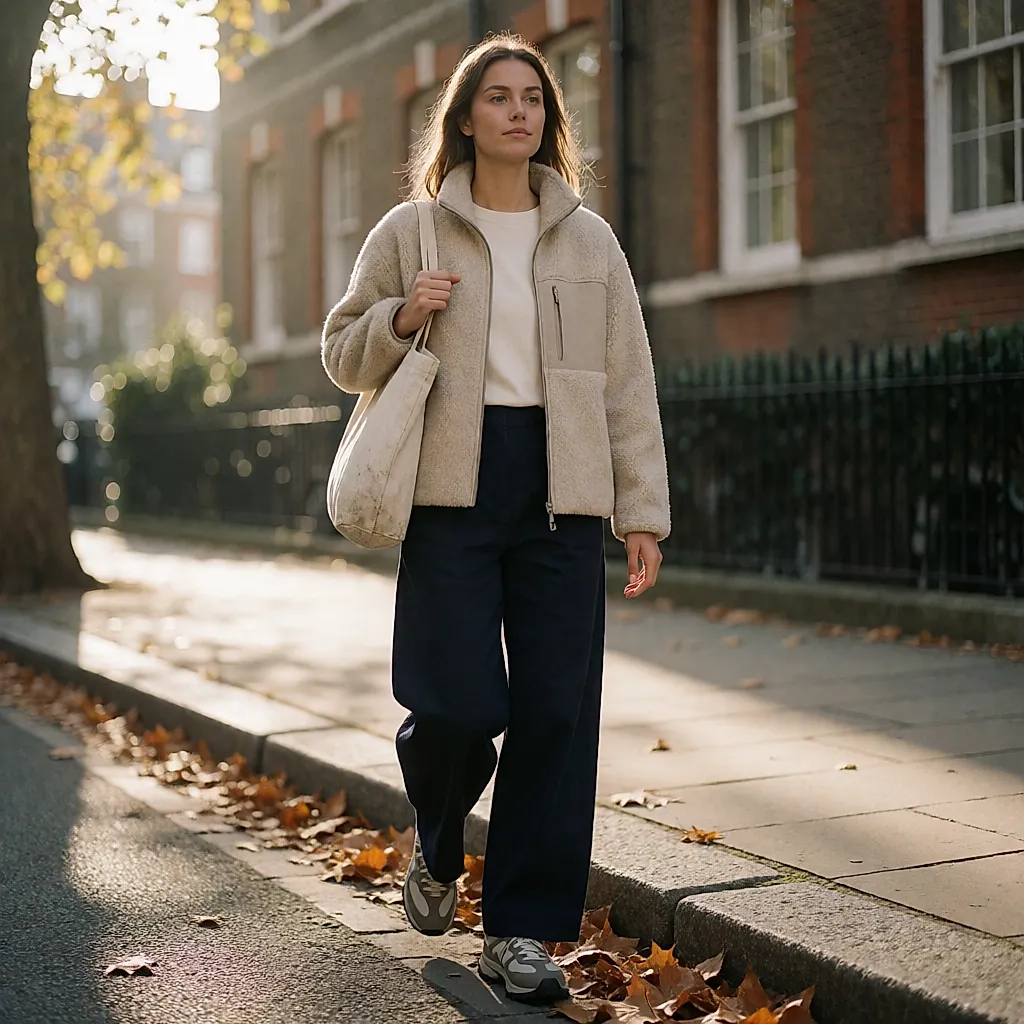
October can't make up its mind: 11°C when you wake up, 19°C when you leave the office, and you stuck in between in a jumper that's too warm or a jacket that's too thin. That's when the fleece makes its entrance, same time every year, without you ever really choosing it. Except this season, it's not the cut that's moving — it's the fibre.
The mid-layer nobody photographs
A fleece has one very specific job: to work as a mid-layer. Warm without weight, it slips under a parka or a trench, works on its own when the afternoon lingers, and rolls into a ball at the bottom of a bag without complaint. It's the least photogenic piece in the wardrobe and one of the most cost-effective: two months of wear, three washes, zero thought on a morning. You wear it, wash it, lose it at the back of the wardrobe, then find it again on 15 October next year.
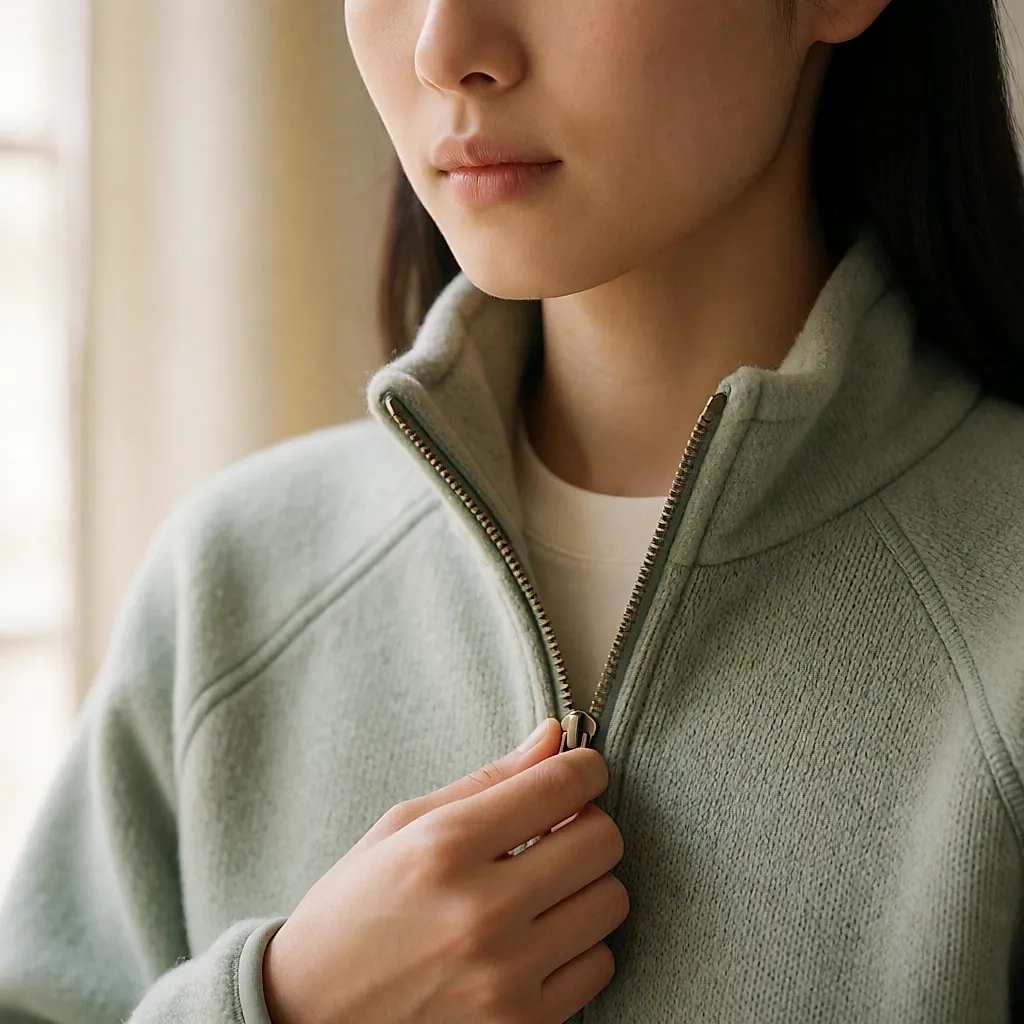
Its problem has never been warmth, though: it's the silhouette. Too loose, and it hugs the sofa more than it hugs you; too fitted, and there's no room for anything underneath. What makes the difference comes down to a few details: a straight cut that allows for a thick T-shirt, armholes high enough to disappear under a jacket, a stand collar that holds its shape, and a well-set zip. That last detail decides everything — without it, the piece looks like a blanket with sleeves. Worn with wide tailored trousers or raw denim, with hiking shoes that have become city shoes, it even has real style.
What changes in the fibre
The principle behind recycled yarn is easy to explain: a worn jumper, offcuts from manufacturing, clothes dropped at a textile bank. The material is sorted, shredded and re-knitted — sometimes blended with new wool to give it body. The result is a recycled wool that keeps the warmth of its virgin counterpart, usually with a lighter footprint than wool from sheep that has to be reared, sheared, washed and transported.
The other change is invisible. Water-repellent finishes long relied on PFAS, per- and polyfluoroalkyl substances nicknamed 'forever chemicals' because they don't really disappear. Rules on PFAS are evolving in the UK and EU, and formulations are changing at manufacturers — not every piece is at the same point, so when a fleece claims to be water-repellent, the label is still your best source of information.
A nuance, though. 'Recycled' does not mean 'impact-free': recycled yarn has still been dyed, transported and knitted. And the more a piece mixes fibres — wool and synthetic in the same knit — the harder it will be to recycle in turn. The useful rule is simple: look for a straightforward composition, and check the share of synthetic fibres before you fall in love with the colour.
What it means in practice
Very little, in truth. A recycled wool fleece wears like any other, and it's cared for in the same way: as little as possible, wool cycle, dry flat. The tumble dryer is its personal enemy — that's what felts, shrinks and tires the fibres. Pilling tends to show up where things rub: bag straps, waistbands, office chair arms. A bobble remover sorts it out in a few minutes, and it's one of the best investments in your drawer.

On longevity, the picture doesn't change either. A zip can be replaced, a seam can be repaired, and a fleece that's treated well will last several winters — and because the style has been stable for decades, nobody will ask what year it's from. That's the real point: the most understated piece is the one already in your wardrobe. If yours is still holding up, there's no rush.
Budget
On price, expect roughly £20–£50 for an entry-level fleece in recycled fibres (sports retailers, supermarkets), £60–£130 for a piece in recycled wool or bouclé wool from an outdoor brand, and £150+ for the most technical versions. What pushes the price up: the share of real wool in the composition, where the yarn comes from, the finish and, let's be honest, the logo.
Where to look? Sports shops for the lowest prices, outdoor brands online for the best materials, and especially second-hand platforms, where nearly new fleeces are plentiful — often resold because the cut didn't suit, rarely because they're worn out. Check your size in the brand before you buy: that's the main trap in a good deal.
Before you get to the checkout: look at the composition (how much wool or recycled fibre?), look for a PFAS-free finish if the piece is described as water-repellent, then try it under a jacket you already wear. And be wary of 'soft' alone: a fleece is judged on its drape and zip as much as its feel.
In the end, the fleece has a quiet charm: it promises nothing, keeps you warm and lasts. This year, it also has a good reason to clean up its act. If you do need to replace yours, aim for recycled wool in a readable composition, a cut that lets you breathe, and a colour you'll still be happy with in February. Otherwise, keep the old one: it still has plenty of Monday mornings to give you.



Comments
Your opinion matters: rate the article, react and reply to comments.
Comments are moderated; AI-assisted comments are flagged. Text emoticons (8-), :-), <3…) are automatically shown as images.