
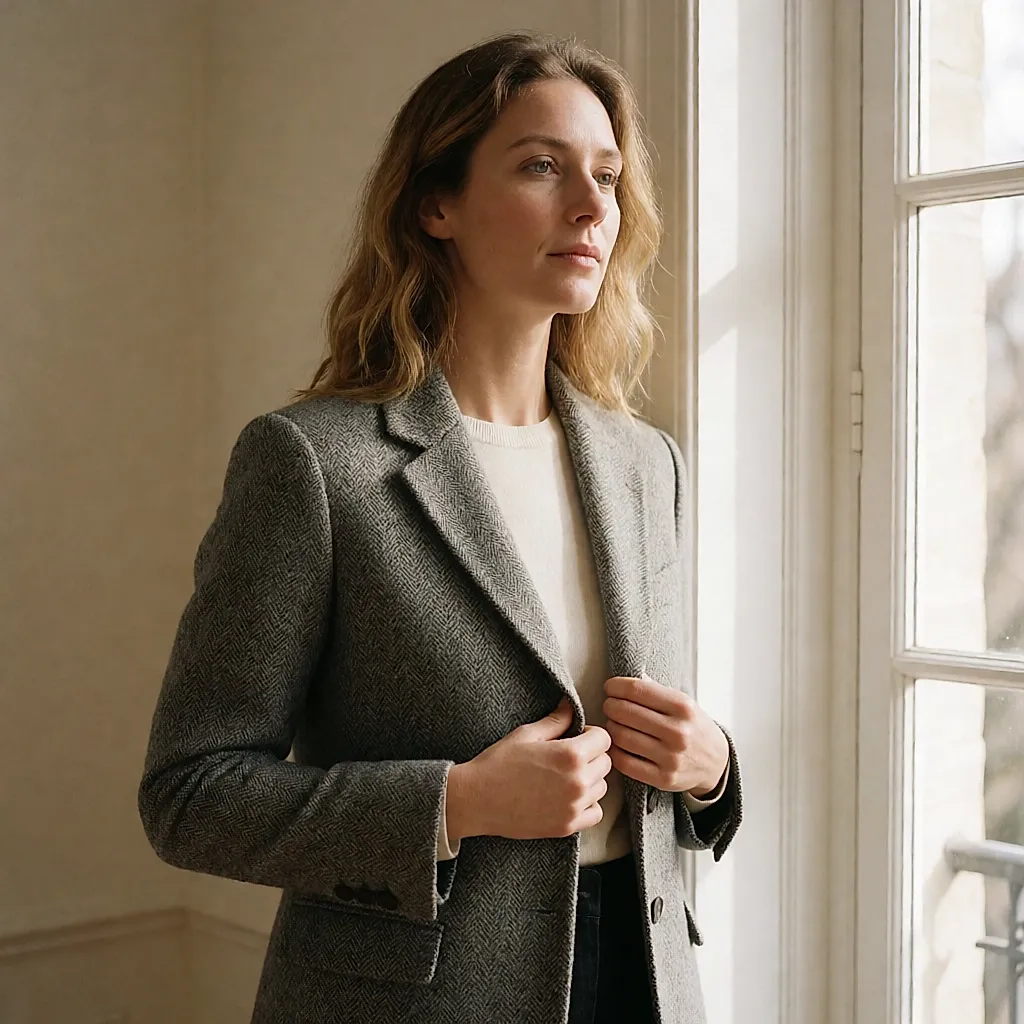
A tweed jacket on the hanger is a promise: presence that holds, a colour that looks like it has a story, chic that doesn’t apologise. In the fitting room, the same jacket can turn you into a neatly padded cushion on legs. The culprit is almost never the colour. It’s the weave.
The weave before the mirror
Tweed is first and foremost a wool weave, and its name carries a story: “tweel”, an old word for twill, was supposedly misread by a London merchant, before everyone attached the word to the River Tweed. It’s a nice version, of uncertain accuracy, but it says the essential thing: here, everything starts with the weave. Tight twill, soft herringbone, Irish bouclé flecked with little colour neps, graphic houndstooth — these patterns decide the drape long before the cut comes into play.
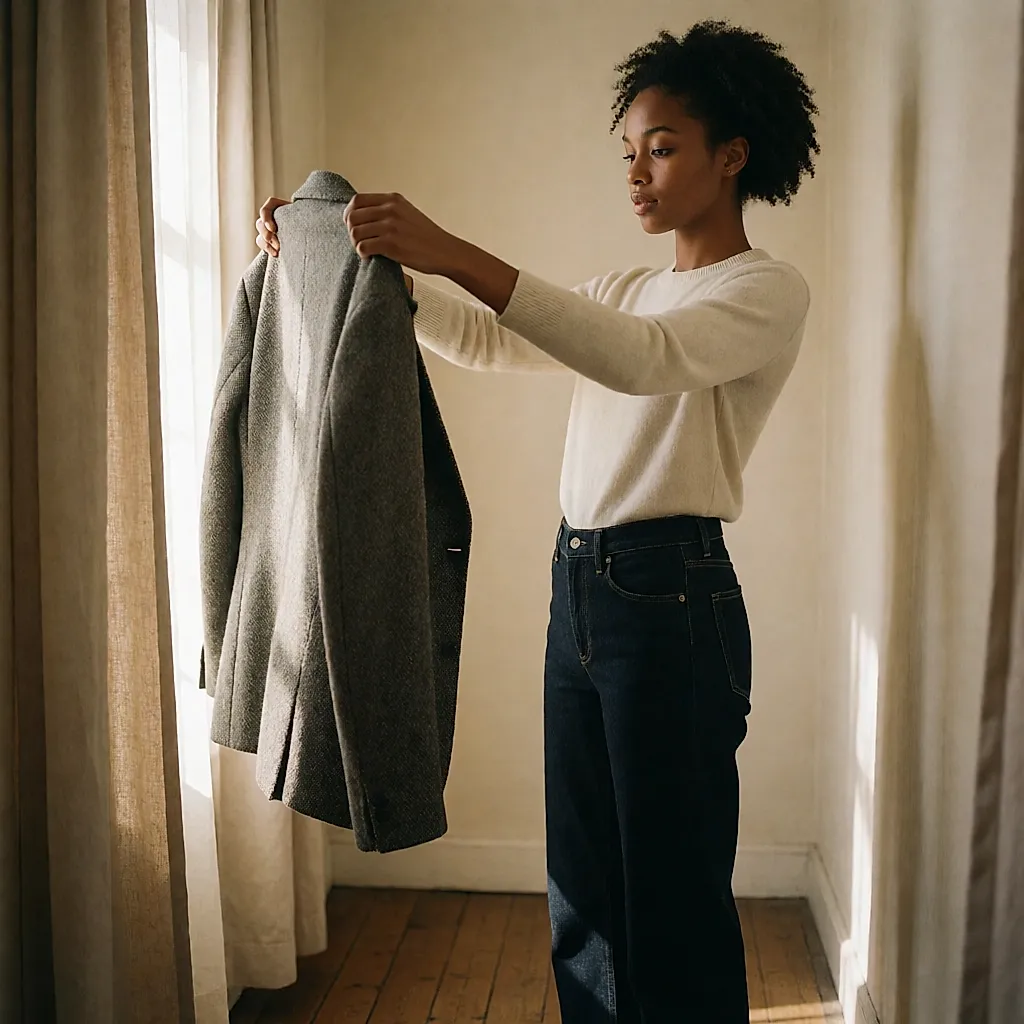
Hence the first move in the fitting room: pick the piece up by the shoulders, weigh it, fold it. A loose, lightweight weave slips through your fingers, follows the body, moves with you — it’s forgiving, but it also creases more quickly where you sit. A dense weave holds its own shape: it structures, straightens the line, and tends to add bulk to the bust and shoulders. On a petite frame, it works well as a skirt or a small cropped jacket; on a fuller bust or broad shoulders, look for it in a straight cut or keep it below the waist. Nothing is off-limits, it’s just a trade-off.
One tweed piece, and let everything else stay quiet
Tweed swallows light and pulls the eye: it’s a talkative texture. The rule that saves almost every outfit comes down to one idea: one tweed piece, maximum. If the jacket leads, it wants a fine knit underneath — merino, cotton, silk — and a clean bottom half: straight trousers, raw denim, a smooth skirt. If the skirt leads, it wants a plain top and a discreet knit.
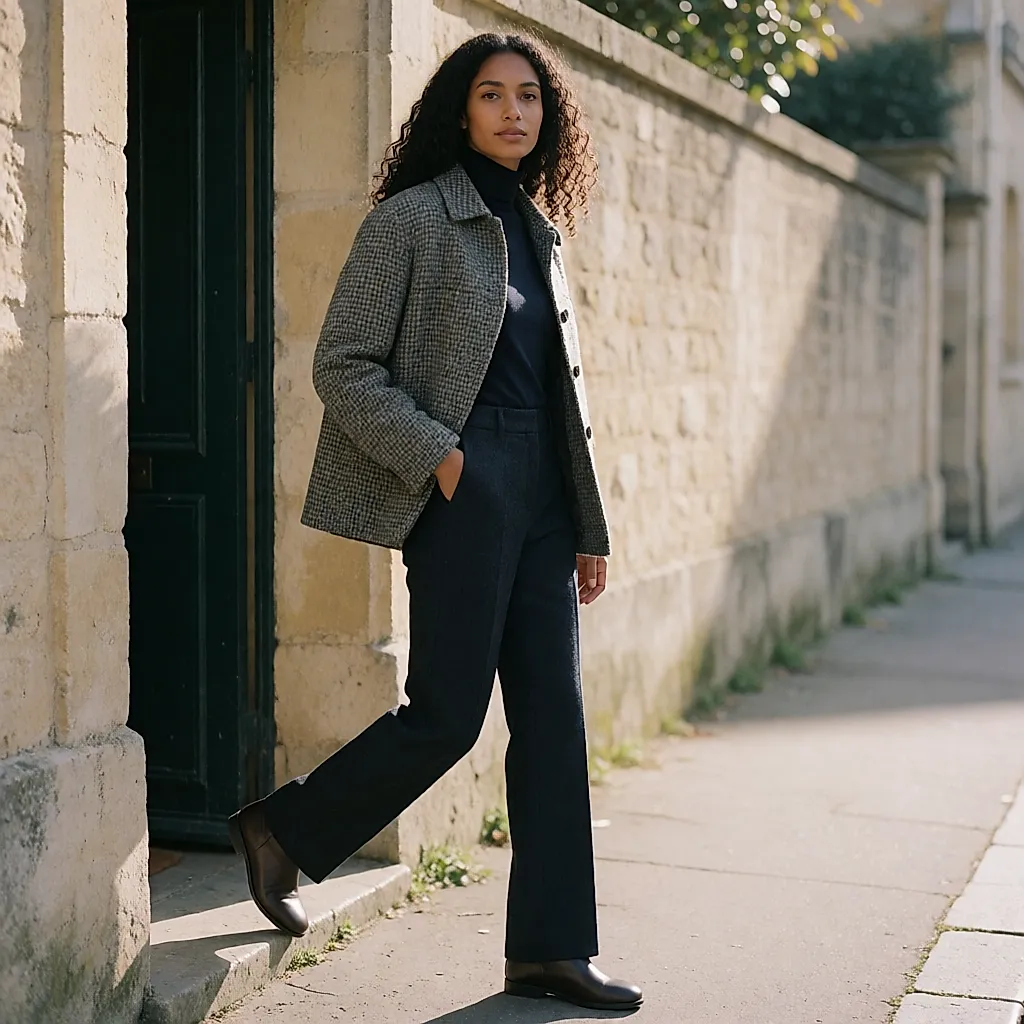
Have you ever tried to squeeze a chunky cable-knit jumper under a tweed jacket? You’ll have seen the result. Texture against texture doesn’t add up; it clashes. Layering, yes, but keep it thin: a fluid shirt, a trench over the jacket when mid-season can’t make up its mind. Head-to-toe tweed exists and can look beautiful, provided you stay within the same family of weave and one single colour — otherwise you leave silhouette territory and enter mosaic.
Lining and seams: the details that decide everything
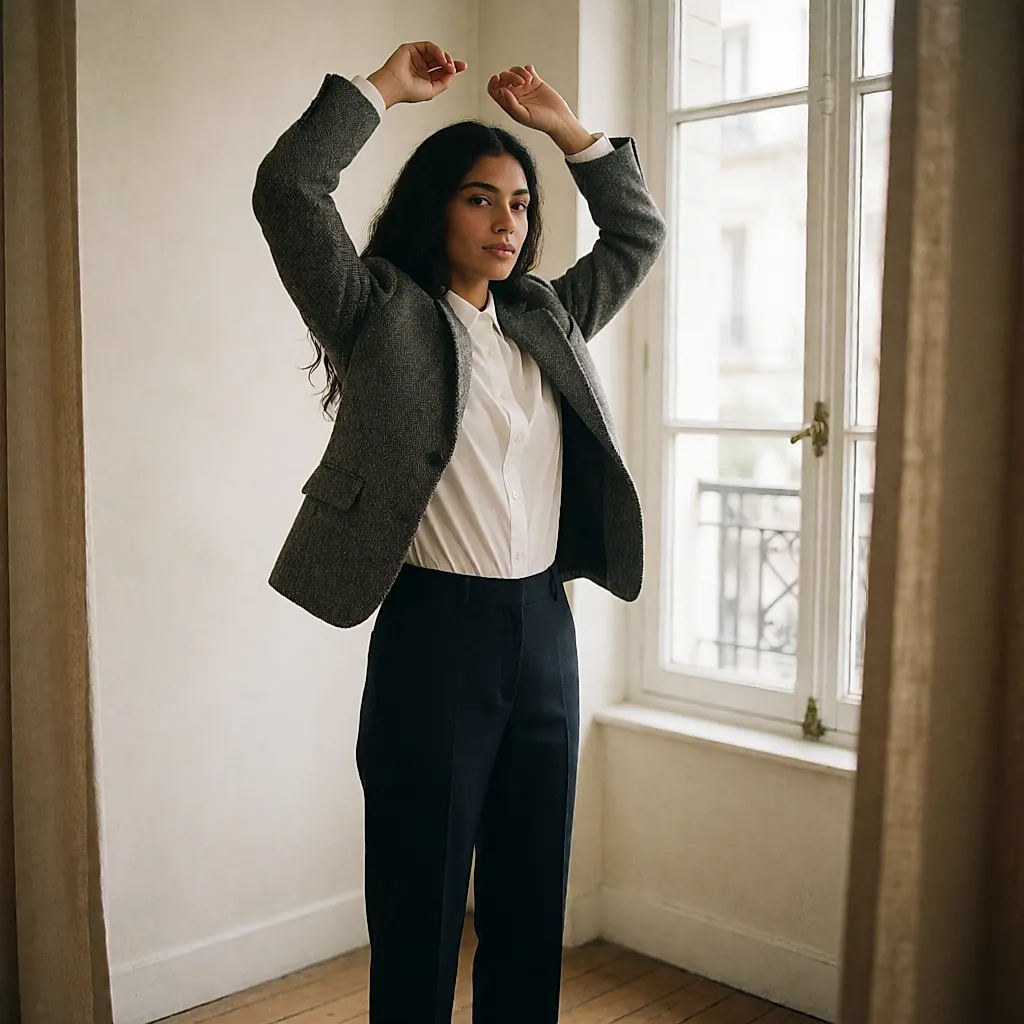
On the hanger, two pieces can look identical. Worn, they tell a completely different story. Turn the jacket inside out: does the lining pull at the armholes when you raise your arms? If so, the drape will be wrong from your first movement of the day. Viscose and cupro breathe and glide well; a lining that’s too stiff kills the drape. Then look at the shoulder seams and the curve of the collar: that’s where a rough tweed ages badly.
A small detail that decides everything after two winters: the buttons. Horn, mother-of-pearl, wood — they can be replaced. A plastic button that pops off can be replaced too, but it gives a poor impression of the overall quality. And check the wool content on the label: the percentage of wool often influences how it holds up and how prone it is to pilling, though it also depends on the weave and any blended fibres.
The mini fitting-room test: wear the piece in daylight, not just under the changing-room spotlights. Raise your arms, sit down, cross your legs. And take along the knit you’ll actually wear with it — it’s often what pushes you to the next size up.
Jacket or skirt: how to decide based on your week
The real question isn’t “which is more on trend”, but “which one will I actually wear, and how often, over the next three months”. A tweed jacket slips over a dress, jeans, wool trousers: it often works harder than you’d think. A straight skirt is easier to live in when you spend your days sitting down, but it needs a top that knows how to fade into the background.
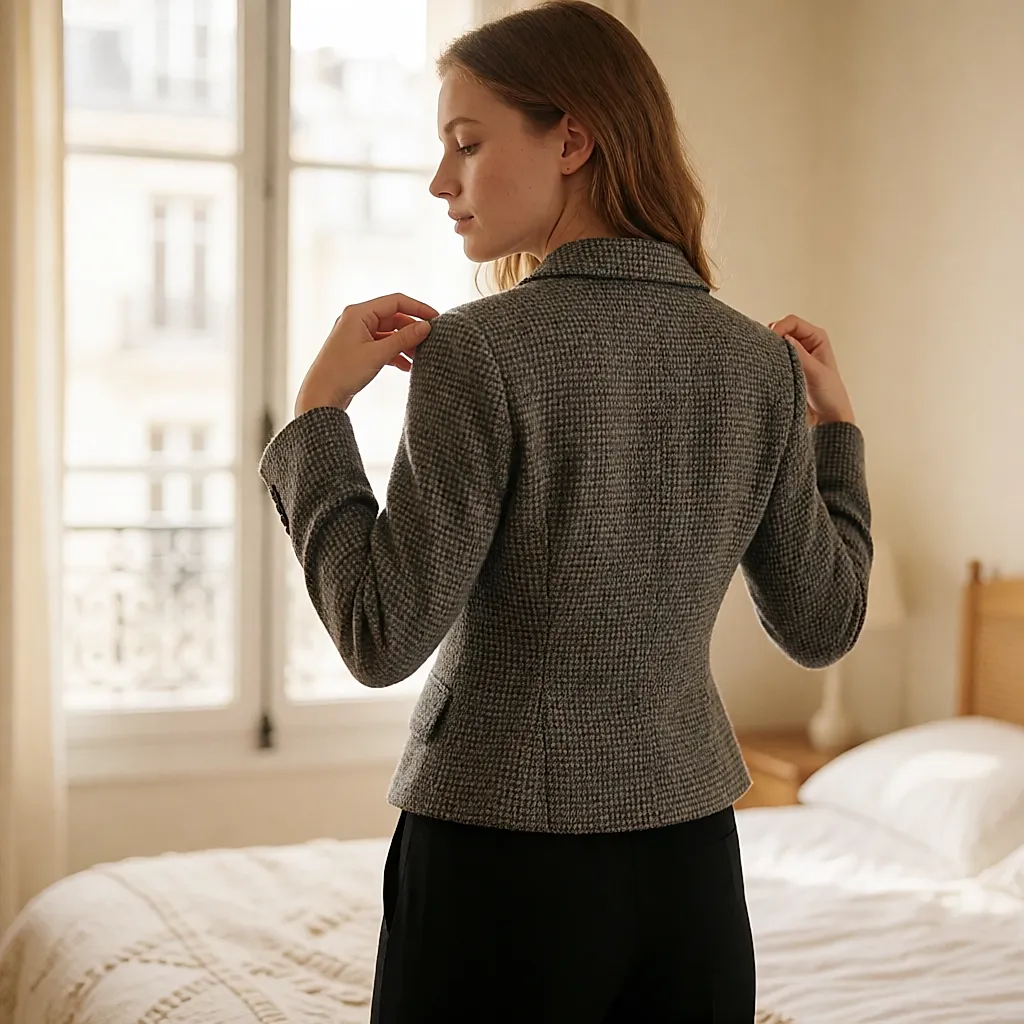
If you’re still torn, there’s one check that matters: the shoulders. A jacket that’s too wide or too narrow at the shoulders is very hard to fix at a tailor’s, whereas a skirt can be taken in at the waist. In other words, choose a jacket by its shoulders, and a skirt by how much you want to wear it.
Budget
As a broad guide, a tweed jacket often sits around £50–£130 on the high street, £150–£350 when wool is the main fibre and the construction is considered, and £430+ from houses working with fine wool or Harris Tweed. For a straight skirt, expect more like £35–£100, and £130–£260 for a really well-made piece. Second-hand changes everything: charity shops and resale platforms often list £15–£80, with some beautiful finds provided you check the lining and seams.
For care, regular brushing is enough most of the time; the occasional trip to the dry cleaner costs a modest amount in practice, though it’s worth checking locally as prices vary by area and dry cleaner. And the low-waste habit: wear it, look after it, keep it. A well-chosen tweed can live for several winters — which is exactly what you ask of it.
Sources
- Harris Tweed Authority — The legal protection of Harris Tweed, accessed October 2026.
- Chanel — Official house website, accessed October 2026.
- Woolmark — Wool care, accessed October 2026.



Comments
Your opinion matters: rate the article, react and reply to comments.
Comments are moderated; AI-assisted comments are flagged. Text emoticons (8-), :-), <3…) are automatically shown as images.