
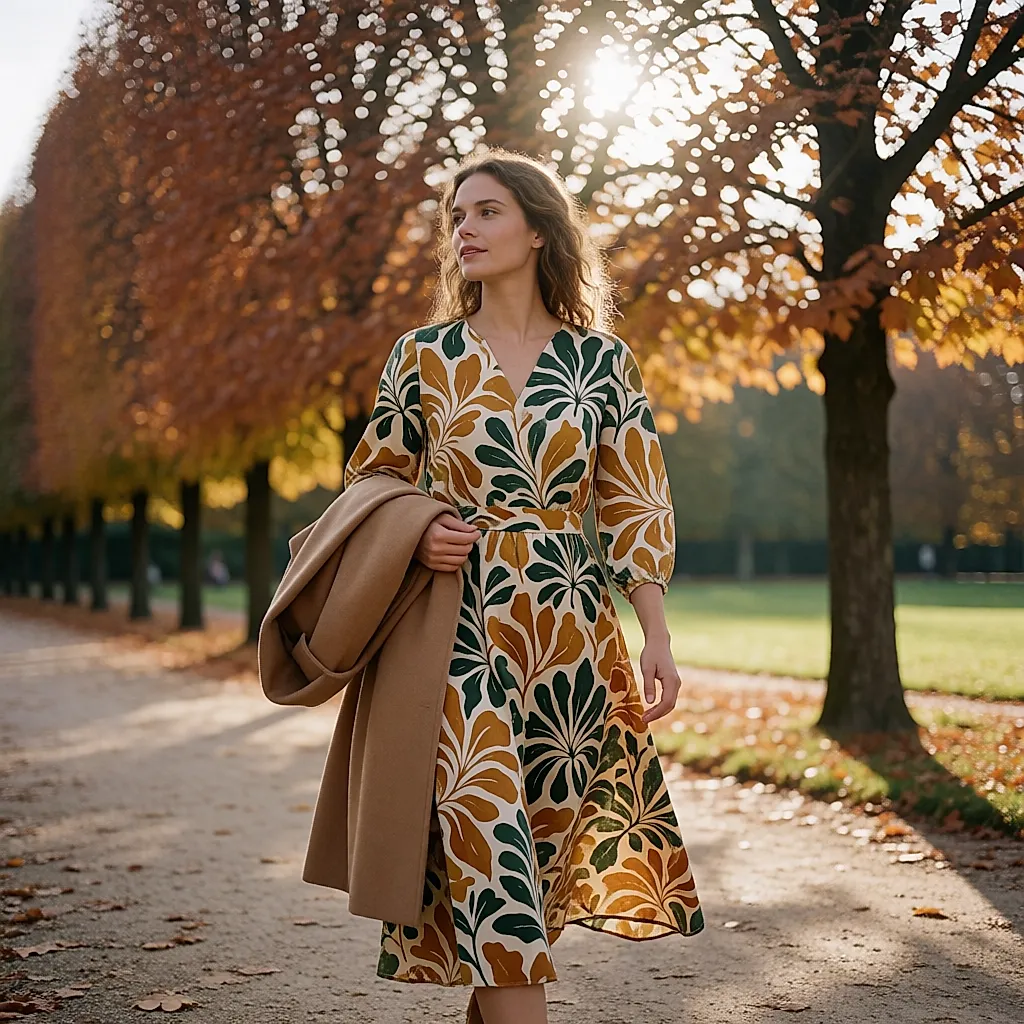
We fall for it in the fitting room, then doubt it once we're home: the story of every floral blouse we own. Too busy, or not quite enough? The sales assistant murmured that it's 'very big this season' — thanks, that doesn't help. The problem is almost never the print itself; it's its scale.
A print is judged from a distance first
A print isn't just a drawing: it's a relationship of scale, between the pattern and the surface carrying it, then between that surface and the eye receiving it. A micro floral seen from 30 centimetres reads like a texture, almost like a speckled solid. The same design on a coat glimpsed from the far end of a platform becomes a colour in motion. A large flower, by contrast, always arrives before you do.
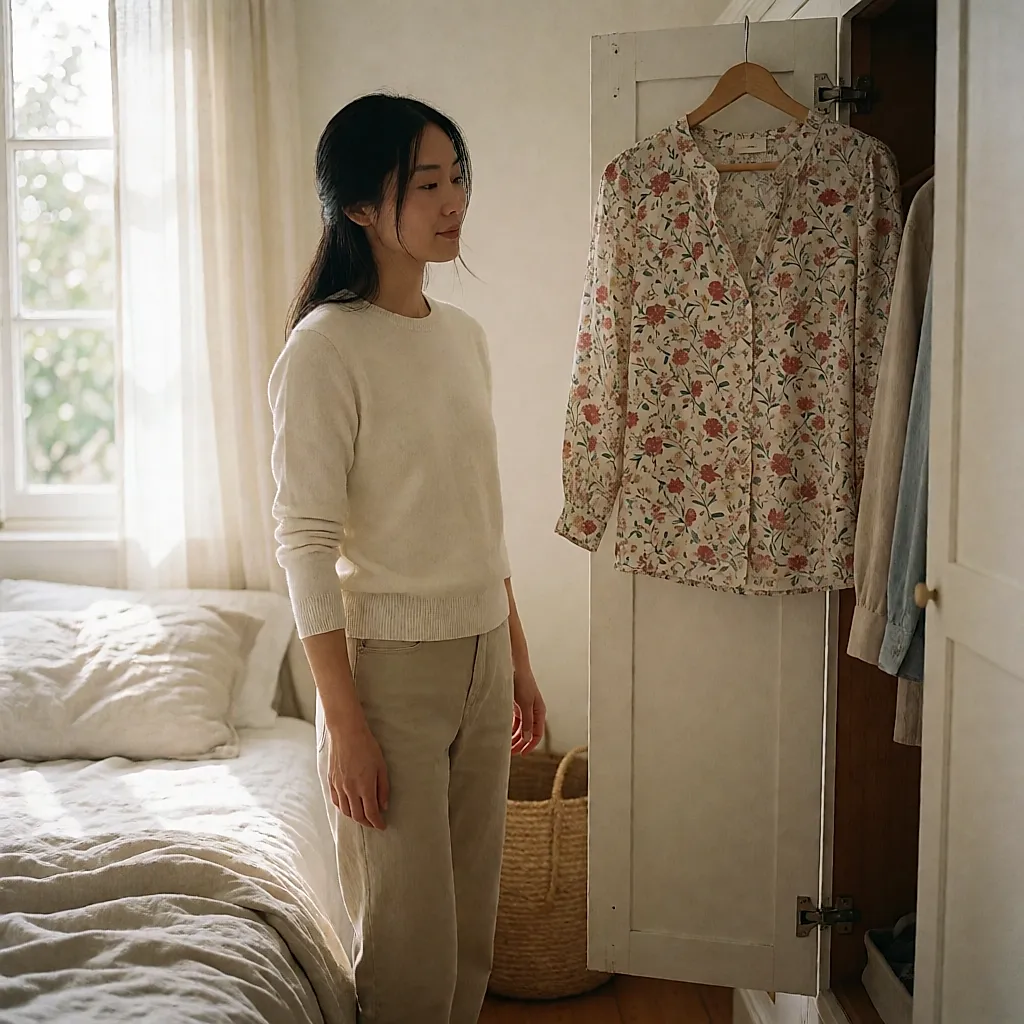
Then there's density, the other half of the adjustment. A tight print, pattern pressed against pattern, quickly saturates the surface; a more spaced-out design lets the fabric and the eye breathe. The simplest check: hold the piece at arm's length, then look at it in the mirror from two or three metres away. If the pattern turns into a blur, it's too fine for that piece.
The garment dictates the scale
Large surfaces call for large designs; it's almost automatic. A coat or trench worn open over a solid outfit makes a good backdrop for a generous print, because we often wear them unbuttoned and they frame the silhouette. On a long dress, the same scale becomes a scene: lovely in motion, more cumbersome when you sit down.

The smaller the piece, the tighter the scale. A top worn close to the face, a scarf, a silk square: the print is read at close range. An oversized pattern takes over and your face drops into second place. Conversely, on a straight, clean cut with a crisp drape, a slightly dense print holds better than on a very fluid cut, where pattern and fabric creases get mixed up.
Solid colour: your safety valve
Here's the balance that rescues almost every look: one print at a time, and the rest in solid colour. The trick is choosing the right plain colour. A useful habit: pull from the print's palette, ideally the shade that appears least. It then becomes a unifying colour rather than a collection of swatches.
Layering offers another way out. A printed shirt tucked under a solid knit, with only the collar and cuffs showing: the right dose of pattern for a Monday morning when you can't face negotiating with your wardrobe. For accessories, stick to matte textures and clean lines. Mixing prints remains a balancing act — same colour family, two clearly different scales — and you don't push your luck on a meeting day.
One print, two distances
There are pieces you see from afar and pieces you see up close, and the scale should follow. A jacket or coat crosses the street, the terrace, the platform: they need a design that reads from several metres away. A dress worn at the table, by contrast, lives 50 centimetres from people's eyes: too large a print dominates, while a medium pattern creates a softer texture.
This is where print becomes a matter of silhouette. A dense, continuous pattern on a voluminous piece visually adds bulk; the same, more spaced out, on a straight cut simply draws a line. Nothing is forbidden, but it's better to know before you pile on a checked coat, floral skirt and scarf — charming on some, decidedly more of a gamble on the rest of us.
The three-metre test. Drape the piece over the back of a chair and step back three paces: the pattern should stay legible without turning into mush. Then check its colour against your basics — if nothing answers it, the piece will stay on the hanger.
Budget
Is it worth spending more? When it comes to budget, print is a good buy: it does the work of accessories for you. As a rough guide, expect to pay around £25–£60 for a cotton or linen blouse on the high street, £60–£150 from an established brand, and more from a designer or for a true silk piece. A printed midi dress is often £40–£90 at the mass-market end, or £90–£200 for a more considered cut and fabric.
Charity shops and resale remain the most generous hunting ground: £10–£40 for a skirt or shirt, sometimes less, with prints from another era that have already been road-tested by real life. Before you fall in love, check the fabric composition label. On very cheap pieces, check the synthetic fibre content — some cheap polyester can look shiny and age poorly.
One last word, more important than everything else: your best print is probably already in your wardrobe. A polka-dot skirt, a small floral shirt bought three years ago, an inherited silk square — these pieces have already passed the three-metre test. We're not reinventing anything: we change the scale, add a well-chosen solid colour, and the look follows. Your turn!

Comments
Your opinion matters: rate the article, react and reply to comments.
Comments are moderated; AI-assisted comments are flagged. Text emoticons (8-), :-), <3…) are automatically shown as images.