

You pull on your raw wool coat — the one you've worn for the past two winters — and something feels off. Not another piece to go out and buy, just one small gesture to tip the whole silhouette. It's amazing how much a square of fabric over the shoulders can change a look without touching anything else. You see them everywhere on the street right now, and not only on the catwalk. Good news: it usually costs less than a jumper, and it flatters pretty much every shape. On one condition — pick the right size, and know how to tie it.
Why the big square is back in the spotlight
After several seasons of very constructed layering, the wardrobe is coming down a notch. We want simple, warm pieces we can throw over anything without thinking — and the big square does exactly that. It lifts a basic in seconds, adds texture without weighing down the cut, and transforms a head-to-toe look without changing a single garment.

Over a blazer, it softens the sharpness and loosens it up. Over a raw wool coat, it adds colour or print and warms the whole outfit. It's a statement piece that doesn't need to shout to be noticed. And on the budget side, it's often the smartest buy of the cold season: for the price of one decent jumper, you can pick up two or three squares that will completely redraw your outfits.
Size decides everything
90 x 90 cm is the classic square. It covers the shoulders, folds into a triangle, ties neatly. If you're new to this piece, start here: it's the most versatile format and the easiest to get the hang of.
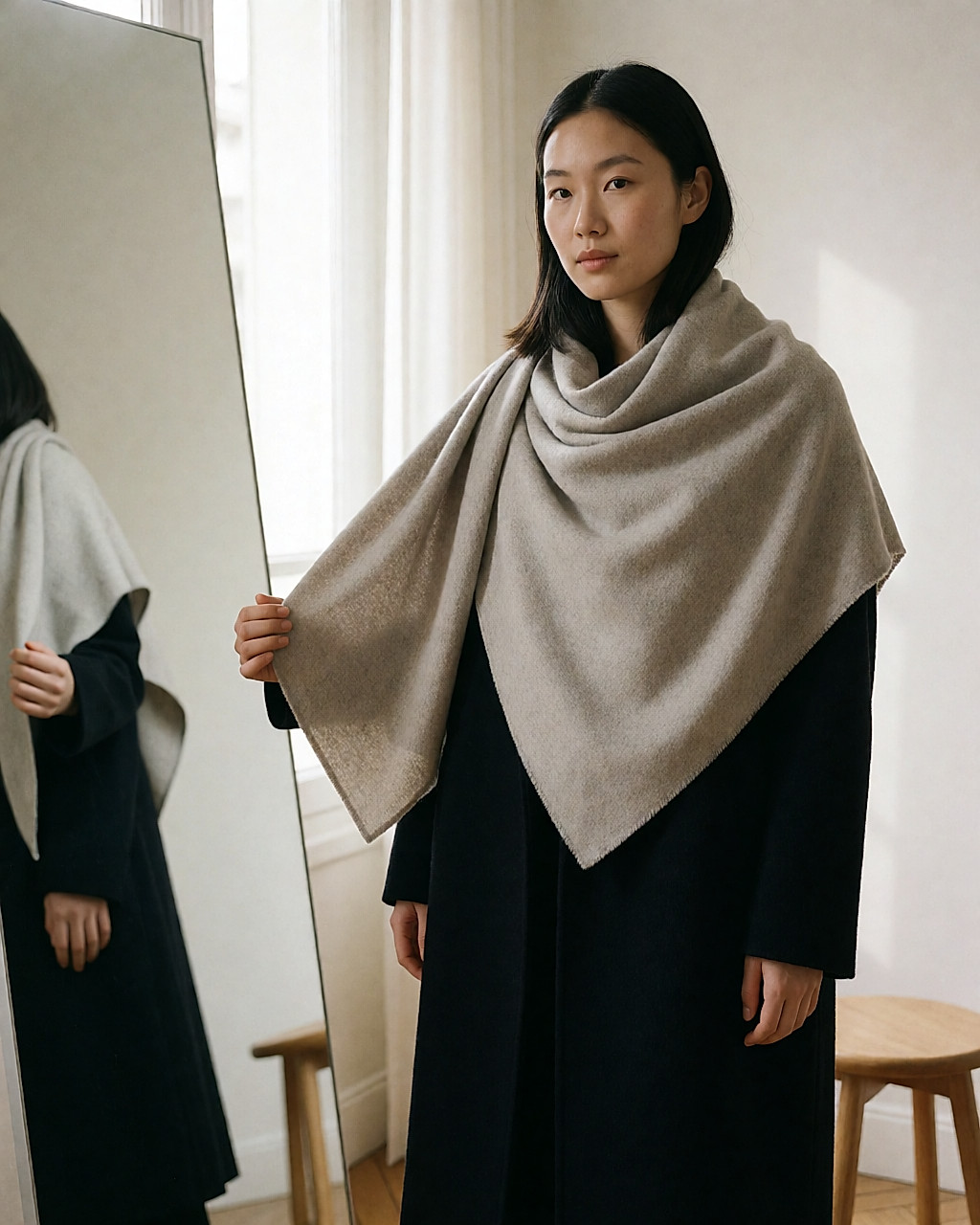
With a 120 x 120 cm, you gain extra drape. Wear it as a shawl over a coat, as a generous neck wrap, or tucked into a belt without creating awkward bulk. It's the size that forgives the most creative tying.
And then there's the 140 x 140 cm, the most generous of all, perfect for an over-one-shoulder neck wrap. But it all depends on the drape: too stiff and it sits like a block on your shoulders; too fine and it won't hold the knot. The rule of thumb is simple: the bigger the square, the softer the fabric needs to be. A 140 in thick wool that stands up on its own is, frankly, a false good idea.
Matte wool, silk-wool, recycled cashmere: which fabric?
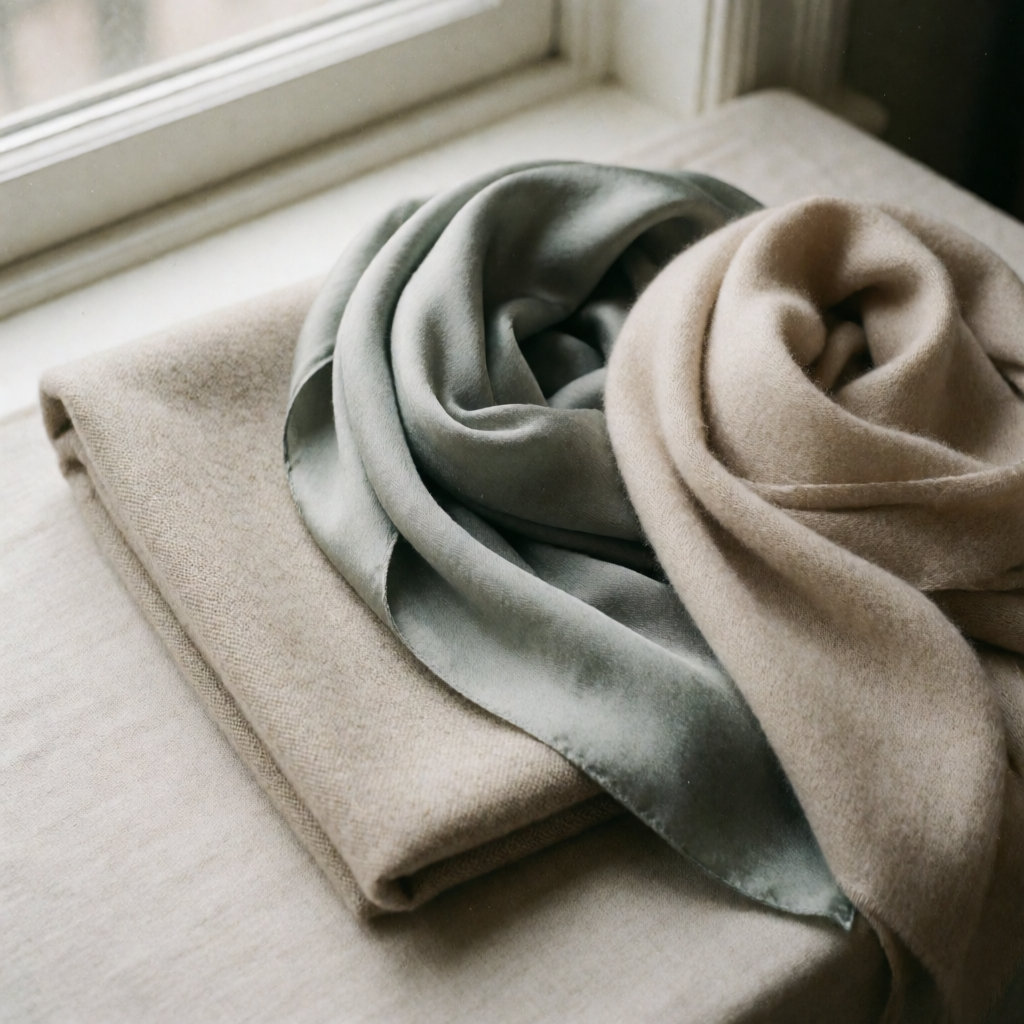
For autumn, go for a warm, matte wool with a fairly tight weave. It structures the silhouette and holds the knot without you having to fiddle with it all day.
A silk-wool blend has a more fluid drape and a cooler feel to the touch. Lovely over a blazer, a bit of a stretch for a hard winter — it's a between-seasons fabric, not a deep-cold one.
Recycled cashmere is the softest, lightest option. This fibre, regenerated from production offcuts or sorted garments, is warm for its weight, but the price climbs fast. And watch out for hollow green claims: read the composition on the label rather than the big lettering on the packaging — a very low percentage changes nothing about how it feels, and that's usually where the cardboard eco-promise is hiding.
One detail that matters: if wool makes you itch, slip a fine cotton collar underneath. No reason to give up on the piece because of that.
Three ties that really work
The simple triangle knot. Fold the square diagonally, place the point at the front or the back depending on what you want to show, bring the two ends forward and tie a simple knot. Tight, it sits well on a roll-neck; loose, it opens up the neckline. Three seconds flat, and it's the gesture that changes everything when you're running for the bus.

The over-one-shoulder wrap. Roll the scarf into a band, loop it round your neck and let it fall over one shoulder only. One shoulder covered, the other free: it lengthens the silhouette and keeps you warm without feeling stifled. Try it over a raw wool coat with a stand collar — the effect is gorgeous.
The belt tie. Fold the square into a triangle, tuck the point into your coat belt, or knot it at the waist over a blazer. One caveat, though: on a waist that's already defined, it creates a horizontal line. Best kept for long silhouettes or straight coats — on a fitted cut, skip it.
In a charity shop: three checks that take ten seconds
The hand-rolled hem. Look at the edge: on a good piece it's rolled and stitched by hand, with even stitches. A machine-overlocked or fused edge stiffens the drape and marks after washing.
The weight in your hand. Pick it up, scrunch it lightly: good wool springs back without holding the crease. If it stays crumpled like paper, the fibre is poor.
All four edges finished the same way. A raw edge on one side and a stitched one on the other is a fault. Check the composition label too, and ask whether the piece has already been washed — felted wool can't be undone.
The mirror test: tie the scarf the way you'd wear it, then drop your arms. If it slips or collapses, the drape isn't right for you. A good square holds its shape without you readjusting it every five minutes.
Budget
In charity shops, expect to pay around £5 to £30 for a wool or blended square. The best pieces go fast, but sold-by-weight sales and markets are still the cheapest route. On second-hand platforms, prices follow the brands: set yourself a limit before you start looking, or you'll double your spend without realising.
New, an oversized wool or silk-wool scarf usually sits between £60 and £120. Above £150, you're mainly paying for cashmere, hand finishing and the name on the label — not necessarily for warmth. What moves the price: the fabric first (wool, then silk-wool, then cashmere), then the size — a 140 costs more than a 90 — then the finishing, the city and the care. A piece that's dry-clean only will cost you more over time than a square you can hand wash.
Where to find one: charity shops and community sales, textile sold by weight, flea markets and street markets, resale platforms. For new: accessory aisles in high street stores, independent designers, online shops.
The advice worth remembering is simple, but it's worth repeating: choose your size according to your shape, and let the fabric come second. Start with a 90 x 90 in matte wool picked up for next to nothing — it's the most versatile piece in an autumn capsule wardrobe. If you enjoy tying it, you can invest later in a 140, in a softer fabric with a drape that moves with you.

Comments
Your opinion matters: rate the article, react and reply to comments.
Comments are moderated; AI-assisted comments are flagged. Text emoticons (8-), :-), <3…) are automatically shown as images.