
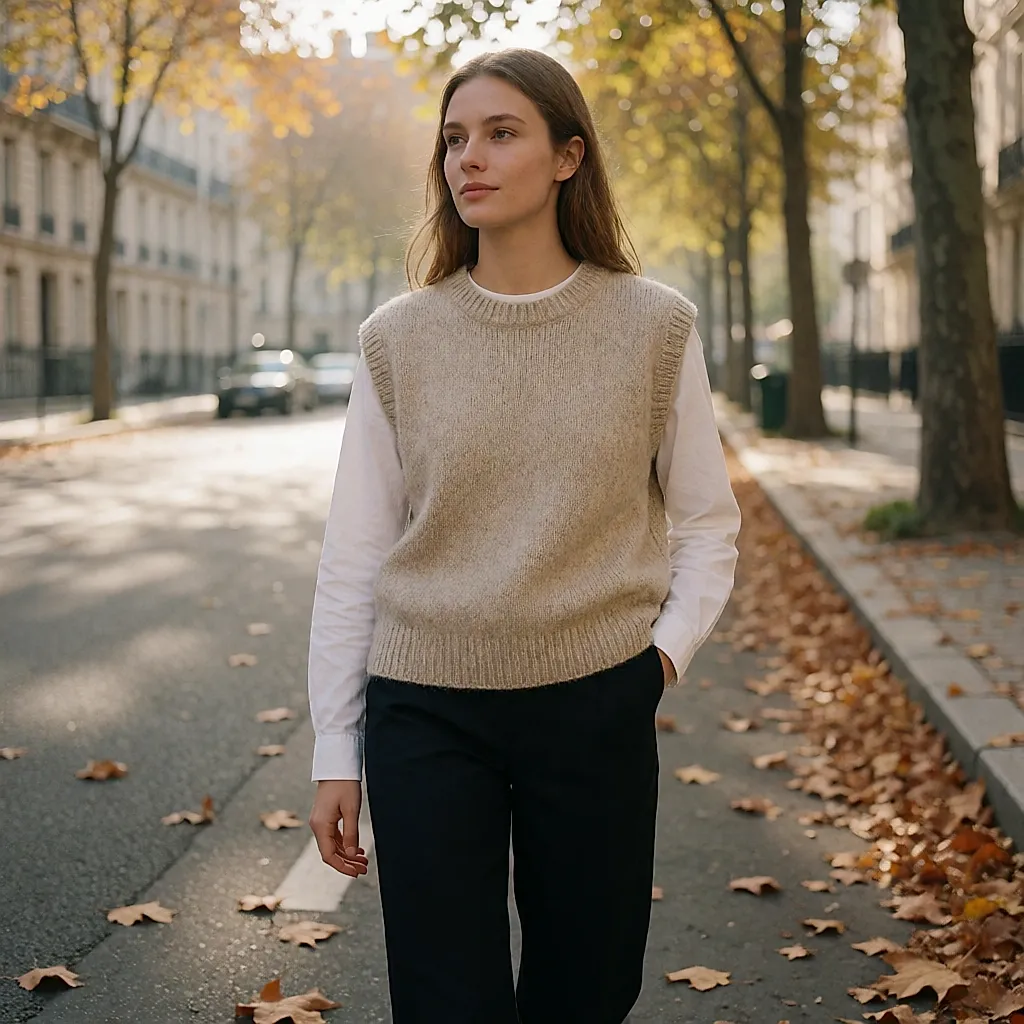
Twelve degrees when you wake up, a sun that still can't decide, and the same question every October morning in front of the wardrobe: jumper, already? Jacket, not yet? A sleeveless knit settles it in ten seconds. Two shoulders covered, arms free, and the day can start.
The jumper has a timing problem
We love it, the jumper. But in October it has a knack of being too warm at 2pm and just right at 7pm. You put it on in the morning, carry it over your arm by lunchtime, and at the office it meets air-conditioning that only knows one season: winter. Not to mention the sleeves you push up, crease, and forget inside your coat.
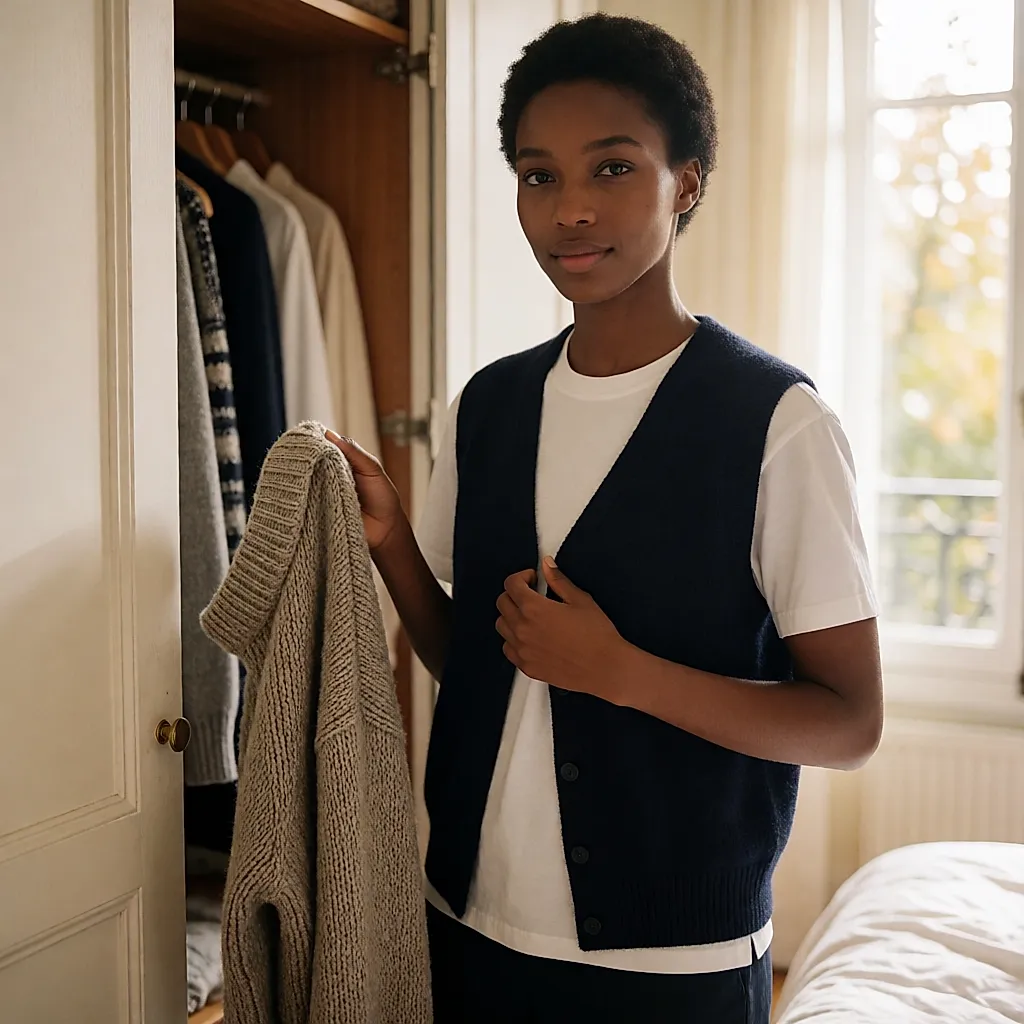
The sleeveless knit is the piece you can take off and put back on without ceremony. Over a T-shirt, it does the job of a light layer; under a trench or blazer, it's the mid-layer – layering in its simplest form. Worn alone, buttoned or open over a shirt, it's enough. That's its privilege: it needs nothing else to look like an outfit, just a cut that holds its shape.
The cut makes the silhouette
Two sleeveless knits in the same size can look made for two different people. It all comes down to the armhole: too deep, and it opens up the torso and turns baggy; well shaped, it holds the body and leaves the arm free. Then there's the shoulder – dropped for a relaxed feel, sharper for a tailored mood – and the length: at the hip to structure a midi skirt, short and belted to define the waist.
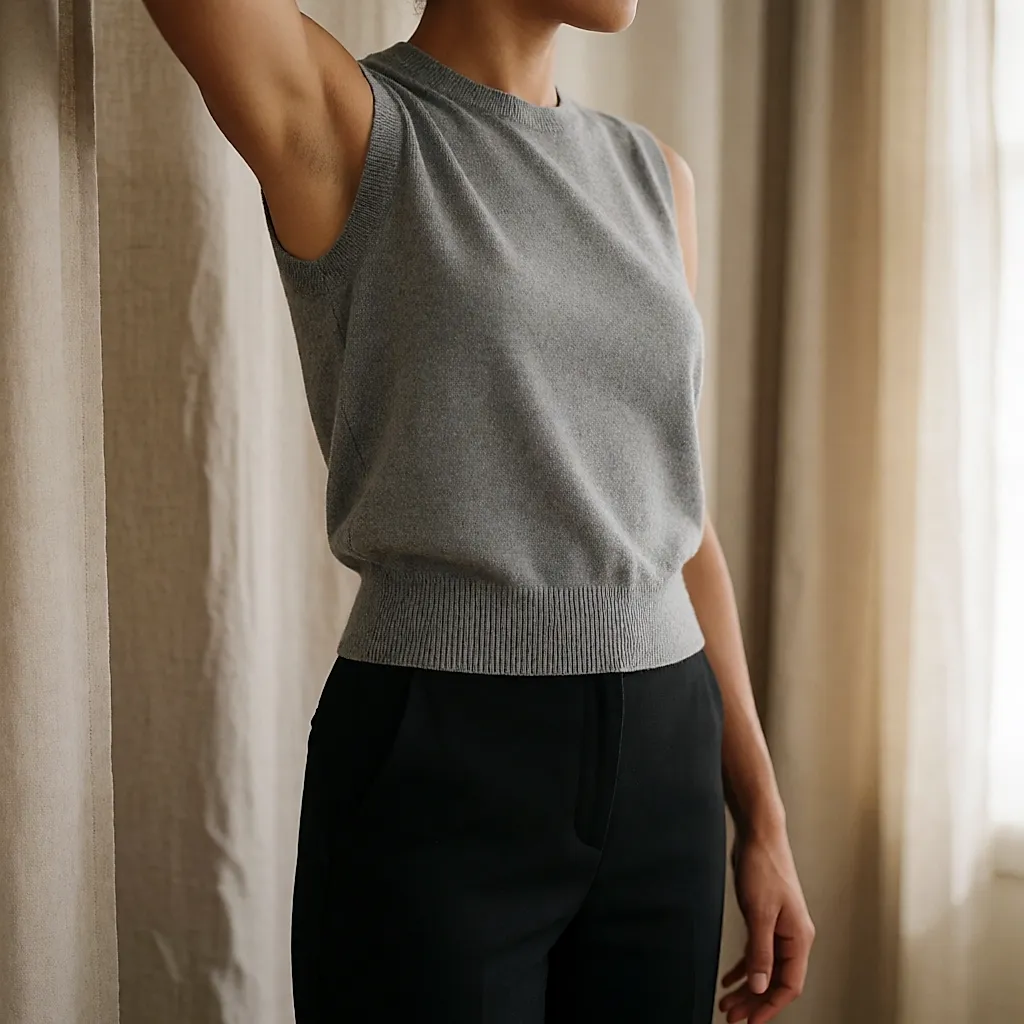
Does it suit everyone? Almost. A chunky gauge and a generous armhole add volume: lovely on a slim silhouette or for deliberate oversize, less easy if you want to lighten the upper body. A fine knit is more forgiving and slips under everything – for a first sleeveless knit, it's the right pick.
Three ways to wear it
At the office, a fine round-neck sleeveless knit over a poplin shirt, with straight trousers: leave the bottom two buttons open to avoid the suit-waistcoat effect, and let the shirt collar peek out. On Sundays, switch things up – thicker gauge, raw denim, trainers, hair up – and the fabric does the work on its own.
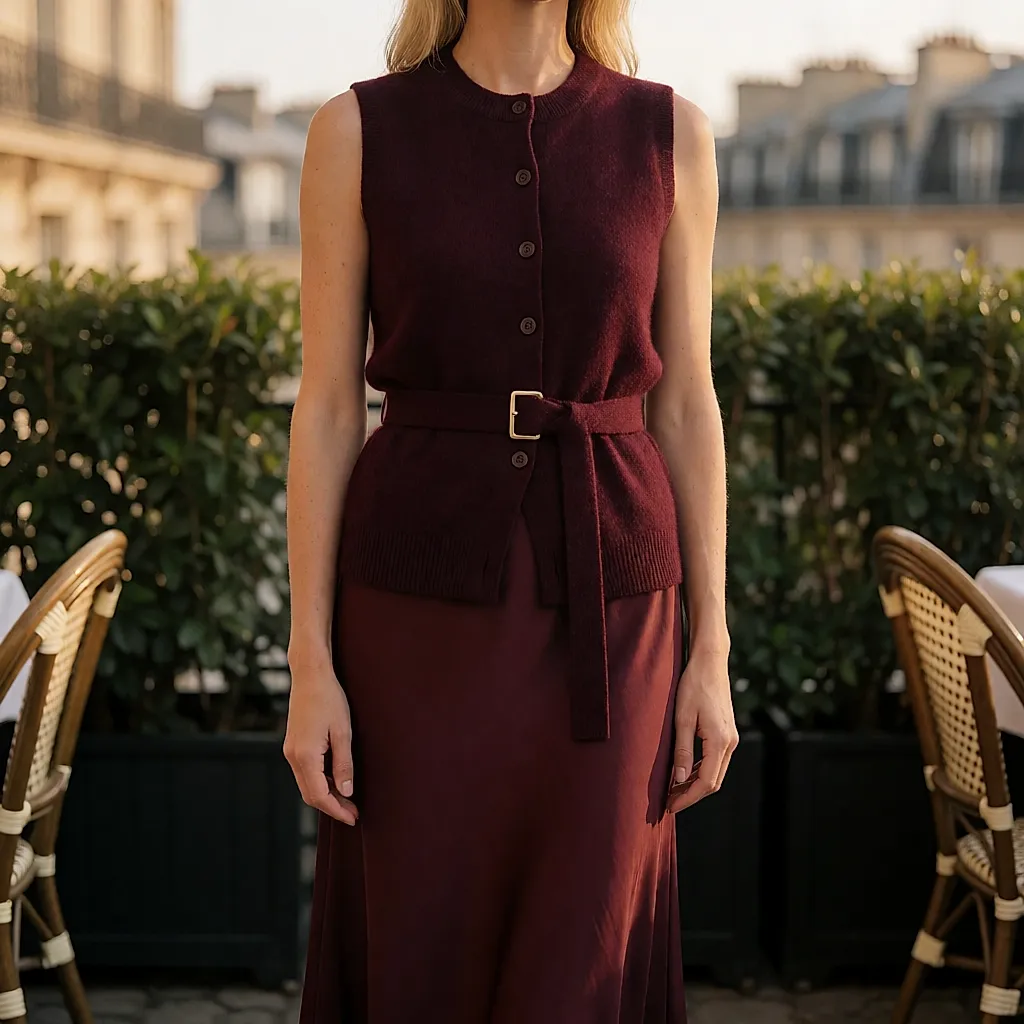
In the evening, dare to do what we too often forget: wear the knit against the skin, belted over a long skirt or fluid trousers. A full knit look, sleeveless knit and skirt in the same family of tones, gives a very sharp look for almost no effort. One rule: don't pile on three thick layers. Knit on knit on knit is delicious on the sofa, much less so on a bust.
When it comes to materials, wool still leads
A fine merino wool, recycled wool, organic cotton for milder days, linen for light: mid-season is about natural fibres, which hold their shape and age better. Look at the composition label before the price label – it will tell you whether the piece will last three winters or three washes. A majority of synthetic fibres, if that's the case, is also noticeable pretty quickly to the touch.
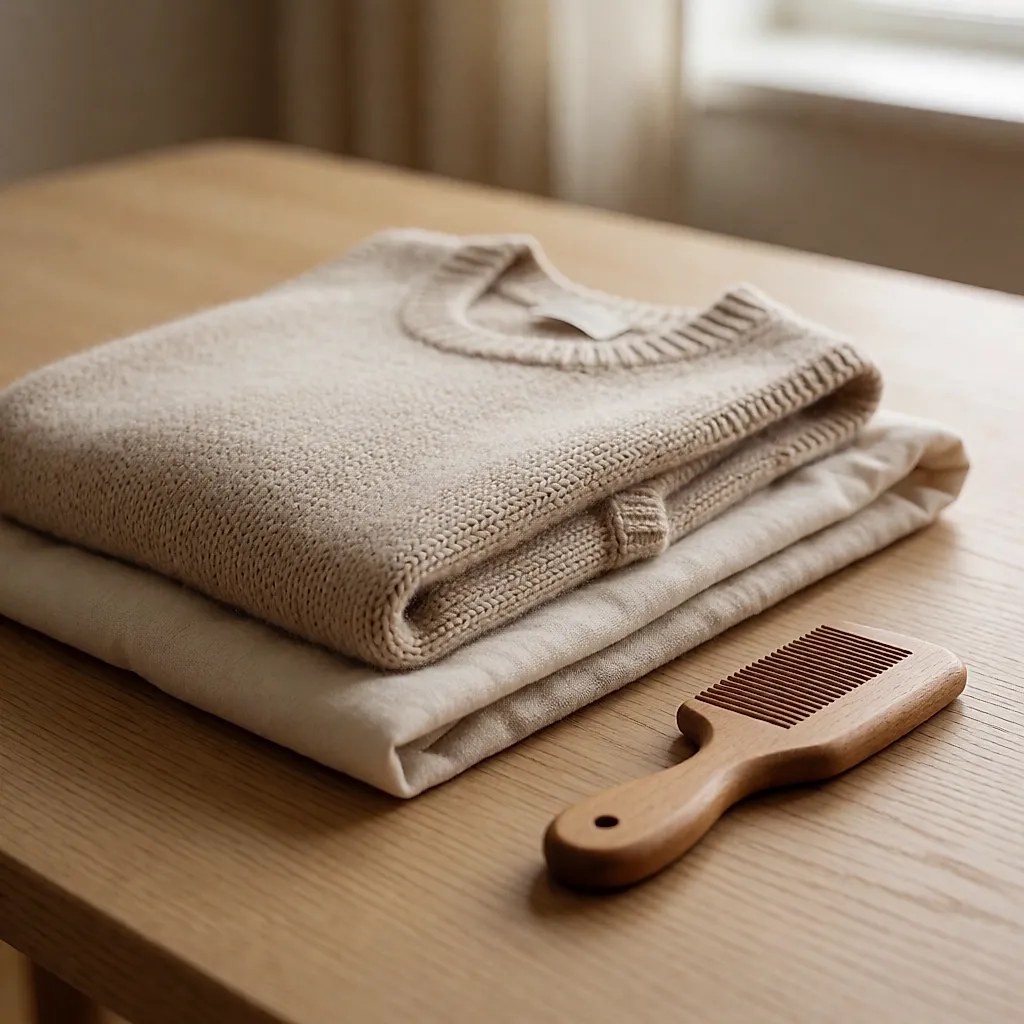
When it comes to care, knitwear asks little of you, but it does ask for the right things: wash rarely, at a low temperature, dry flat, fold rather than hang, and remove bobbles with a comb made for the job. Treated well, a wool sleeveless knit doesn't wear out, it develops a patina. That's also why second-hand makes sense: beautiful knits from ten years ago are still here.
Budget: what to spend, and where
In charity shops or on resale platforms, expect £10–£40 for a wool or cotton piece, sometimes less. On the high street, more like £40–£90, with the wool content varying hugely from one style to another. From knitwear brands, £90–£200, and £150–£350 for 100% merino wool or European-made.
What pushes the price up: the proportion of wool, the fineness of the gauge, where it was made and the quality of the finishing, ribbed edges included. Timing matters too – end of season and winter sales remain the best windows for a piece you'll keep for years. As for where, it all depends on your patience: charity shops and resale for the thrill of the find, boutiques and specialist brands for the certainty of size.
In the fitting room, three checks that take a minute. The label first: exactly how much wool is in it? The armhole next, by raising your arms above your head – if the sleeveless knit rides up to your ribs, it's too tight. The drape last: let it hang for a second; it should fall straight, without pulling at the buttons.
This sleeveless knit, in the end, is not just another accessory. It's the piece that sorts out mornings when you don't know what the weather is doing – and that may be its greatest luxury: it doesn't ask you to decide anything. Get one that falls well, wear it until it wears out, and you'll see that the jumper, in this story, will have waited until November.
Comments
Your opinion matters: rate the article, react and reply to comments.
Comments are moderated; AI-assisted comments are flagged. Text emoticons (8-), :-), <3…) are automatically shown as images.