

On the hanger, it looks perfect: neat collar, straight shoulders, crisp white. It's in the evening light, once you've put it on, that the verdict lands — transparency, a collar that ripples, a hem that rolls. The white T-shirt isn't a neutral basic: it's a piece in its own right, and the good ones are chosen almost like a coat.
The weight of the jersey is the deciding factor
The difference between a T-shirt that looks scruffy and one that looks tailored comes down less to the cut than to the density of the knit. A fine knit — the kind that lets light show through at the shoulder — stretches, loses its shape in the first wash and shows every crease. A heavyweight jersey, by contrast, has structure: it falls straight, keeps its shape and gives the silhouette the clean line you look for in vain in T-shirts that are too soft.
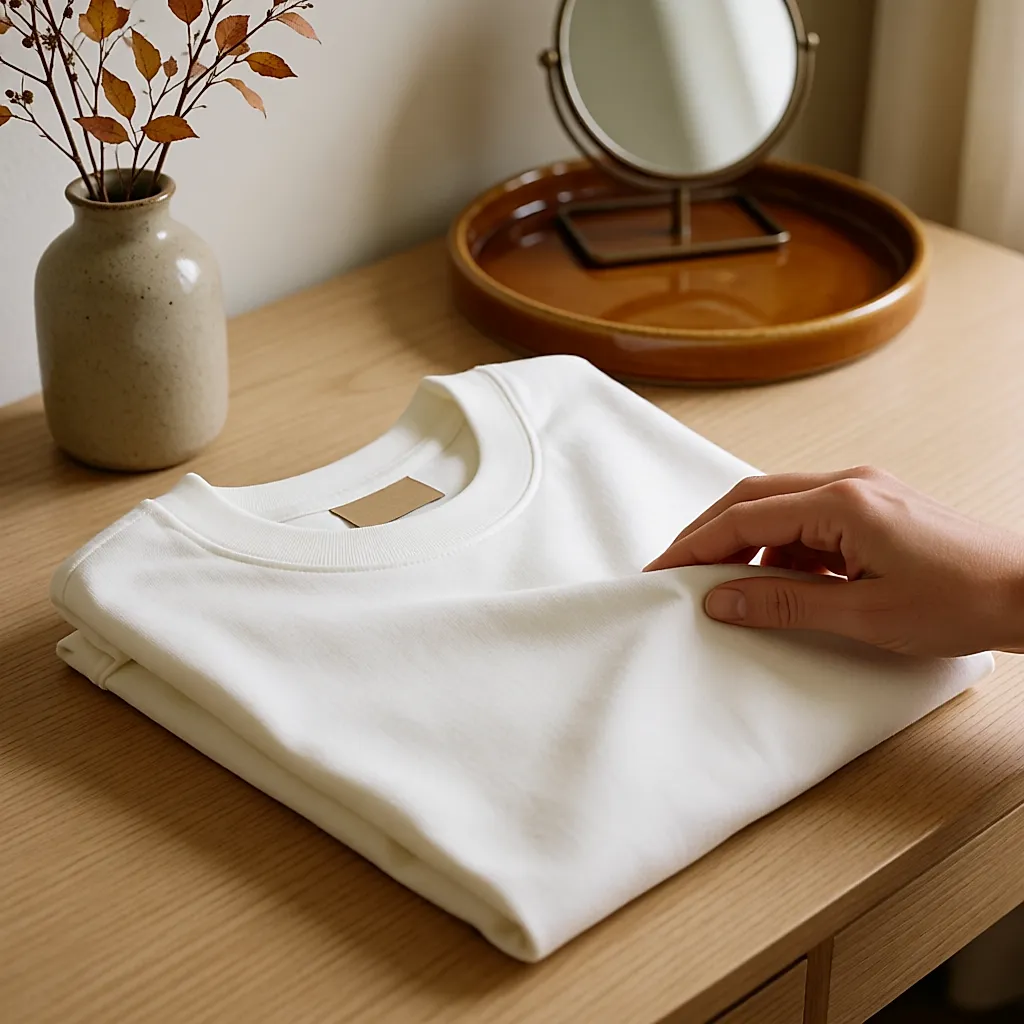
The simplest clue is still the weight in your hand. The gsm figure, sometimes given in product details, helps build a picture: in practice, a dense jersey often sits above 180 g/m², but touch is what settles it. Pick it up and scrunch it: if it springs back quickly and still feels thick between your fingers, that's a good sign. Check the composition too — favour cotton, organic if possible, and look at the proportion of synthetic fibres, which can sometimes weigh down the drape without necessarily ageing better.
Three checks worth making in the fitting room
Can five minutes in the fitting room settle it? Often, yes — provided you know what to look at. First the collar: a double-layer ribbed collar holds its shape, while a single-layer one slackens from the first wear. Put the T-shirt on, move your arms, wait two minutes — if the collar already gapes like a flag, it will gape all evening. Next, opacity: stand against the light, facing a window or under direct light. What you see there is what your dinner companions will see. Finally, the hem: if it rolls, the jersey is too thin or the cut is pulling.

The side seams, often invisible, also tell you how it's made: two straight seams that neither pull nor twist are better than a tubular knit that spirals. And if you plan to tuck the T-shirt into trousers, check the length — too short and it rides up with every movement; too long and it bunches into an unflattering heap.
The three telltale signs: a collar that springs back when you tug it gently, a hem that lies flat over the hips, and honest opacity against the light. If one is missing, put the T-shirt back — however nice it looks.
At night, it just needs a different setting
A heavyweight T-shirt changes status after dark: it becomes a structural piece, almost sober. With wide-leg pleated trousers and heels, it makes an effortless dinner look; with a long satin or wool skirt, it breaks up the skirt's dressed-up feel. Layering works too: a dense T-shirt under a dinner jacket, or an open shirt over the top. The idea is to treat it like a tailored piece, not underwear.

With accessories, be bold: a gold chain, graphic earrings, a belt at the waist. Crisp white, brightened by evening light, takes more daring than you might think. The only rule is to keep the rest of the outfit sharp — a heavyweight T-shirt will not forgive a half-hearted finish.
What to spend
Expect to pay around £20–£40 in supermarkets or at fast-fashion chains: the jersey is often decent, but the collar rarely lasts more than a season. Between £50 and £100, basics labels and some heavy-cotton shirtmakers offer a genuine step up in quality — side seams, a double-layer collar, denser cotton. Beyond £130, you're paying for organic cotton, European manufacturing and sometimes the name.
Second-hand is still excellent value: a heavyweight white T-shirt can turn up in charity shops or on resale platforms for around £10–£25, provided you check the collar and opacity before buying. And the advice that applies to the whole wardrobe: wear it, wash it less, keep it for longer.
A white T-shirt that lasts an evening is nothing ordinary: it's a demanding basic, chosen like a piece of your wardrobe. Take the time to try it on, hold it up to the light, scrunch it in the fitting room. And if the collar slackens, put it back — however nice it looks. A gaping T-shirt ruins a whole outfit, whereas a dense jersey will stay with you far longer than one evening.



Comments
Your opinion matters: rate the article, react and reply to comments.
Comments are moderated; AI-assisted comments are flagged. Text emoticons (8-), :-), <3…) are automatically shown as images.