

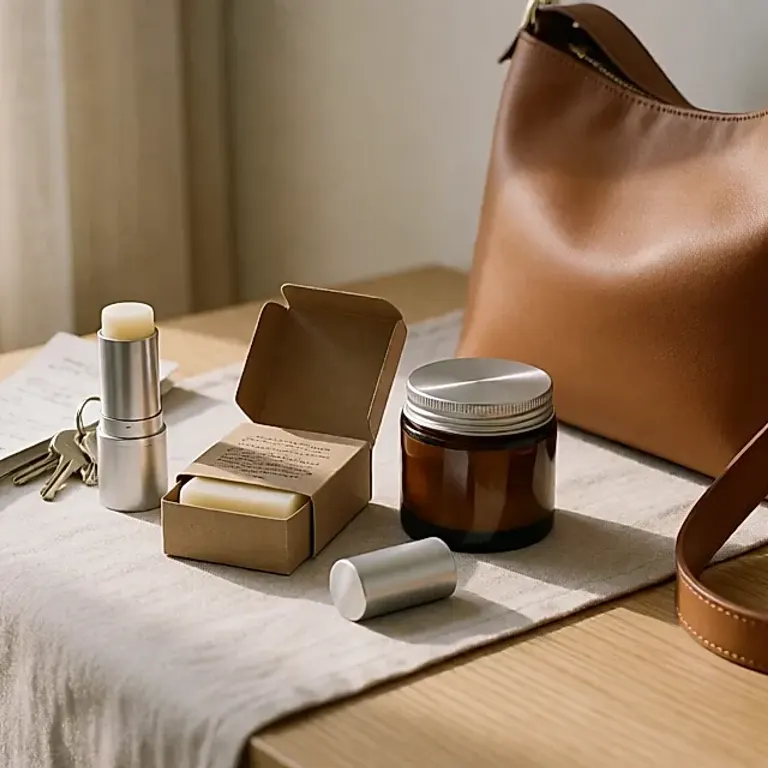
The SPF50 stick lives at the bottom of my bag, wedged between a bunch of keys and a leaking pen. Its casing is scratched, the lid stays on by habit, and yet it does most of the heavy lifting against brown spots.
A brown spot doesn't reveal itself while it is forming. It waits for your tan to fade. While your complexion is golden, the contrast is low and the eye sees nothing; once your skin returns to its natural colour, the spot comes out of hiding, darker than the rest of your face. Hence the late-autumn reflex: out comes the brightening serum. Except the serum arrives after the battle.
Before it comes sunscreen — and above all the second layer of the day, the one almost all of us forget. That's where it all plays out.
Your morning layer won't last until evening
You apply sunscreen in the morning, congratulate yourself and head out. Then you make phone calls, touch your face, take off your scarf, rest your cheek in your hand during a meeting. The film shifts, thins, rubs away. One morning application does not cover a whole day: if you take one sentence from this piece, make it that one.
The practical rule, often repeated by brands and pharmacists: reapply every two hours when you're outdoors, and after anything that has worn away the film — lunch outside, a workout, an hour in the car. UVA rays, meanwhile, pass through office windows without asking permission, which settles the question of whether being indoors means you're fine.
In practice, reapplying doesn't mean redoing your routine. You're not adding the thick morning layer; you're going over the minimum on the areas that catch the sun: cheekbones, bridge of the nose, forehead. And the backs of your hands — often where the first spots show, even though we've never really kept an eye on them.
Stick or fluid? It comes down to how you use it, not the claims on the tube
On paper, an SPF50+ fluid takes the prize for texture. It glides on, spreads down to the neck and disappears in 30 seconds. In the morning, it's what you want under foundation — on one condition: let it dry for a minute or two before make-up. Without that pause, powders and foundation grab at it and you get the dreaded pilling, those little white bobbles around the nose that ruin a careful face of make-up.
The stick, meanwhile, makes no claims to elegance. It's waxy, can drag at foundation if you swipe too hard, and it shines. But it slips into a bag, can be applied without your hands, doesn't leak in a make-up bag, and lets you reapply over intact make-up. It's the lunch-break candidate, not the one for the bathroom shelf.
The most cost-effective split is still fluid in the morning, stick during the day. If your foundation won't tolerate anything underneath, use the stick for everything and accept that you'll end the day a little shinier than planned — you'll be protected, which is the main thing.
Actives: one guest at a time under sunscreen
Niacinamide, vitamin C, alpha-arbutin, azelaic acid, tranexamic acid: these brightening ingredients are everywhere, all go on before sunscreen, and none needs to be in a race with the others. One brightening active in the morning is enough; the rest of your routine is perfectly fine without them.
But beware of piling on too many layers: combining exfoliating acids and retinol in the morning under sunscreen can irritate, especially when you're first using them. Those two are better saved for the evening. And if you have to choose between serum and protection, keep the protection, even if it means moving the serum to after dark: no cream makes up for a day spent without sunscreen. That said, I'm not going to pretend there's a perfect answer — I don't have a formula that protects eyelids and lips perfectly on every reapplication. We do our best, then we reapply.
One last point, and it matters: if a spot changes shape, colour or border, it's no longer a serum question. Get it checked by a GP or dermatologist without delay.
What to expect to pay
Expect to pay roughly £15–30 for a tinted SPF50 stick from a pharmacy or beauty retailer, and around £12–30 for an SPF50+ face fluid, though supermarkets and high-street retailers often have options under £20. A 30ml or 50ml bottle usually lasts longer than it looks. An 8–15g stick, though, disappears fast if you use it on your hands too: that's the format to restock, not to ration.
On ingredients, mineral filters (zinc oxide, titanium dioxide) often leave a white cast — and that's exactly where a tinted stick earns its keep by neutralising the cast. The trade-off to know: sunscreen refills are still rare, and the stick is often a plastic container you throw away whole. Look for larger formats or cardboard tubes where they exist, without kidding yourself about the rest.
The no-mirror reapplication move: two swipes of stick on each cheekbone, one on the nose, one on the forehead, then blend with your fingertips from the centre outwards. Ten seconds, no brush, and your make-up stays put.
One stick in the bag, one fluid on the shelf, and the two-hour rule lodged somewhere in your head. The brightening serum can come next, on skin that's already protected — that's the order that makes sense, and that's already a lot for a scratched object at the bottom of a bag.

Comments
Your opinion matters: rate the article, react and reply to comments.
Comments are moderated; AI-assisted comments are flagged. Text emoticons (8-), :-), <3…) are automatically shown as images.