
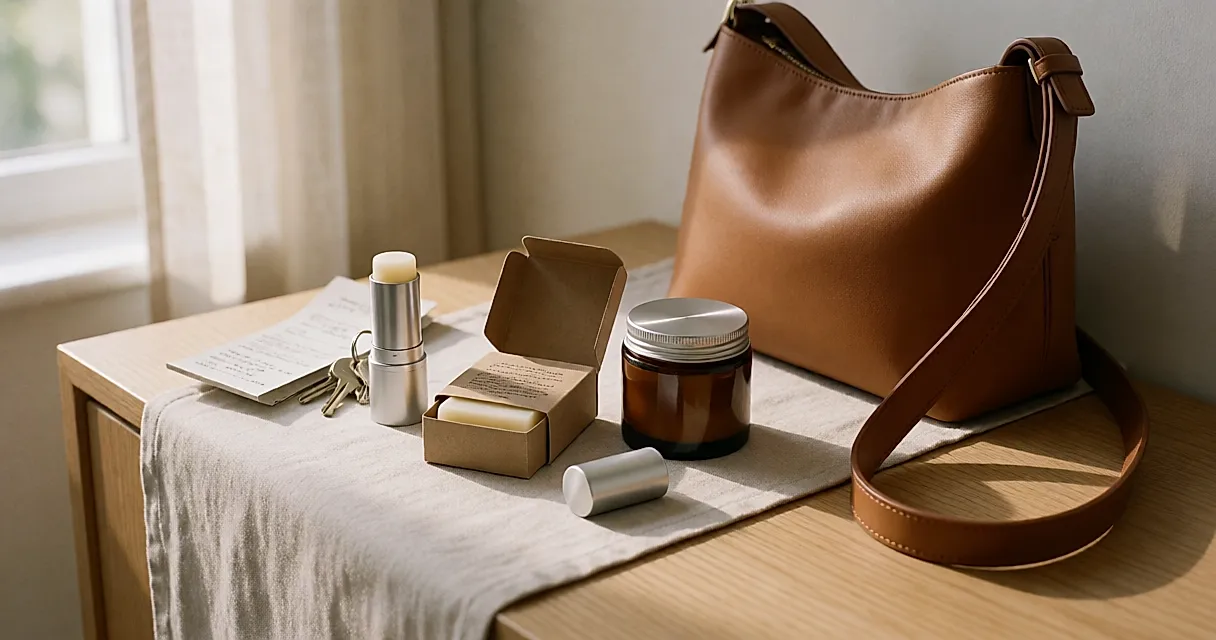
The tube of cream has picked a side: lid open, it has emptied part of its contents over your prescription slip and last week's receipt. The lipstick beside it hasn't moved a millimetre. Same bag, same jolts, two very different fates. The formula wasn't what made the difference — the format was.
The bottom-of-the-bag test doesn't lie
A product that lives on your bathroom shelf can be perfect. One that comes out with you has to survive a bunch of keys, a packed train and the biscuit crumb that's been lurking since Tuesday. That's where it all unravels: a pump that presses itself against the lining, a lid that works loose by a quarter-turn, a stick that softens the moment the bag sits in the sun.
Once a product is meant to be carried, the product page stops being the star. What matters is the closure (screw, click or flip-top: will it actually hold?), the shape (a stick cannot split open), the empty weight, and the material of the packaging. A brilliant cream in a jar becomes a low-level worry in travel format if the lid doesn't screw down properly. And let's be honest: most of us have bought something because it fitted the pouch, not because it lived up to its promises.
The format decides how you use it
A jar asks for a clean finger. A tube asks for a squeeze, sometimes one too many. A stick is rubbed straight onto the skin: hard to beat in the car or on a weekend away, less precise when you need to control the dose. A solid bar warms between your palms before it melts — two extra minutes at night, two minutes too many on a Monday morning when you're already hunting for your keys.
This isn't just a comfort detail: the gesture decides how often you reach for it. The quicker it is, the more you use it; the slower it is, the more pleasant it needs to be, otherwise it ends up alongside the serum you bought on a weak day. Then there's end of life, the bit nobody mentions in-store: a solid left on the shower ledge softens, a stick forgotten in the sun turns mushy, a refill needs a container that has been washed and thoroughly dried. None of it is insurmountable, but it's an effort to plan for, not a surprise to discover.
What you gain and what you pay for with solid, refill and glass formats
Solid products have one clear advantage: no water in the formula, so packaging can be lighter, often card or paper. In use, they aren't for everyone — they lather less, remove make-up differently, and some textures simply don't translate. As for how long they last, that depends so much on how often you use them that claims of 'three months' deserve scepticism: from one face to another, from a quick shower to a long, contemplative one, the difference is real.

Refills are often the best compromise when the container is sturdy — thick glass, aluminium — and the refill is easy to find near you. The classic trap: a refill that costs barely less than the new product, or one that's impossible to find outside the brand's own website. Check the bottle's strength, too, because a refill becomes useless the moment the container breaks on the first weekend away.
Glass, finally, is beautiful, stable, reassuringly heavy — and simply heavy in a small bag, fragile in a gym bag. Aluminium weighs less and stands up better; look at its internal coating and its recycling route. Card, light and elegant, often hides a plasticised film inside. So there's no perfect solution: it's a trade-off, again and again.
What it costs
Expect to pay roughly £8 to £25 for a solid face or body product, and around £8 to £20 for a solid shampoo, depending on the range and size. In supermarkets, entry-level options go lower; in health-food shops and pharmacies, prices rise with concentration and certifications (COSMOS, Ecocert, for example), which certify standards rather than performance.
For a refillable container, budget around £20 to £60 for the first purchase, then £15 to £45 for a refill — which is exactly why it's worth checking availability before you get attached to the bottle. A glass travel format costs around £10 to £25; a solid metal or rigid card case around £5 to £15. Where to shop: pharmacies and health-food shops to see and weigh things up, brand stores and official websites for refills, supermarkets to try a solid without spending too much. If you're unsure, start with the cheapest format to replace: a solid soap or a stick.
Before you pay, two minutes of checks: open and close the container (a firm screw thread, not a vague approximation), weigh it empty — your shoulder will thank you — and look for the refill online before you commit. If it doesn't exist, you'll know that bottle is only passing through your life.
The right format isn't necessarily the greenest on paper: it's the one you actually want to pull out of your bag. A product that travels well, opens one-handed and refills without a fight has already won half the battle — the formula does the rest. And if the lid betrays you anyway, at least you'll have learned to keep the important paperwork in another compartment.
Comments
Your opinion matters: rate the article, react and reply to comments.
Comments are moderated; AI-assisted comments are flagged. Text emoticons (8-), :-), <3…) are automatically shown as images.