
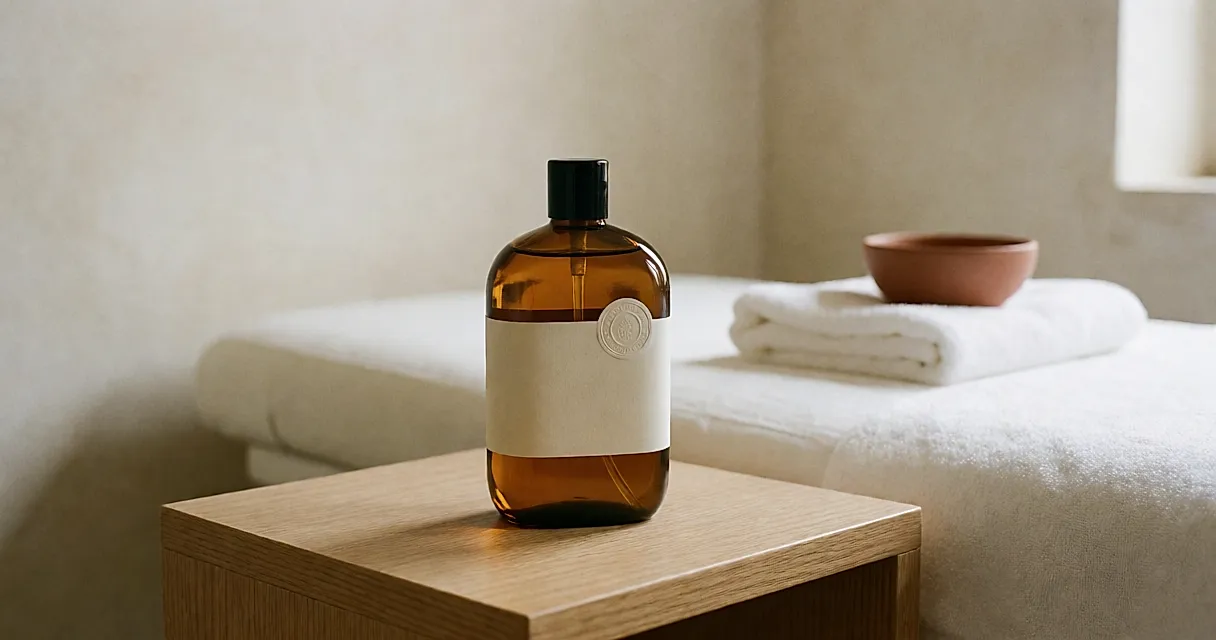
The percentage of active ingredient sits in big type on the front of the bottle. Under the shower, that same ingredient gets about as long as a chorus before it disappears down the plughole. That's the gap in body skincare in a nutshell: luminous-skin promises printed on a product you never actually leave on. Safe to say the question deserves better than a slogan.
Thirty seconds of lather, then the water
A shower gel is a cleanser first and foremost. Its job is straightforward: catch the sebum, the sweat, the leftover moisturiser and carry them off with it. To do that it relies on surfactants, the molecules that make the foam and bind as happily to water as they do to oil. The catch is that those same molecules have no reason to leave an active ingredient sitting quietly on your skin: they rinse everything away, including the bits you'd rather keep.
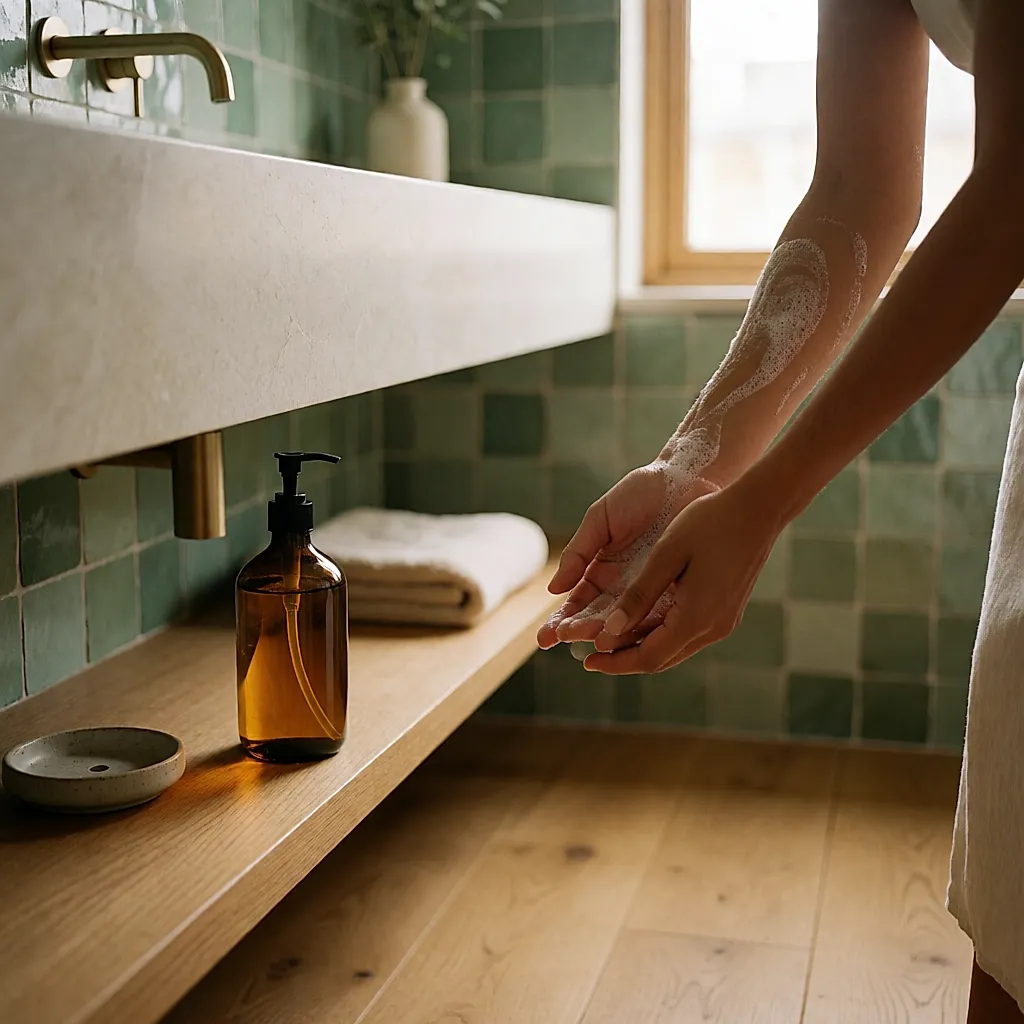
Contact time, in reality, is counted in seconds. You lather, you scrub, you rinse, and you step out clean, sometimes a bit tight, with a film of fragrance and, at best, a few moisturising agents the formula has left behind. Between that and changing the colour of an arm there's a sizeable gap. What stays on your skin after a shower is residue, not treatment.
None of which means a shower gel is pointless, let's be clear. It means you have to ask it for what it can actually do: clean without stripping, and leave a good base for everything that comes afterwards.
The percentage is an ornament
The bigger the number, the more you want to believe it. Except a stated concentration tells you nothing about what actually reaches your skin: it says how much active went into the bottle, not how much is left after thirty seconds of hot water. A shower gel with vitamin C or niacinamide can be perfectly pleasant to use without making much difference to your skin tone.
And frankly, I couldn't find a single properly conducted trial of a body wash marketed as "brightening", with skin colour measured before and after. What exists is formulations, marketing claims and online reviews. Not enough to settle it, enough to stay cautious.
There is one possible effect, though it's a modest one: skin that's properly cleansed, with dead cells and greyness cleared away, reflects light better. That's called a clearer-looking complexion, not lighter skin. A significant distinction.
Start by doing less harm
Here's the bit the labels leave out: stripped skin looks dull. Very foamy, heavily fragranced, high-pH shower gels often leave that tight feeling, the signal that you've pushed the cleansing a bit too far. The skin responds by defending itself, drying out and losing exactly the glow you were after.
So what do you pick? Gentle surfactants, glucosides or coconut-derived ones, a short formula, a pH close to your skin's own. Skip the daily scrub mitt, the scalding water and the vigorous rubbing. And rinse quickly: there's no point leaving it to sit, it isn't a mask.
The habit that changes things fits in one line: the less you attack your skin, the more of its natural glow it keeps. Not dramatic, but it's what you can see on a bare arm in November.
The bit afterwards does the real work
This is where it all gets decided, and oddly it's the step most of us skip when we're in a hurry. After a shower, a body cream or oil applied to damp skin helps limit water loss; massaged in, with a little glycerin or urea to hold onto moisture, that one move does more for your skin than any percentage printed on a bottle of shower gel.
If you genuinely want to work on clarity, a mild chemical exfoliant (fruit acids; in practice many people use one once or twice a week) helps smooth the surface. And on exposed areas, hands, forearms, décolletage, daily sun protection remains the step that limits sun-related pigmentation. Not glamorous, but effective.
As for established patches of pigmentation or areas that are genuinely more pigmented, that's a matter for your GP or a dermatologist, not the toiletries aisle.
What it costs
No need to spend a fortune. A gentle own-brand shower gel at a supermarket tends to come in under £5 for 250–500ml; a pharmacy or beauty retailer version is more likely to sit somewhere between £7 and £15 depending on size and on the claims on the label. Solid formats and refills, often in card or glass, generally land between £6 and £12 and save one more plastic bottle.
For body moisturiser, a big supermarket tub starts at around £5; an organic or active-rich version climbs to roughly £12–£25. The real saving isn't where you'd think: it's not stacking three "special" shower gels in the bathroom and keeping one body cream you actually finish.
A sensible yardstick for shower gel: if your skin feels tight afterwards, that's a good prompt to try a gentler formula. Change the product before you change the cream.
At the bottom of it, the answer is almost disappointing: no, a shower gel won't lighten your skin, because it has neither the time nor the means. But chosen well, it stops dulling it down, and that's already a lot. The rest happens afterwards, in that slightly rushed reach for the pot of body cream. Give that one five more minutes.


Comments
Your opinion matters: rate the article, react and reply to comments.
Comments are moderated; AI-assisted comments are flagged. Text emoticons (8-), :-), <3…) are automatically shown as images.