
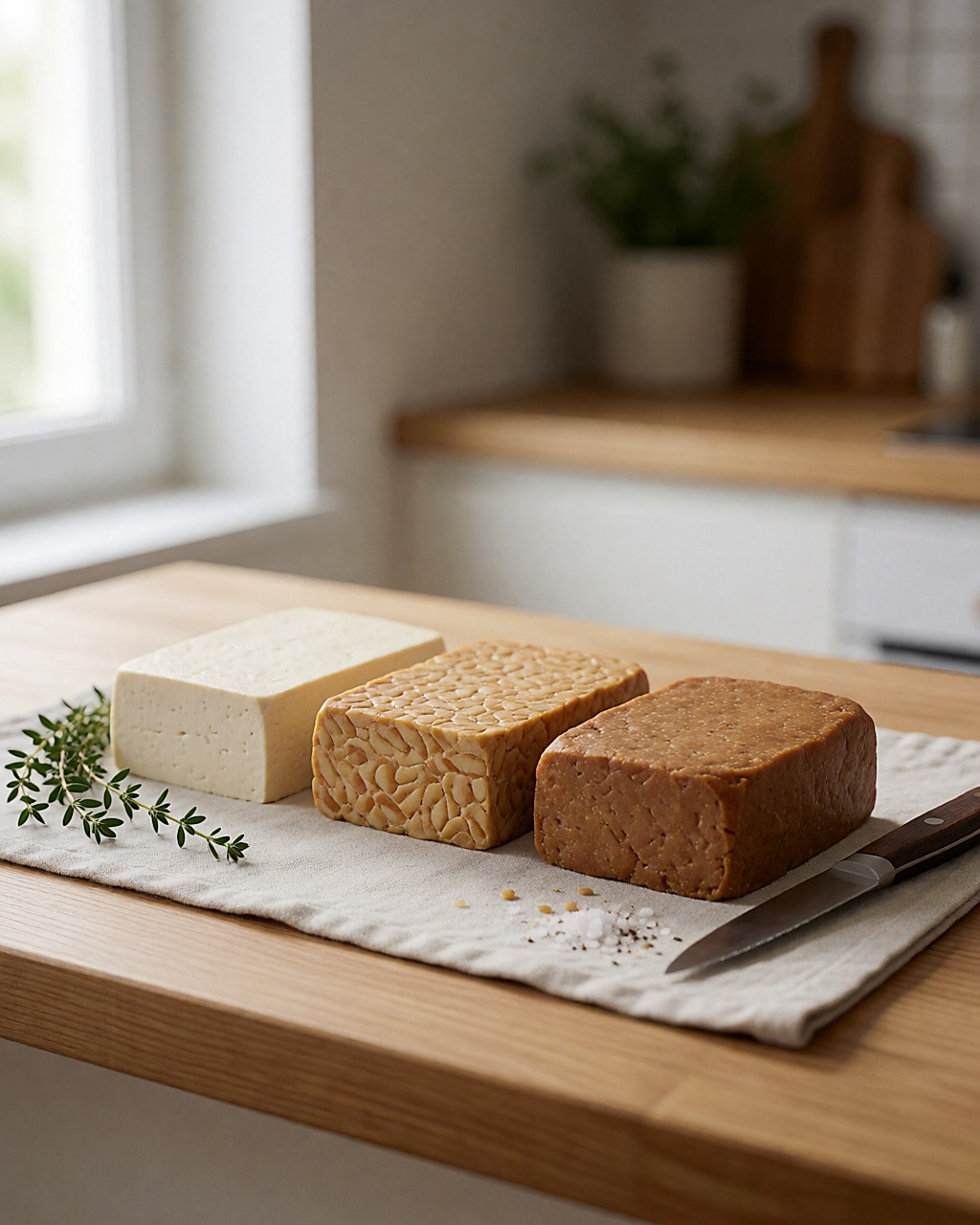
You push open the door to the chilled aisle, and there sit three packs that look almost identical: tofu, tempeh, seitan. All claim to be proteins, all promise to replace meat. Yet behind the label, they are three foods with almost nothing in common — not the raw ingredient, not the texture, not the salt content, not the way you cook them. So how do you tell them apart without buying the wrong one?
Three formats, three uses
Start with plain tofu. It is a curd made from soya milk, produced a little like fresh cheese. Firm tofu holds its shape in a frying pan and can sit in a slow cooker without falling apart; silken tofu is better for sauces, creams and desserts. It is the chameleon of the trio: it has very little flavour of its own, so it takes on whatever you give it — a huge advantage, as long as you season it properly. And it is not only the plain block: on the shelf you will also find smoked tofu, perfect cold in salads or wraps with no cooking, and marinated tofu, which needs just five minutes in a pan for busy evenings.
Tempeh, next, is whole fermented soya. Dense texture, uneven surface, a faint nutty note. It holds up very well in cooking and works beautifully with punchy sauces. Seitan, meanwhile, has nothing to do with soya: it is wheat gluten. Dense, chewy, very high in protein, it is already cooked when you buy it. One word of caution: it should be avoided if you have coeliac disease or a gluten sensitivity.

What the ingredients list says
A good plain tofu often has a short list: soya, water and a coagulant — magnesium chloride or calcium sulphate. If calcium sulphate is used, the product may also provide calcium, something worth checking if you are cutting back on dairy.
Then look at the 'salt' line in the nutrition table, per 100 g. The UK's McCance and Widdowson's composition tables make it easy to compare products, and the findings are often revealing. In practice, marinated, smoked and breaded versions are often saltier than the plain block. The same goes for fat: a breadcrumb coating and a trip through the fryer push up the fat, so the food can be much more calorie-dense than it looks.

One thing to keep in mind: as organic certifiers such as the Soil Association remind us, organic standards guarantee that GM crops are banned and that pesticides are used under strict rules. They say nothing about salt content or degree of processing. Those are two separate questions, and a product stamped organic can still be very salty.
Texture and the basic technique
What usually goes wrong is not the product, it is the technique. And there is no mystery here: three simple habits are enough to turn a bland block into something you want to serve again.
Press. Tofu comes out of its pack full of water. Between two plates or in a clean tea towel, leave it to drain for fifteen minutes: it will brown instead of boil.
Brown. Hot pan, a little oil, medium heat. Put the pieces in and leave them alone for a few minutes. That crust changes everything.
Season. Marinade does not penetrate a compact block very far. Focus on coating instead: soy sauce, nutritional yeast, spices, lemon, before or during cooking. For tempeh, a five-minute simmer before cooking softens its bitterness — a small detail that changes the plate. Seitan is already cooked: you just warm it through, brown it and serve.

The fridge test: an unopened plain tofu will keep until the date on the pack. Once opened, store it in a clean jar of water in the fridge, changing the water regularly, and eat it soon. Tempeh and seitan keep for less time once opened: it is best to eat them quickly, respecting the date on the pack.
Budget
Prices vary a lot depending on city, brand, organic status and pack size. Expect roughly:
- Plain tofu: £5–£12 per kg in supermarkets, £9–£18 in health food shops;
- Smoked or marinated tofu: £11–£22 per kg;
- Tempeh: £13–£26 per kg;
- Seitan: £11–£22 per kg;
- Breaded versions: £11–£22 per kg, with a higher fat content.
Where to find them? The chilled plant-based aisle in supermarkets, where the range has expanded a lot in recent years; health food shops and farmers' markets or veg box schemes; and Asian groceries, where plain tofu is often the cheapest per kg — as long as you check the origin and salt content. For tempeh, still rare on shelves, buying online is a good fallback.
A health note: as the NHS Eatwell Guide reminds us, these foods fit into a plate rich in vegetables and fibre, but they do not do the work for you. If you have a soya allergy, a kidney condition or coeliac disease, speak to a health professional before changing your diet — this is something to discuss, not an adjustment to make on your own.
There you have it: the three formats are now clearer in your mind, and more importantly, you may no longer want to confuse them. The next test? A block of plain tofu pressed well, a hot pan, and see for yourself. One thing is certain: cooked properly, these three deserve their place in the fridge — not as a last resort, but as proper ingredients in their own right.
Sources
- UK Government — McCance and Widdowson's The Composition of Foods Integrated Dataset (CoFID), accessed 2026.
- NHS — The Eatwell Guide, updated 2026.
- Soil Association — Organic certification, accessed 2026.

Comments
Your opinion matters: rate the article, react and reply to comments.
Comments are moderated; AI-assisted comments are flagged. Text emoticons (8-), :-), <3…) are automatically shown as images.