
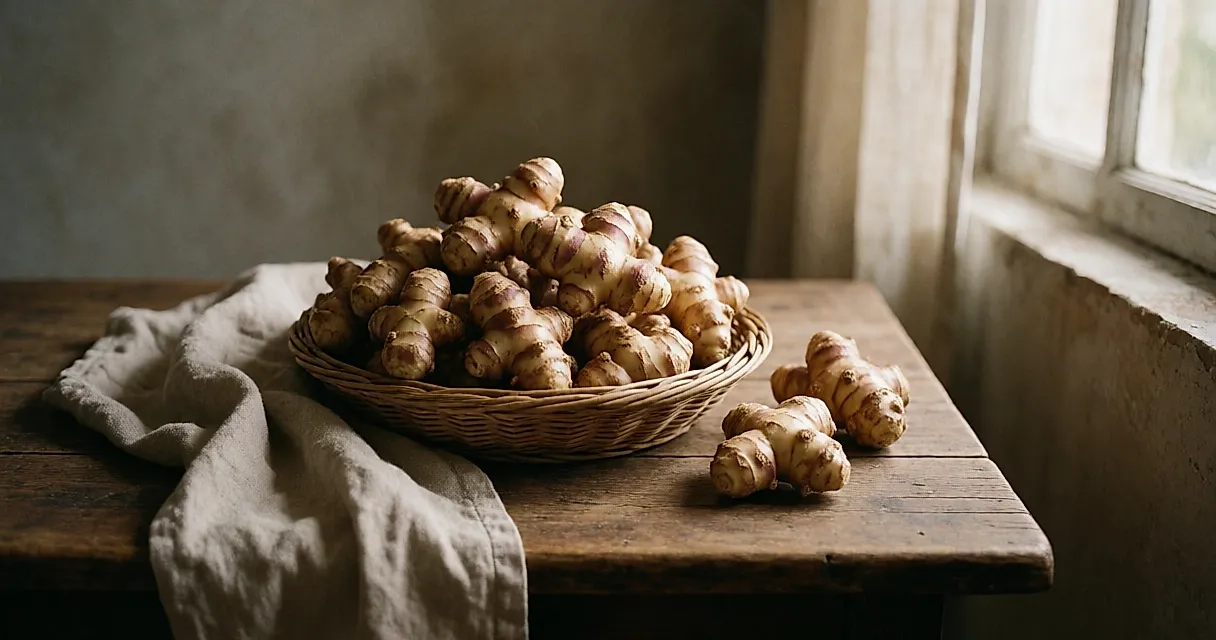
It looks like a pebble that has just got out of bed: earthy skin, knobs in every direction. Yet every autumn the Jerusalem artichoke reappears on market stalls, in loose bins and in growers' boxes. Its flavour brings artichoke heart to mind, with a hint of hazelnut and, when raw, the crunch of water chestnut. This tuber has character. And its price remains surprisingly modest.
An artichoke likeness, a character all its own
Despite the name, the Jerusalem artichoke is not an artichoke at all. It belongs to the sunflower family, and the part we eat is the underground one: a knobbly tuber, beige or purple, with the look of a forgotten root. In a way, that is exactly what it is: an old vegetable, grown in Europe for a long time before falling out of fashion, and now brought back into circulation by the return of loose, unpackaged shopping and heritage varieties. Its season runs through the cold months, from autumn to early spring - precisely when we are looking for food that satisfies without feeling heavy.
On the flavour front, the fairest comparison is still artichoke heart, with a hazelnut note and a texture that changes completely with cooking. Raw, it crunches. Cooked, it softens, rounds out and becomes almost sweet. This shift is partly down to its composition: over weeks in storage, some of its inulin turns into simpler sugars, and the tuber becomes milder. All the more reason not to judge it on the first bite in October.
Inulin, a fibre that needs handling with care
Inulin is the Jerusalem artichoke's signature: a fibre the small intestine does not digest, which reaches the colon where bacteria feed on it - hence its label as a prebiotic fibre. Like many fibre-rich vegetables, it has a place on a plate that supports satiety and regular bowel movements. On weight loss, however, it is better to promise nothing: studies looking specifically at inulin have produced mixed results. In other words, this tuber is no appetite-suppressing shortcut: it does the job of a fibrous vegetable, which is already a great deal for an evening meal.
But this fermentation has a well-known downside: the bacteria that break down inulin produce gas, and an overly generous portion eaten in one go can cause bloating and a few noisy moments in a very quiet meeting. In practice, a small portion goes down fine; a large plate on the first evening much less so. And if your gut is usually sensitive, or you have irritable bowel syndrome (IBS), it is better to go gently and speak to your GP or a registered dietitian.
Increase gradually. Try a few tubers the first time, see how you get on, then adjust. Any discomfort that persists or worries you deserves advice from a healthcare professional - not guesswork on the internet.
At the stall, the skin comes before the taste
Choosing a Jerusalem artichoke is simpler than it looks. It should be firm under the finger, with taut skin, no soft spots or spongy patches, and no sprout pushing through. A wrinkled or soft tuber has already lost its crunch, and no amount of cooking will bring it back. Size is not a quality criterion: small ones can go whole into a roasting tin, while large ones are better suited to soup.
As for storage, this is a good keeper. In a cool, dark, airy place it will last several weeks; in the salad drawer, allow a few weeks, wrapped in a cloth or slipped into a paper bag rather than plastic. That makes loose buying and veg boxes particularly useful: you can buy a decent quantity, spread it across several meals, and leave the packaging at the shop. Store it unwashed, too - the soil around it protects it.
Cooking it lightly without drowning its flavour
First instinct: a velvety soup. Cook the peeled tubers in stock, blend, then adjust with a drizzle of olive oil and a squeeze of lemon. No cream is needed: the texture is already creamy by nature. This is also where Jerusalem artichokes get caught out - mash drowned in butter, a gratin covered in cheese, and their artichoke-heart flavour disappears under 3 cm of fat. The vegetable is not heavy; what goes around it is.
Second instinct: the oven. Cut into wedges or thick slices, add olive oil, salt and a sprig of thyme, then let them colour - in practice, around 200°C (180°C fan/gas 6). The edges caramelise, the inside stays soft, and the side dish becomes the main event. For crunch, change method: grated raw, it makes a surprising salad with lemon, olive oil, herbs and a few hazelnuts. It oxidises quickly once cut - lemon juice is not just about flavour; it helps keep the colour pale.
What it costs
Nothing exotic in the price: bought loose at a market, it often costs around £2-£4 a kilo depending on region and season, a little more in organic shops; with veg boxes and community-supported agriculture (CSA) schemes, the price depends on the subscription you choose. At that price, a vegetable that keeps well, makes a pot of soup for a tableful and can stand in for starchy carbohydrates on an evening plate remains good value. You will find it from greengrocers, at farmers' markets, in loose and refill aisles and through local veg-box schemes.
And if the mood takes you on a November Sunday evening, with a saucepan, a drizzle of oil and a lemon hanging about, this is exactly the kind of dinner you can manage with nothing planned. Perhaps that is the Jerusalem artichoke's best argument: it asks for neither talent nor special equipment, just a little patience on the first evening while your gut finds its feet.
Comments
Your opinion matters: rate the article, react and reply to comments.
Comments are moderated; AI-assisted comments are flagged. Text emoticons (8-), :-), <3…) are automatically shown as images.