
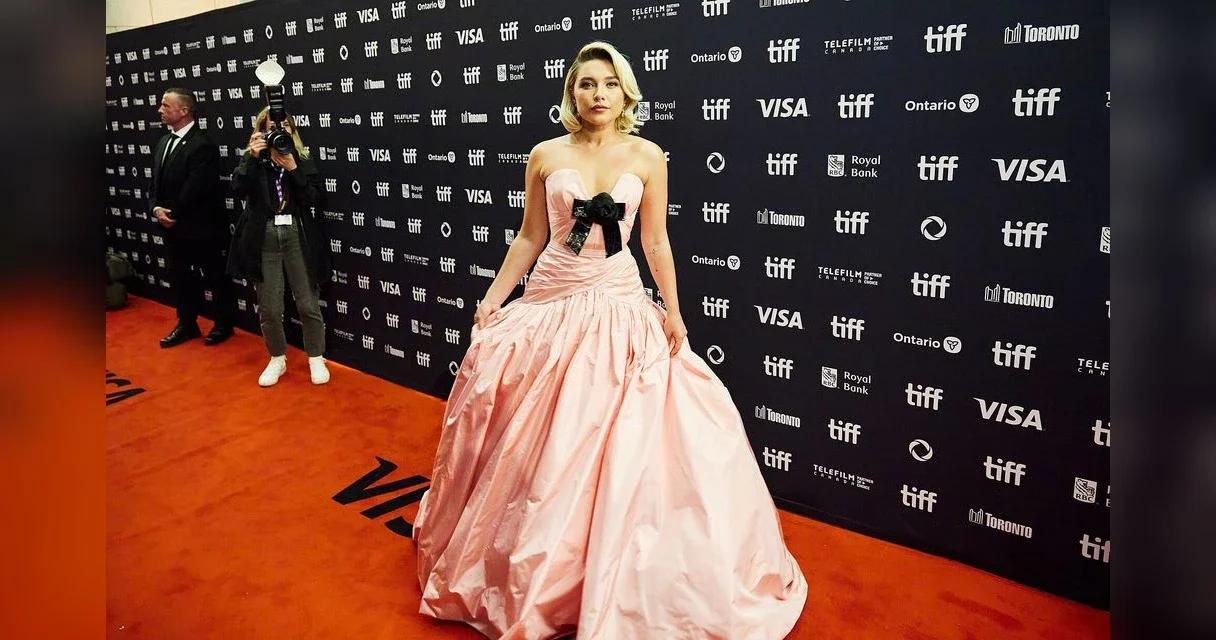
On Florence Pugh, your eye jumps straight to the dress — that is what the event photos keep. Yet what lingers once you have closed the page is a sense of balance: a shoulder that holds the top, a hemline that breathes, a drape that does not argue with the light. So what if we looked at the silhouette before the outfit?
Volume up top sets the tone
In her public appearances, Florence Pugh often works a simple idea: a top with presence. Not necessarily a big top; a constructed one. A drawn shoulder, a collar that stands up, a sleeve that holds its shape, a cropped jacket that stops dead. That volume is not there to hide anything — it frames. The eye travels up, pauses at the waist, then moves down. That is where it is all decided.
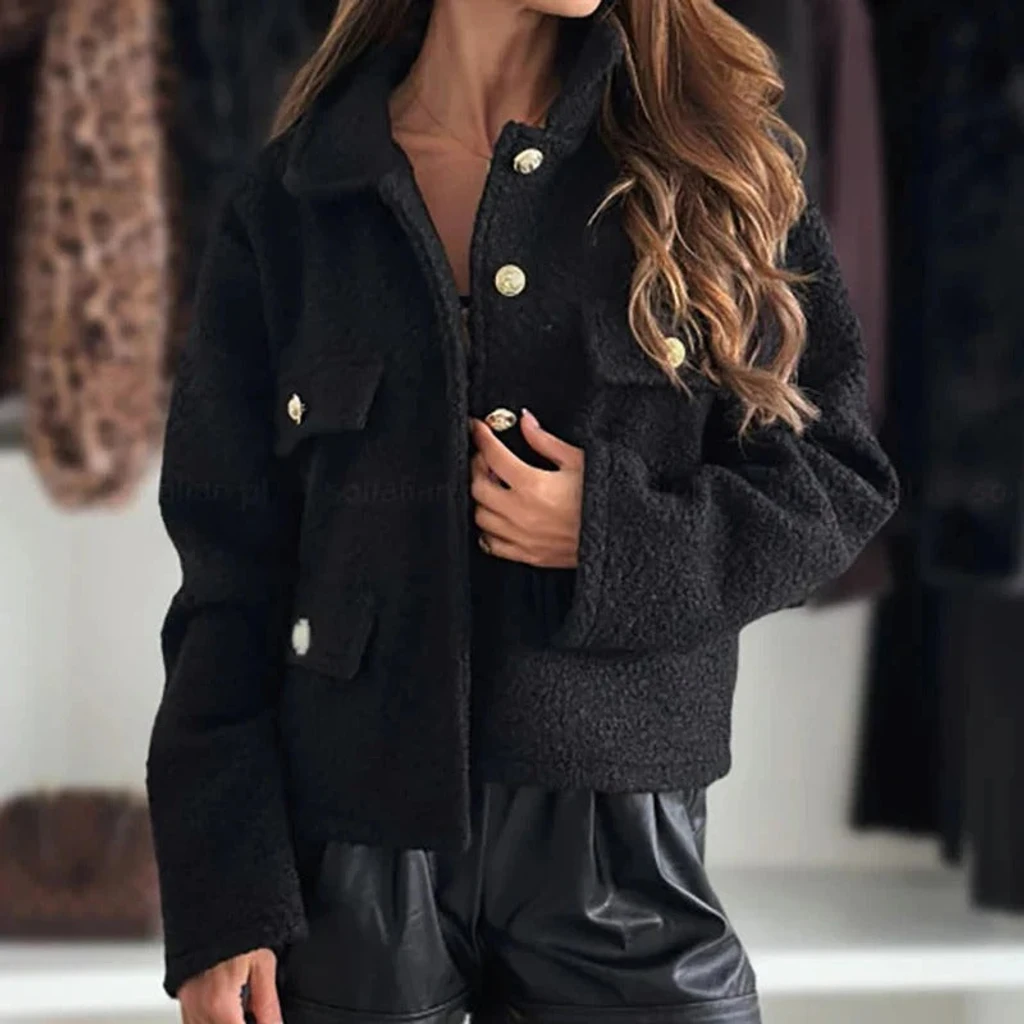
The trap is thinking you need volume everywhere to look "stylish". In reality, one volume zone is enough. If the top takes up space, the bottom can stay clean: straight trousers, a skirt that falls without flaring, a line that follows rather than competes. The other way round, if the top is fluid, a fuller skirt can take over. The question is not "which piece?" but "where do I want the eye to stop?".
The hemline, so often misunderstood
The length of a skirt or trouser changes a silhouette more than a colour does. A hem that stops at the calf cuts across the leg; one that skims the ankle lengthens it. It is not a law, it is a matter of proportion: the longer and more fluid the bottom line, the more legible the shoe has to be. A slim ankle boot, a court shoe, a flat sandal that shows the foot — the bottom half is always in conversation with your feet, is it not?
On Florence Pugh, the bottom line is never an afterthought. It can be clean, falling, almost architectural, or soft and full of movement. Either way, the drape matters more than the trend. A fabric with body gives a clean silhouette; one that pours creates softness. You can like both, but you cannot ask a fluid fabric to hold a straight line. It is like asking a cat to fetch.
Fabric makes the difference
A silhouette is not only read in centimetres. It is read in texture. Fluid fabric or fabric with body? A wool or heavy cotton jacket does not fall like a silk blouse; linen trousers live their life creased, and quite right too. Volume up top holds better with fabric that has structure: poplin, cool wool, dense cotton. Movement down below sometimes asks for more give: lightweight wool, linen, silk. Just check the fibre breakdown on the label — not to demonise synthetics, but to know what you are buying.
Then there is the ironing question, which is not a magazine subject but a life subject. A piece that needs twenty minutes with the iron before every outing will end up at the back of the wardrobe, whatever its drape. Florence Pugh can carry very elaborate volumes on a red carpet; on a wet Monday morning, you adapt. Style is logistics too.
What does this look like in your wardrobe?
Take out a piece you love but that feels "too much". Look at it full length, not in the bathroom mirror. If the top is bulky, try the cleanest bottom you own. If the bottom is wide, keep the top close to the body or shorten it. If the length is eating you, get it hemmed: an alteration often costs less than a new piece and changes everything.
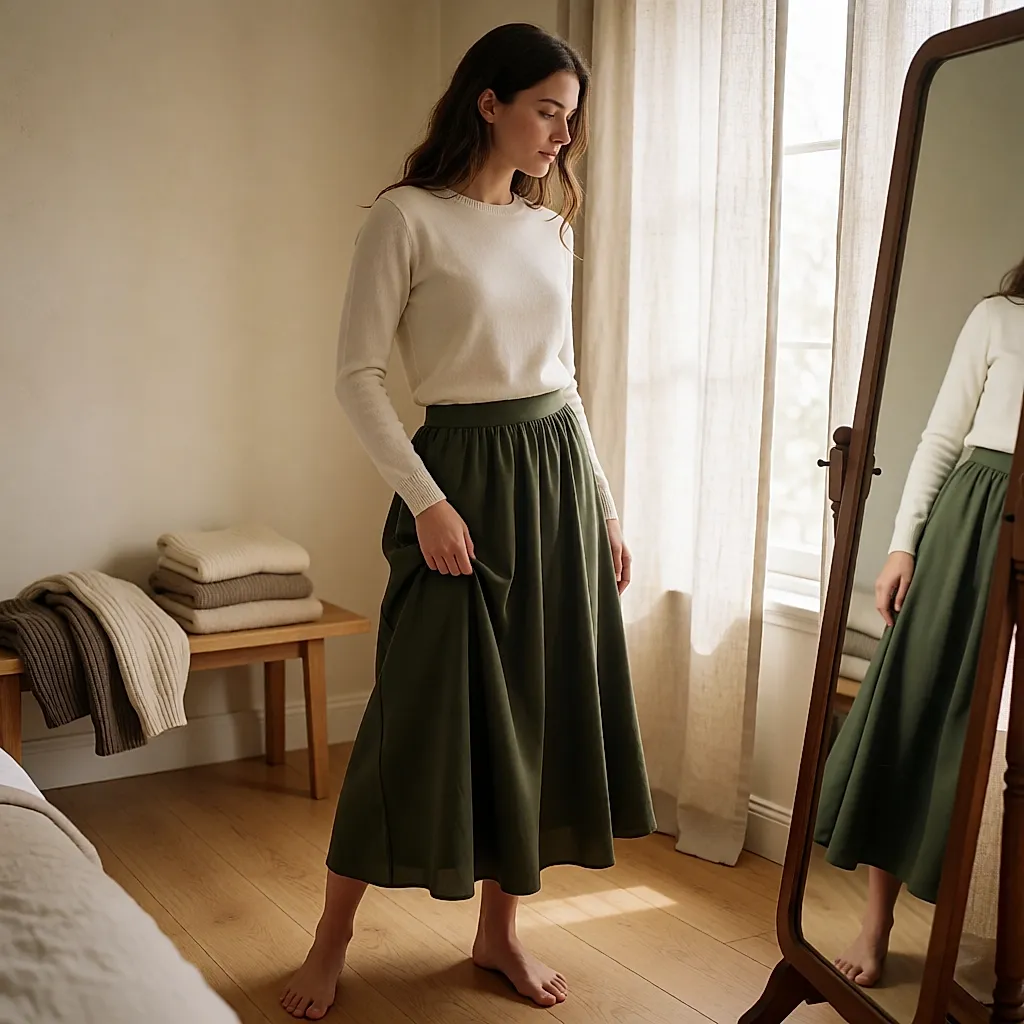
An open coat is a good judge: it frames the silhouette without hiding it. If everything holds without you having to tug at your T-shirt, you are onto something. If not, take off a layer, raise the waist, shorten. The aim is not to look like Florence Pugh, it is to find your own balance: volume up top that you own, a bottom line you can read, and a drape that lets you breathe.
The three-quarter test: step back three paces and look at your silhouette from three-quarters, not straight on. You will see straight away whether the volume up top and the bottom line are talking to each other, or turning their backs.
Budget
On the budget front, there is no need to chase an exact copy. A structured cropped jacket in wool or heavy cotton will set you back roughly £75 to £250 on the high street, and £20 to £60 secondhand depending on brand and condition. High-waisted trousers with a clean drape: £55 to £160; a blouse with controlled volume: £35 to £105. Prices vary with fabric, manufacture and where you shop — in London, the same piece can cost £25 more on the shop floor.
The best investment is sometimes the local alterations shop: £15 to £30 for a simple hem, a little more to take in a waist. You start with something you already own and give it the proportion it was missing. It is less glamorous than a parcel arriving, but it saves more outfits.
In the end, Florence Pugh reminds us of something very simple: before hunting for the perfect outfit, look at what the silhouette is saying. Volume you own, a clean line, a drape you have chosen — and the rest follows. You do not need a new wardrobe for that. Just a full-length mirror, three steps back, and a slightly less hurried eye.

Comments
Your opinion matters: rate the article, react and reply to comments.
Comments are moderated; AI-assisted comments are flagged. Text emoticons (8-), :-), <3…) are automatically shown as images.