
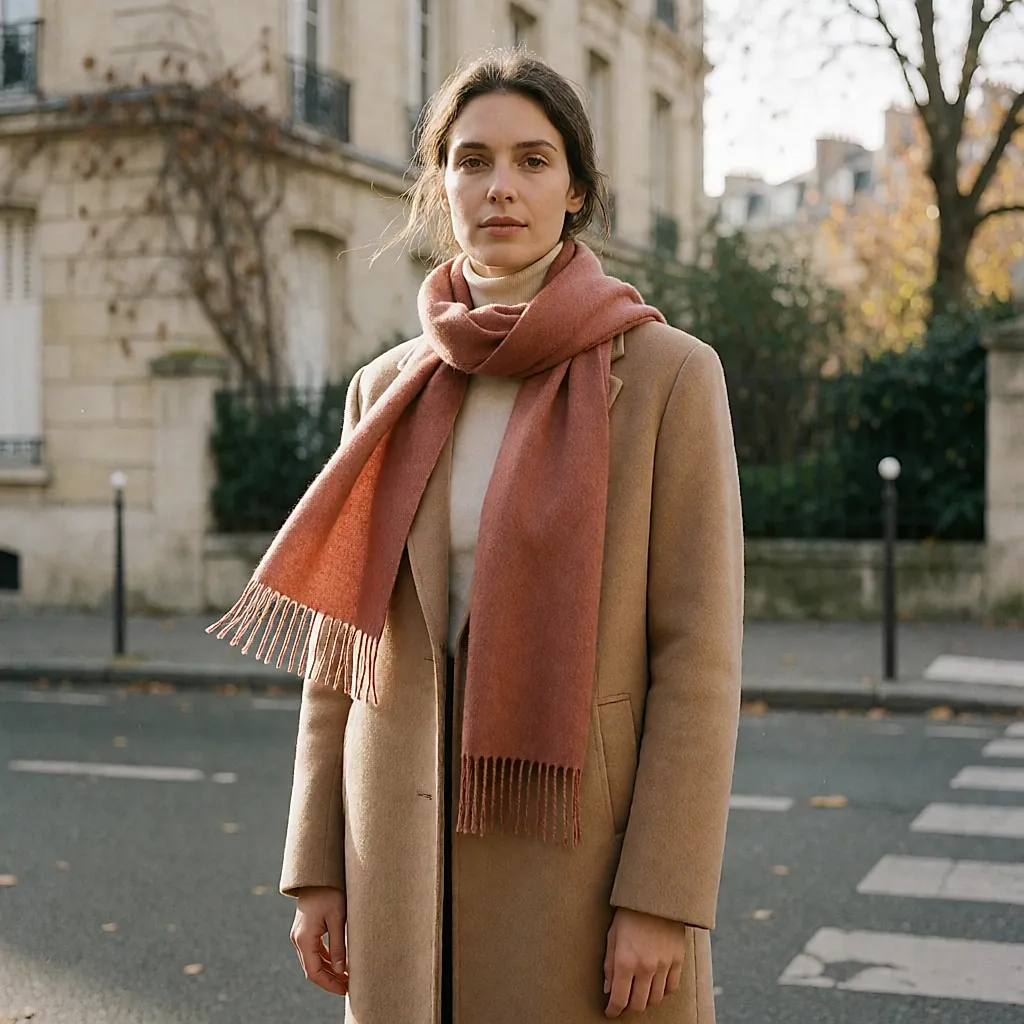
There are two kinds of women on the street in November: those who pull their chunky scarf up around their chin, and those who cross the road with a square of fabric barely wider than a hand, looking perfectly calm. For years, we suspected the second group were lying. In reality, they'd simply worked something out: warmth isn't measured in volume.
It all comes down to drape
A fine scarf that actually keeps you warm starts with a fabric that drapes well. Cotton voile—matte, light, easy to live with—suits the first cold snaps and forgives the bag you've stuffed it into on your way out. Silk chiffon plays a different tune: fluid, luminous, it slips over a collar and doesn't trap heat in the same way; it's a piece of style as much as a shield against the wind. Then there's very fine wool—merino, cashmere—just a few millimetres thick but genuinely insulating, without the bulk that turns your upper body into a cushion.
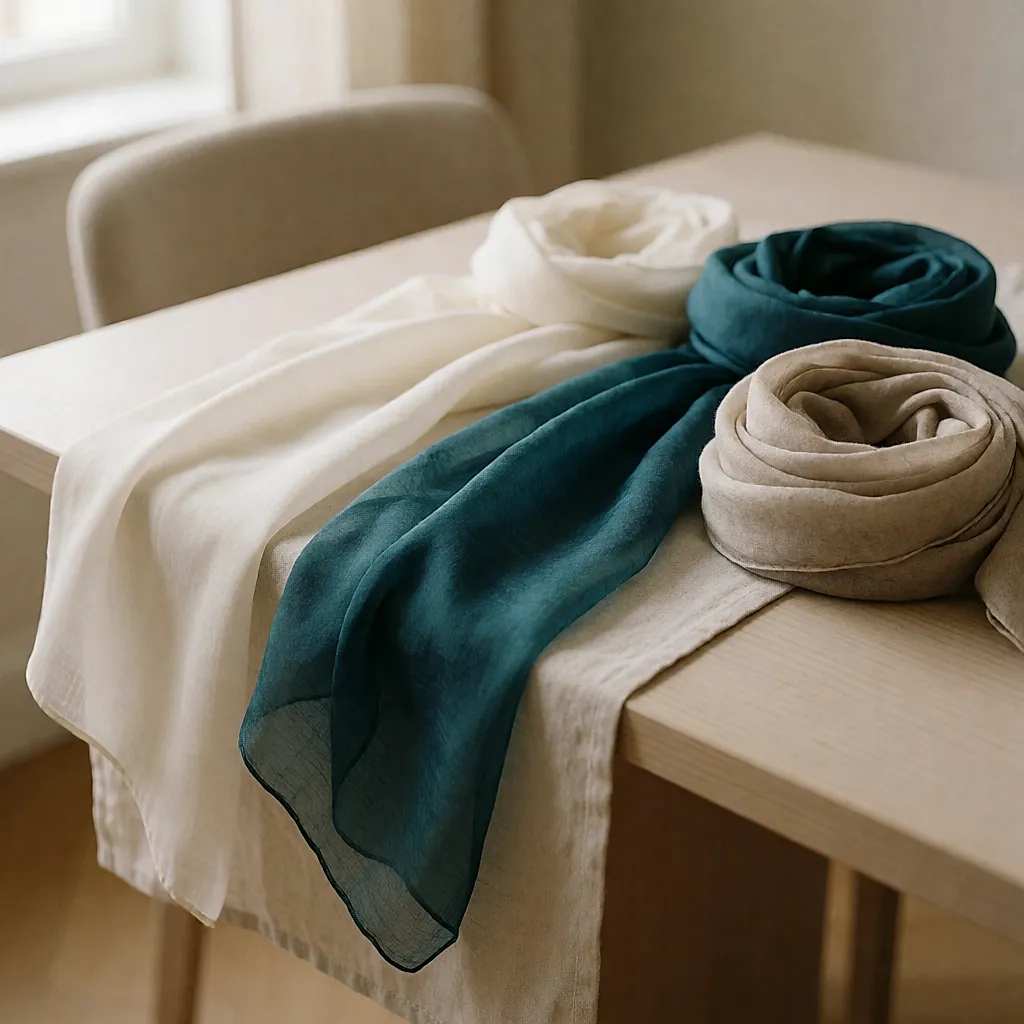
The good question isn't 'which brand?' but 'what thickness of yarn?'. In practice, a dense wool often stands up to wind better. The useful habit: read the label and check the synthetic fibre content, whose feel and drape are often less refined than natural fibre. Better to know what you're buying before you knot it.
Narrow, long, short-knotted: why the geometry matters
Width matters more than length. A narrow scarf—20–35cm wide by 150–180cm long—doesn't have enough surface area to keep your torso warm: it frames the face, highlights a neckline, slims. That's exactly what we ask of it. Large square scarves, meanwhile, fold into a triangle and slip under an open coat, where they act as a small shawl without breaking the shoulder line.
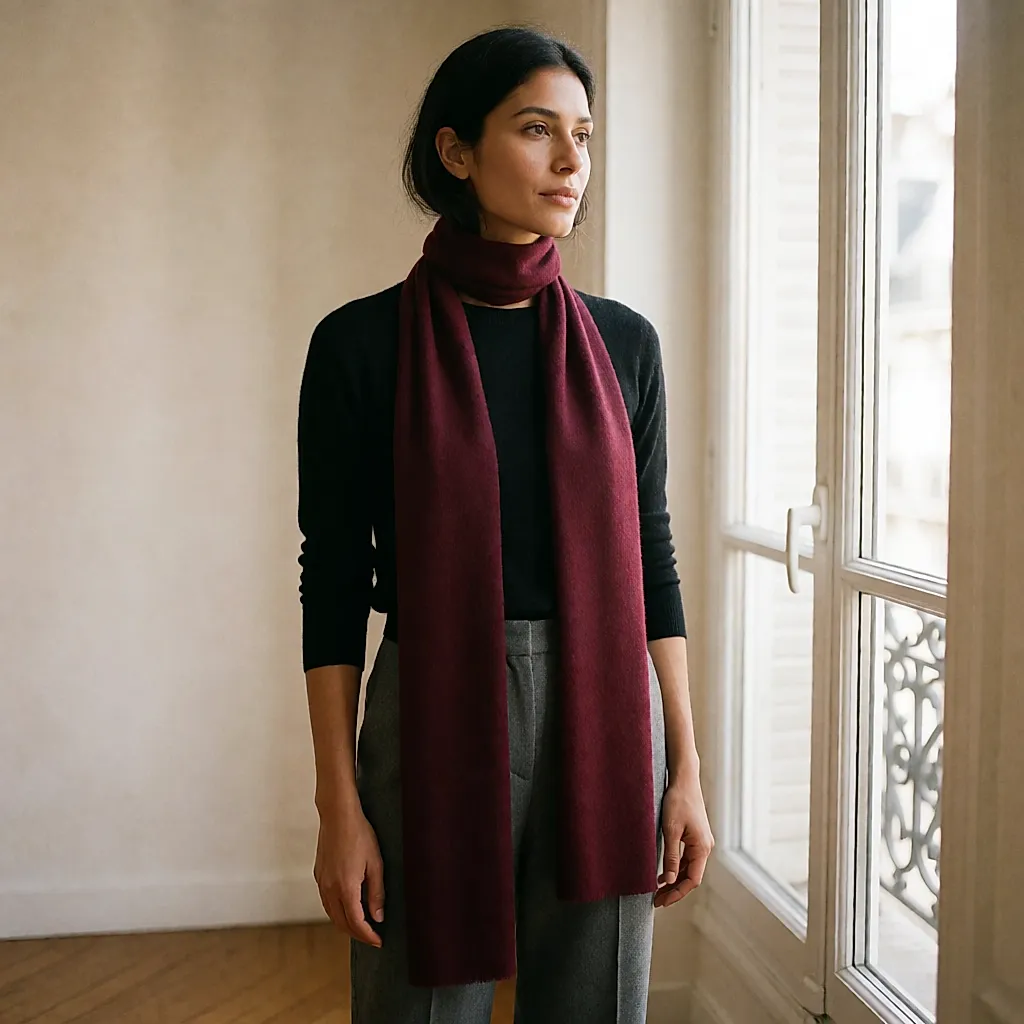
Then there's the knot, and that's where it's all decided. Knotted short, like a necklace, it occupies the neck and gives the outfit structure. Left hanging, both ends in mid-air, it draws a vertical line that lengthens the silhouette. The short knot is the right pick with a large-collared coat, when the fabric around the face is already generous; hanging ends, meanwhile, save short coats, which sometimes lack the length to stretch the silhouette.
Over a roll-neck or under a coat: two approaches
Slipped over a fine roll-neck, a scarf creates clean layering: the knit holds the neck, while silk or fine wool brings colour. But if the roll-neck is thick, the scarf adds a third layer of volume and you end up with a snowman's neck. Layering that works comes down to a simple formula: fine roll-neck plus fine scarf, never the other way round.
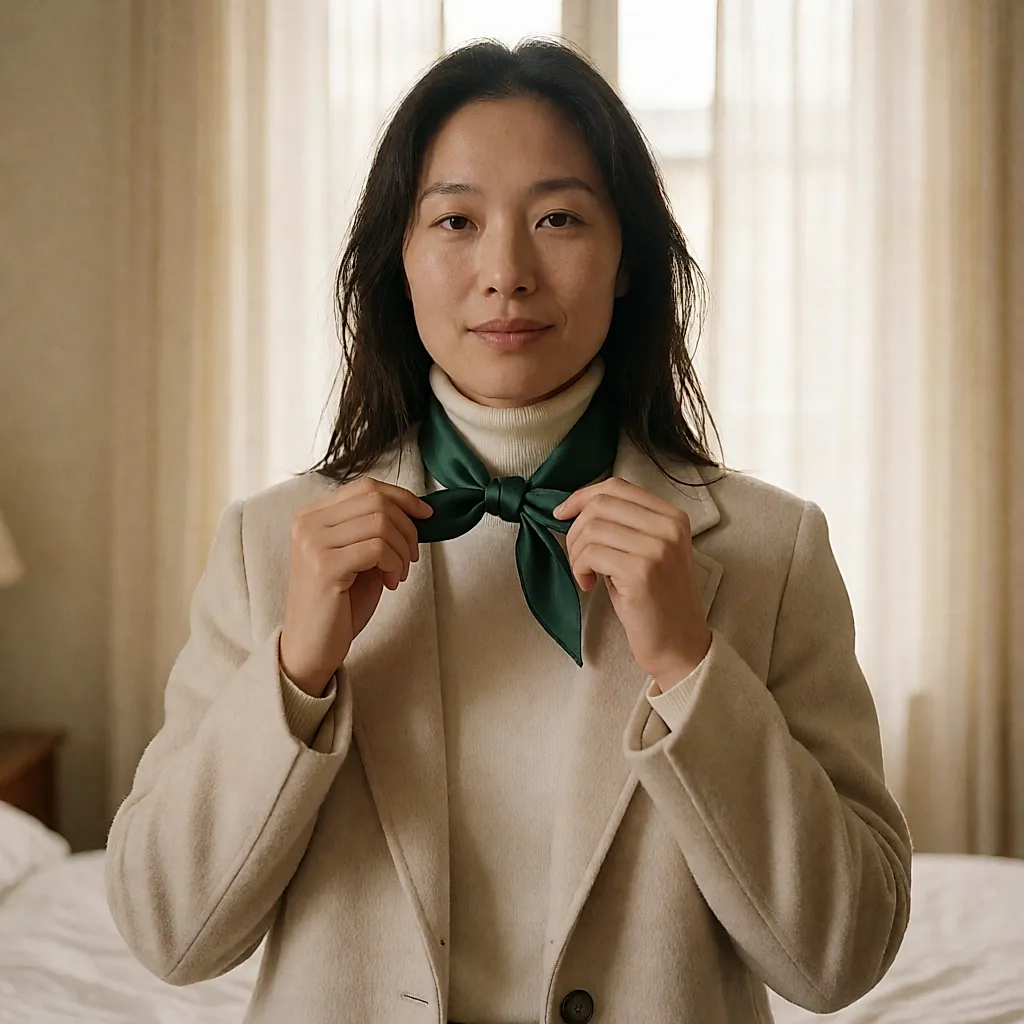
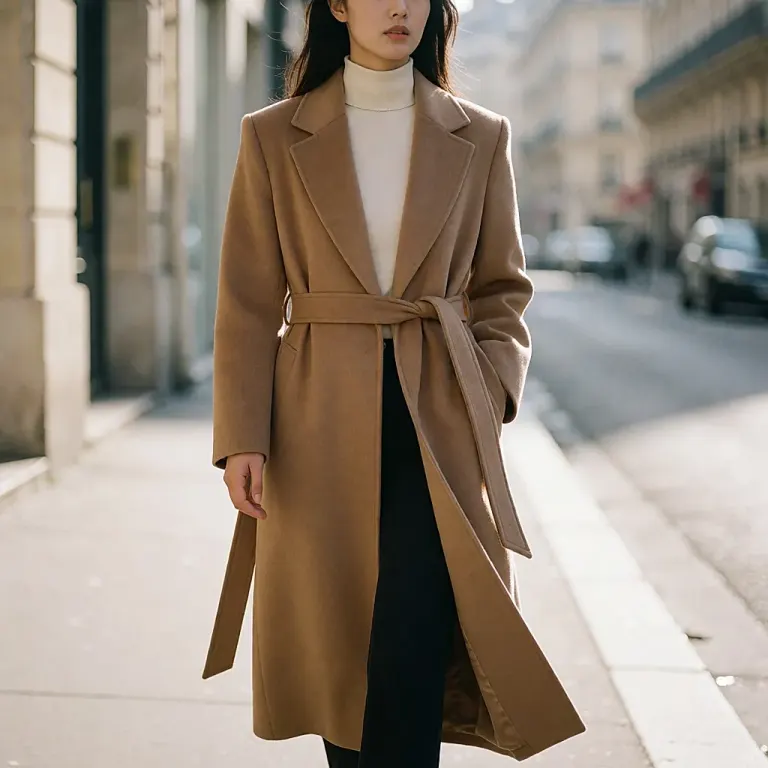
Under a coat, two options. Over a straight-cut jacket, to highlight the neckline without disturbing the shoulder line, which stays sharp. Or inside the collar, barely visible, with a fine knit and a short coat: the 'I haven't done anything' effect, very effective. In both cases, keep the width modest—too much fabric on a structured jacket cancels out exactly what you like about it.
The temperature at which it gives up
A rule of thumb from the team, not a law of physics: above 15°C, a fine scarf is an accessory, and that's perfectly fine. Between 8°C and 15°C, worn high over a roll-neck and under a closed coat, it does the job of a light scarf—provided there's no wind. Below 8°C, especially in gusts, it no longer replaces anything: it covers too little surface area, and fine fabric doesn't stop the wind. It isn't a failure; it's geometry.
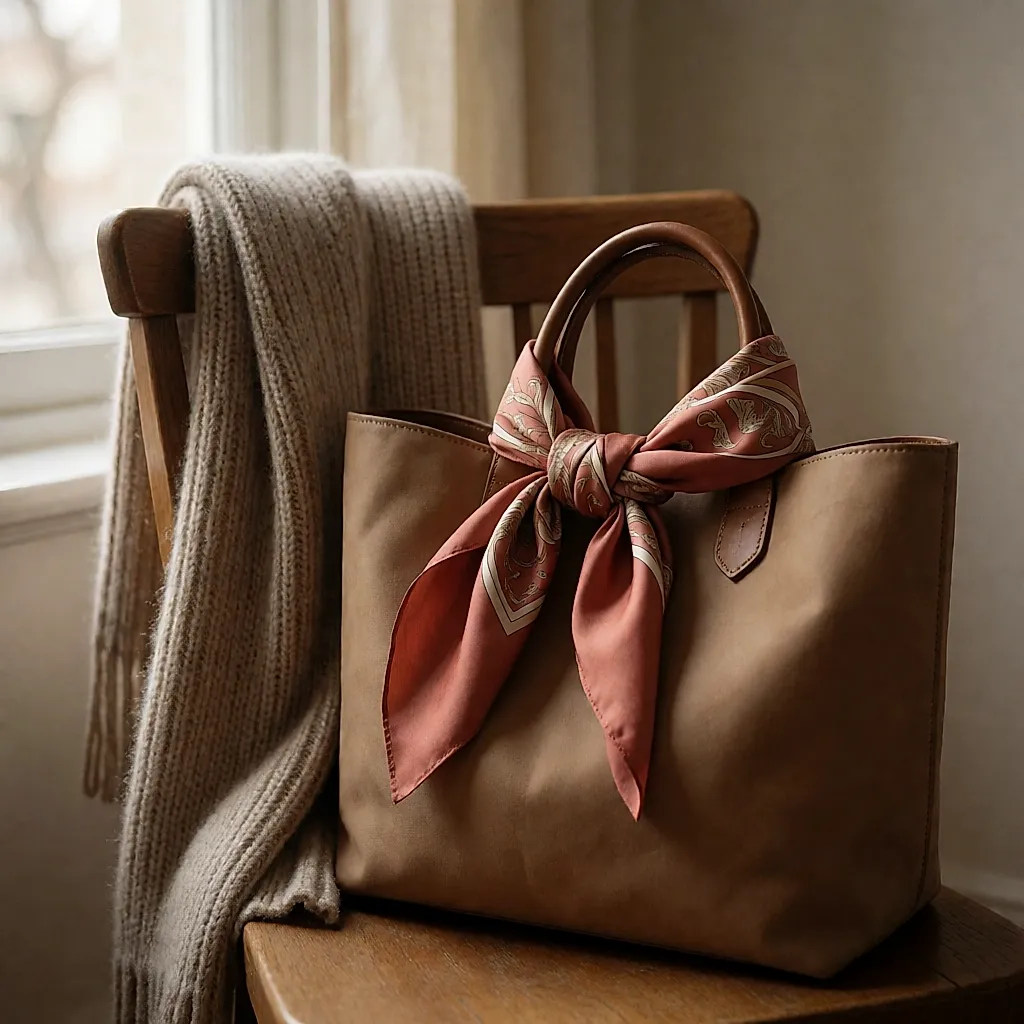
On the days it gives up, don't put it away just yet. Slip it under a chunky scarf as a second layer, knot it around a bag handle, keep it for indoors—overheated office, train, open-plan space where you swing between air conditioning and the radiator. That's often where it earns its keep most.
Budget
Prices vary widely: expect roughly £10–£25 in supermarkets or high-street chains, where blends dominate—the label is your friend. Between £30 and £70, you'll find well-woven cotton voile and very fine merino wool in boutiques. Beyond that, from £90 to £250 depending on the brand, you're into silk and cashmere, with a drape and hand-feel you can sense at the first knot.
Where to look? Markets, haberdashers, fashion boutiques and supermarkets for new; charity shops and resale platforms for the rest. Scarves are one of the easiest accessories to hunt down: barely worn, often forgotten in a drawer, and sometimes inherited from a quality level hard to find on the high street today.
The knot without a lump. Fold the scarf lengthways, loop it once around your neck, then pass both ends through the loop you've made and pull gently to one side. The knot stays flat under a coat and avoids that little bump you then spend five minutes flattening in front of the lift.
The chunky scarf hasn't had its last word, and no one here wishes it any harm: it rules the deep cold, the mountains and mornings at -5°C. But in between, there's a whole season when you can cross the street without looking like a duvet. A fine scarf, a fine knit, a short coat: that's the winning combination, and your silhouette will thank you.

Comments
Your opinion matters: rate the article, react and reply to comments.
Comments are moderated; AI-assisted comments are flagged. Text emoticons (8-), :-), <3…) are automatically shown as images.