
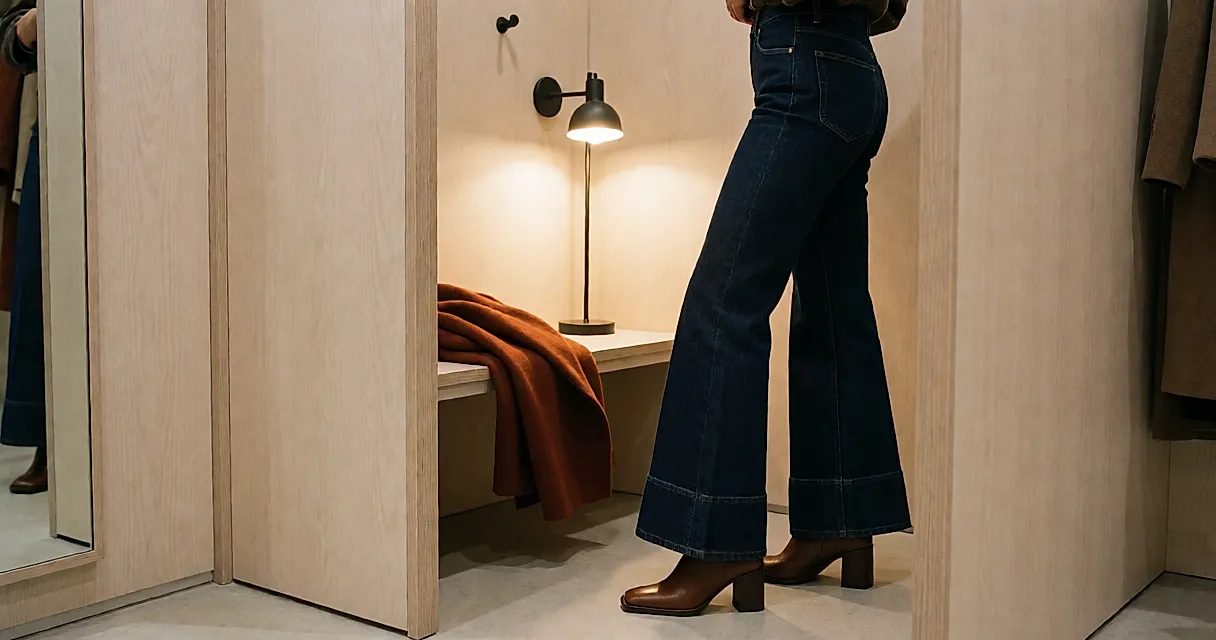
Flared jeans that fall well show only two details of your boots: the rounded toe at the front and the line of the heel behind. The shaft, the seams, the zip, even the little label on the sole — all of them now live under the denim, out of sight and safe from wet pavements. So the question is no longer “which boots should I buy?” but “what shows?” That shift has a considerable advantage: it brings back into play pairs you thought were ready to be retired.
The shaft disappears, the rest takes over
With skinny jeans, a boot had to fight to exist: a slim shaft, a neat ankle, a flawless zip, because every crease showed and the boot concertinaed around the leg. A flare changes the rules completely. A slightly wide shaft, leather that has lived, a tired lining? No one is going to check under the hem. What was a buying criterion yesterday becomes an invisible detail today.

Next, sort out the length of the hem, because it decides everything. In practice, look for 22–26 cm across the hem when laid flat on a classic flare: that is the width that covers the shaft without crushing it. A hem that sits just off the floor, within a centimetre or two, gives the cleanest drape; too short, and it cuts the leg and makes the whole shoe visible — exactly the opposite of the effect you want.
The heel is what people notice
Since it is the only thing showing at the back, it may as well say something. A square heel of 4–6 cm remains the easiest to wear: stable on cobbles, it lasts a whole day without asking for a break. It is also the heel that works best with a generous flare, because it balances the volume of the trouser leg instead of playing against it.
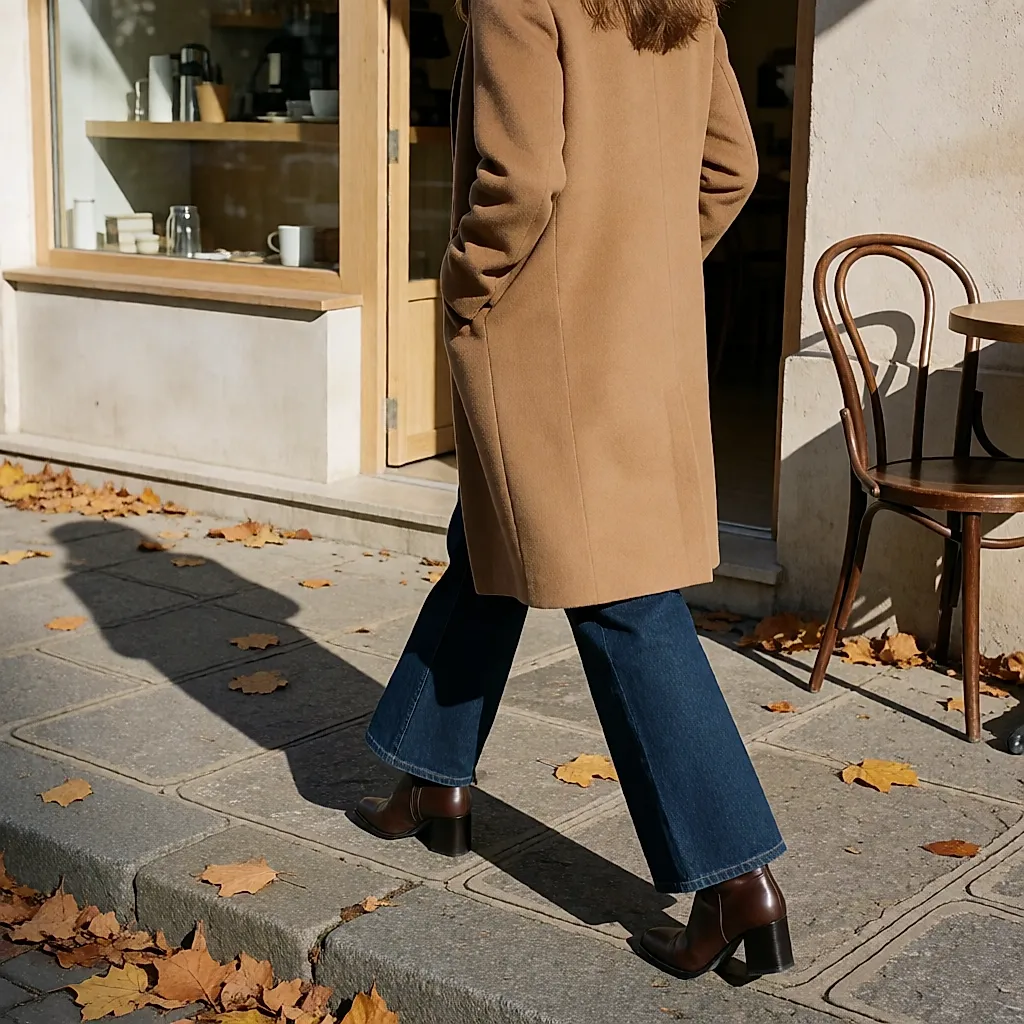
A bevelled heel, dressier, shifts the line towards evening; a spool heel, rounded and a little retro, brings the right seventies note to raw denim. As for the 3 cm kitten heel, it works — provided the flare is on the finer side; otherwise, its delicacy gets lost in the volume. One question will settle it: in the full-length mirror, do you see the heel or the toe first? The answer sets the tone of the outfit before you have even chosen a coat.
The toe decides the rest
The toe is the signature that shows at the front. Rounded, it keeps the look casual and forgives everything: faded denim, a thick jumper, a straight coat. A wide square toe brings a graphic, very seventies edge that works beautifully with a flared pair with pleats or visible seams. Almond is the all-round compromise you can pull on from Monday to Sunday without thinking.

A fine pointed toe, on the other hand, needs a little more care: at the end of a voluminous flare, it can look dainty. There is nothing forbidden about it, but choose a slightly tapered toe rather than a sharply pointed court shoe — the contrast will be more balanced, and your walk more assured.
The pair you already own is often better than a new buy
Have a proper look through the wardrobe before you reach for your card. Boots with a marked shaft, a zip that catches, a sole worn down on one side: under a flare, only the toe and heel remain, and both can be repaired. A full resole usually costs around £45–£80 at a cobbler, and a replacement heel around £25–£50. For good-quality leather, that is often less than a new pair made with synthetic materials, which may last a season.

On materials, keep the usual reflex: leather (ideally vegetable-tanned), a leather or rubber sole, and a glance at the label to check the proportion of synthetic fibres. It is not about banning anything, just knowing what you are buying. And if you really do need to add a pair, second-hand shops and resale sites are full of square-heel boots whose tired shafts will no longer show at all.
Budget
A new pair in decent-quality leather sits at around £90–£250, depending on the brand and country of manufacture; expect more like £120–£300 for a western boot or a style with a more detailed heel. In charity shops, vintage shops or resale sites, you can find good square-heel pairs for £20–£70 — check the sole and the lining, because that is where wear tends to hide. And do not forget the cobbler: £45–£80 for a refurbishment is often the best value of the lot.
The full-length mirror test. Put on the jeans and boots, then step back three paces. What should stay visible: the toe, the heel, and nothing else. If the shaft appears with every step, the hem is too short or the boot too tall. If the hem drags, taking it up by a centimetre is enough — a cobbler can adjust it without breaking the drape of the trouser.
At heart, a flare does something quite rare: it gives shoes you had set aside another chance, and it gives freedom to anyone who has no desire to hit the shops. Get out your old boots, look at what shows, and let the heel do the talking. The jeans take care of the rest.


Comments
Your opinion matters: rate the article, react and reply to comments.
Comments are moderated; AI-assisted comments are flagged. Text emoticons (8-), :-), <3…) are automatically shown as images.