

A few ideas for a green wedding
A reader wrote to me last week. She is getting married in June, is expecting eighty guests, and her fiancé is dreaming of imported roses. Save the planet or save the relationship? Breathe. A low-impact wedding is not a list of deprivations: it is a series of decisions made at the right time, and above all in the right order.
The venue: secure it a year ahead
This is the decision that dictates all the others. A working farm, a renovated barn, a meadow where you pitch a marquee: you are leaning on a place that already exists, instead of building an ephemeral set for one evening. As soon as you sign the quote, plan for wet-weather backup, and consider how far your guests will have to travel. A venue within reasonable distance of a railway station often generates fewer car journeys and flights than a remote spot at the end of a lane.
Invitations and the gift list
Two options stand up. Digital invitations, almost free and paperless, or printing on FSC- or PEFC-certified recycled paper, in exactly the right quantity. For the gift list, steer people towards what lasts: pre-loved tableware, an experience to share, a fund for a train trip rather than a flight.

At the table
With fewer than fifty guests, cooking yourself with seasonal produce can be one of the most effective gestures: less transport, less waste. Beyond that, look for a caterer who works locally and seasonally. And be wary of one word in particular: 'organic'. In the UK, the term is legally protected and must be certified by an approved organic control body. In France and the EU, organic labelling is also regulated, but the AB logo remains optional and the EU organic logo is required mainly on pre-packaged organic food produced in the EU—not on every catering service. A supplier who writes 'natural' on their menu is saying nothing verifiable; for organic claims, ask which products are certified and what evidence backs that up.

The silhouette
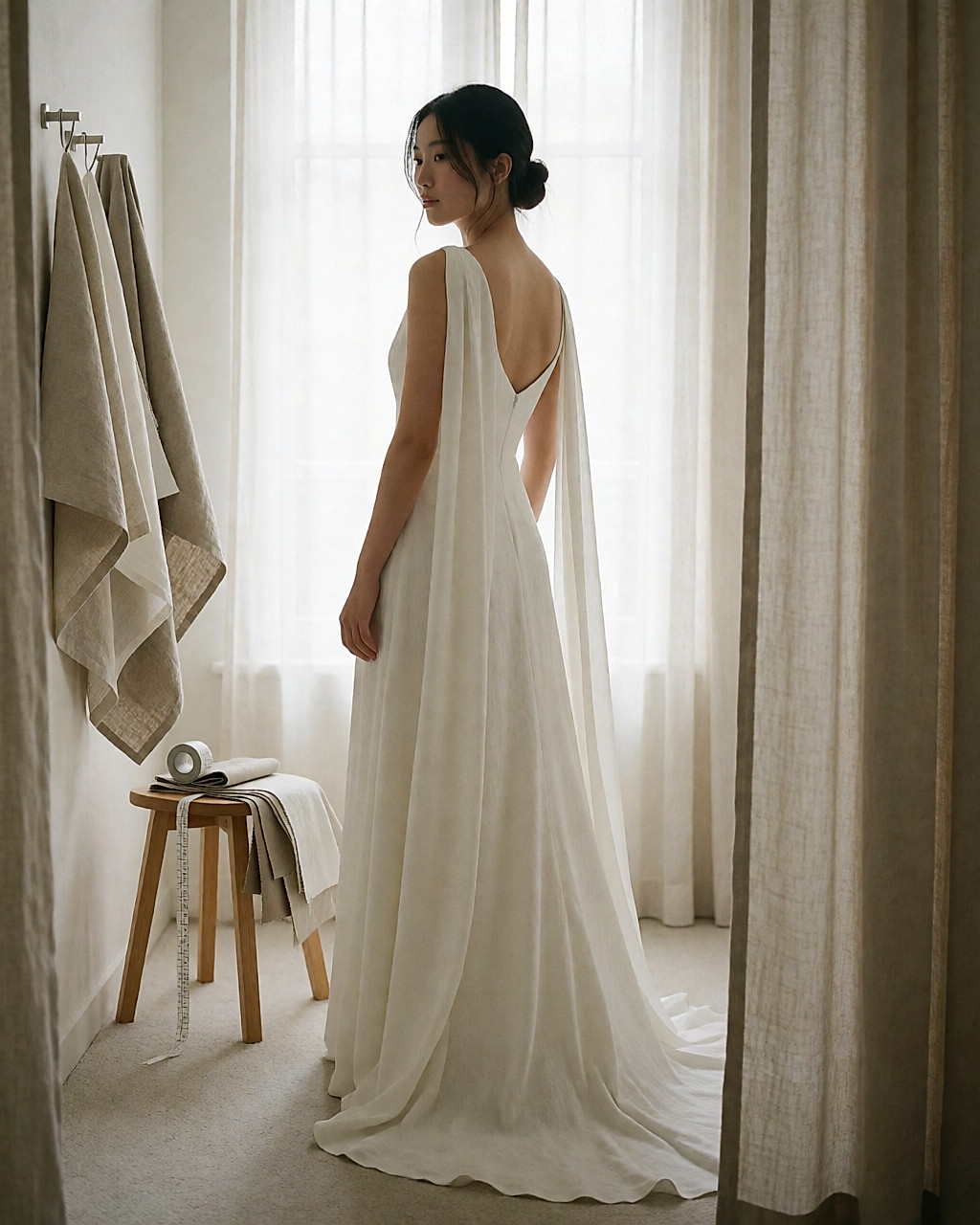
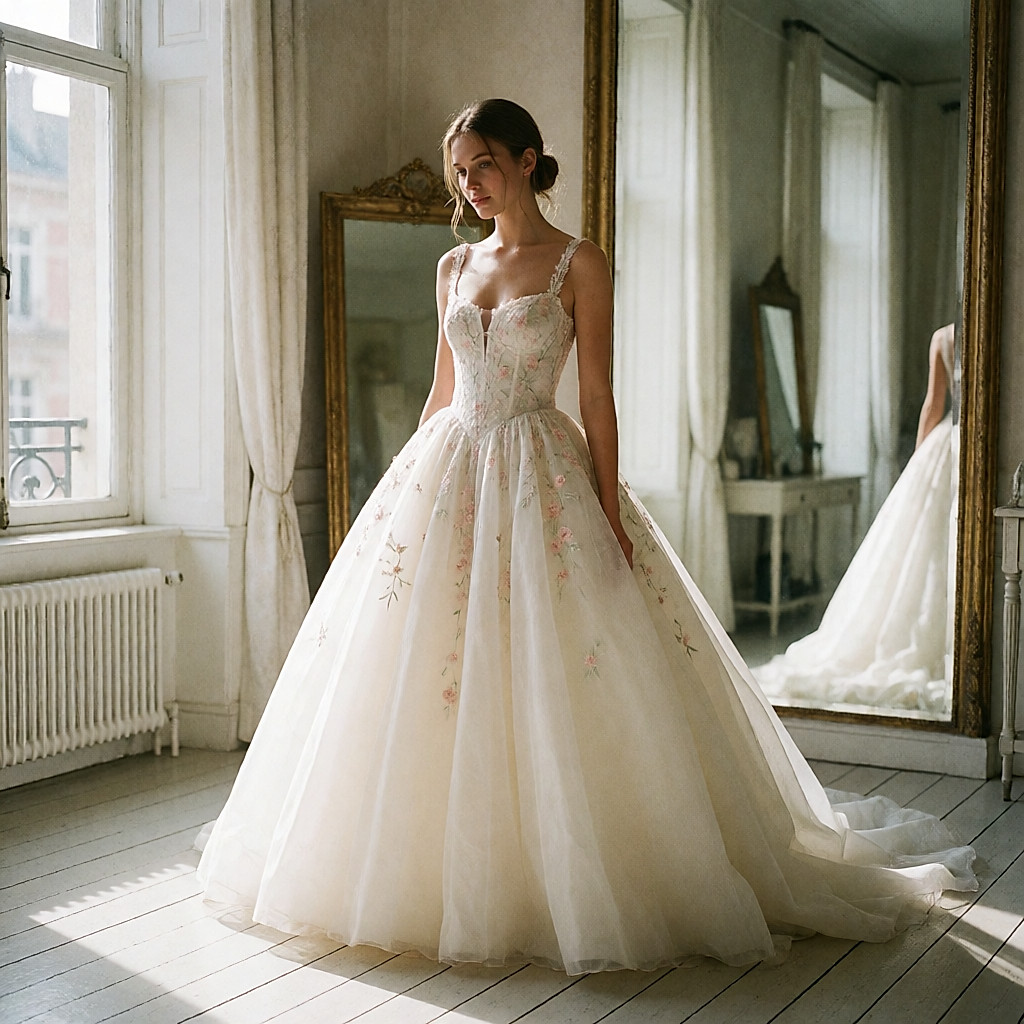
When it comes to the dress, the fabric matters more than the style. Linen and hemp have a slightly raw drape, beautiful in a fluid cut; mulberry silk gives a softer, more fluid drape. If you are looking for a cellulose fibre, lyocell is often made using a solvent process where most of the solvent is recovered, from wood whose certification depends on the supply chain: preferable to polyester, but not neutral either. Look at the labels before the price tag. GOTS governs the processing and traceability of textiles made with already-certified organic fibres, according to environmental and social criteria—not the growing of the fibres, which falls under agricultural organic regulations and certifications. OEKO-TEX Standard 100 tests for harmful substances against limit values—it is not an organic label. And consider rental or second-hand: it is the piece in your wardrobe you will not wear again. A tailor can alter a second-hand dress; allow enough time for fittings.
Decor and flowers
Seasonal flowers, grown near you, cut the day before: the compromise that holds up over time. Crockery, chairs and tablecloths are easy to hire. If you really do not have time, delegate to a wedding planner, but ask about their suppliers, not just their moodboard.
The gesture that changes everything, with no budget: let each guest take home the bouquet from their table. You avoid throwing flowers at the end of the night, and your decor lives on at home for another week.
Budget
- The venue (farm, barn, village hall): expect from a few hundred pounds to several thousand for a weekend, depending on region, time of year and the number of nights on site. Book around a year ahead.
- Catering: from £35 to £80 per guest for a served meal, more depending on local and organic options; between £20 and £45 for a buffet. This is the most flexible line.
- The dress: from £130 to £430 to hire, £260 to £780 second-hand, £800 to £2,200 and up new. Add £85 to £215 for alterations.
- Invitations: from 85p to £3.50 each printed, a token sum digitally.
- Flowers and decoration: from £350 to £1,300 depending on volume. At the same time of year, get several quotes: price varies mainly with variety, volume and season.
- The wedding planner: from a few hundred pounds for partial support to several thousand for full organisation from A to Z.
These figures shift with region and date. Always ask for a written quote, and consider low season, from November to March, to keep the bill down.
Sources
- UK Government (gov.uk): environmental impact guidance and carbon footprint tools.
- GOTS, Global Organic Textile Standard (global-standard.org).
- OEKO-TEX (oeko-tex.com).
- European Commission, EU organic logo (the green leaf).
- Department for Environment, Food & Rural Affairs (Defra), organic farming and food labelling in the UK (gov.uk).



Comments
Your opinion matters: rate the article, react and reply to comments.
Comments are moderated; AI-assisted comments are flagged. Text emoticons (8-), :-), <3…) are automatically shown as images.