

One gust has turned it inside out, and there you are on the pavement with a half-bald umbrella, a rib dangling like a tired piece of wire. It is always a Monday when this happens. The question is whether the thing deserves a second life, or a one-way trip to the bin.
An umbrella has a rare advantage: it can still be taken apart. A replacement part costing a few pounds, a visit to the local cobbler, and it is ready for another two winters.
What can be replaced, and what condemns it
Three parts account for most repairs. The rib first, the flexible strut that pulls the canopy taut and gives the umbrella its frame; when it snaps, the whole thing looks like a skeleton. Then the spring, the small mechanism that draws the rib back towards the shaft: it weakens, pops out, and the whole frame starts to rattle. Finally the tip, the little cap at the end of each rib, which disappears without warning and leaves a piece of metal ready to catch the lining of your coat. All three can be replaced, often for the price of a sandwich.
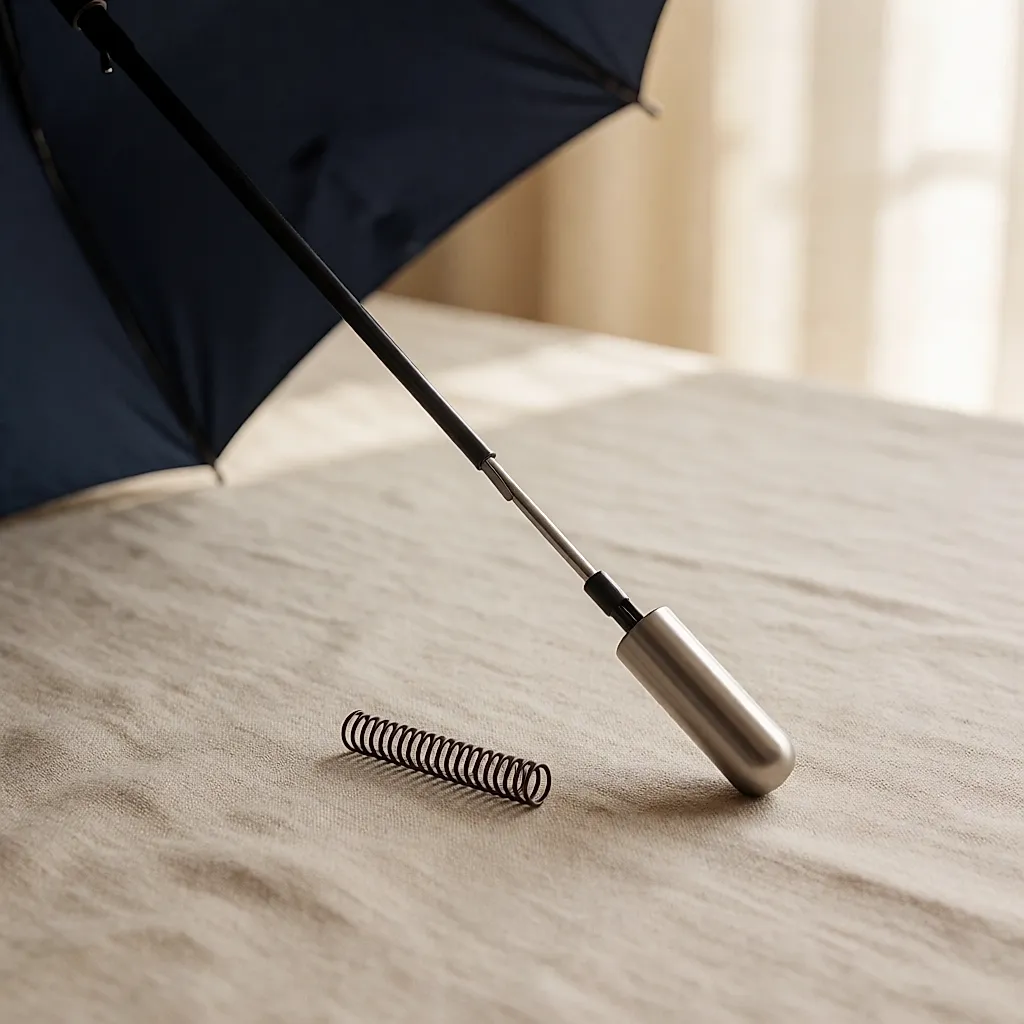
And the rest? Some faults signal the end. A bent shaft never really straightens: the runner, the ring that slides the umbrella open, will keep catching, and you will spend every shower wrestling with a stubborn object. Ripped-off rib attachments — the small fittings that connect the ribs to the shaft — usually point to a canopy that is tired in the same place. And a tear running across two panels often costs more to repair than the umbrella itself. In that case, replacing it is not a whim.
In the shop, three checks before you pay
First, test the mechanism and the fittings. Open and close it twice, slowly, as if you had all the time in the world. The mechanism should glide without juddering, without a stiff point, without that sharp click that betrays an already wobbly fitting. Then look at how the ribs are attached to the shaft: rivets, screws, moulded fittings, it does not matter — what matters is that nothing moves when you give it a gentle twist. An umbrella that trembles when new will tremble far more in November rain.
The second check is the canopy under tension. Open it fully and step back. If the fabric pulls taut, with no sagging pocket or gaping fold between two ribs, you have a model that will stand up to wind. If it floats loosely, it will turn inside out at the first gust and give you that familiar bat-wing silhouette we all know. The third is weight: good or bad sign? A heavier umbrella often gets its strength from a more substantial shaft and ribs — whether your shoulder agrees is another matter.
The habit that costs nothing
An umbrella's lifespan is also decided in the ten minutes after a shower. Go inside, shake it out, open it wide in the hall for an hour or two, then put it away dry. Stowed wet in its cover, it keeps damp deep in the folds and ages badly.

The rest comes down to small things: a stitch in a seam that is coming undone, a replacement tip bought from a haberdashery, a rib entrusted to a cobbler. Nothing heroic, but it is often what separates the accessory you keep for five years from the disposable one you buy again every autumn.
What you can do yourself: fit a new tip (a few pounds from a haberdashery), stitch a small repair in the canopy near a tip, dry and store it flat.
What to leave to a repairer: a rib or spring to replace, a seam repair across several panels, anything to do with the fitting on the shaft. A bent shaft will not straighten — that is one of the cases where you buy new.

What it costs
For repairs, expect roughly £10 to £25 for a rib or spring at a cobbler or alterations shop, depending on the town and the model; a canopy seam often costs around £8 to £20. For spare parts, a haberdashery or luggage shop should be able to help. At those prices, it is not a difficult decision.
For a new umbrella, prices vary widely. A stopgap model from a supermarket or luggage chain costs around £15 to £30 — handy for the glove compartment, less so for getting through a winter. An umbrella with a sturdy shaft, dense canopy and clean finish is more likely to sit between £45 and £90. Above £100, you are into small production runs, wooden shafts and thicker fabrics: a purchase you expect to justify over several years.
An accessory, not a disposable
It is not the centre of your wardrobe, but on a day of torrential rain it is often the only part of you anyone sees from ten metres away. It may as well stand up straight.
So the next time a gust hands it back to you at a drunken angle, give it a reprieve before the bin. And if the verdict is final, choose the next one with the same care as a good trench coat: a clean line, a fabric that holds up, a shape that does not collapse in the first gust.


Comments
Your opinion matters: rate the article, react and reply to comments.
Comments are moderated; AI-assisted comments are flagged. Text emoticons (8-), :-), <3…) are automatically shown as images.