
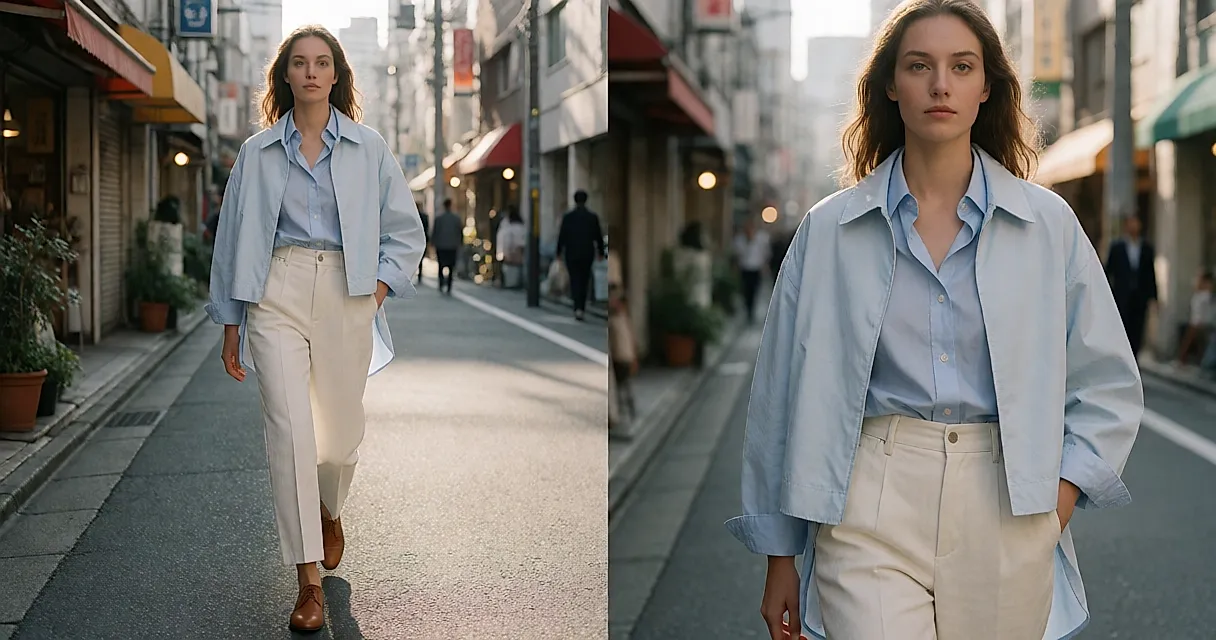
It was scrunched at the back of a drawer, between two belts and a scarf you never dared wear. The slim trouser has resurfaced — not the 2005 version, the other one. The pair that hangs straight, stops at the ankle and finally lets the rest of the outfit breathe. A good find for the season, on one condition: don't wear it the old way.
The slim trouser has switched sides
In Japanese and Korean fashion pages, the fitted bottom half is no longer there to make anyone look slimmer: it acts as a counterpoint. Pair it with very loose tops, longline shirts, short boxy jackets — and it's the contrast that makes the look, not the width of the trouser. The message is clear: a clean piece below, volume above, and the silhouette holds itself together.
What makes it work is the cut. The new slim trouser sits higher on the waist, eases only slightly at the calf and stops decisively above the ankle. The drape is no longer that of a disguised legging: look for dense cotton, a slightly firm twill, a cool wool for winter — fabrics that hold a line instead of clinging. The famous 'just stepped out of the shower' effect? Not for us.
The whole equation in one sentence
Volume above, precision below. That's the whole secret of its return, and it's what sets it apart from the full skinny look of the Noughties. An oversized jumper over a slim trouser breathes; a tight top with the same trouser sends you straight back to school. The nuance isn't small — it's the main thing to remember.
And here's the good surprise: the slim trouser becomes an easy piece. It works with round-toe ankle boots, slips under a slightly oversized blazer, and works with a pair of loafers without looking like an office in 1998. Above all, it has the advantage of being the neutral base that makes a top you found too big yesterday morning wearable. You don't buy a new wardrobe; you rebalance the one you already have.
Three moves to avoid a throwback
First, length. A hem that stops above the ankle, or barely breaks on the shoe, changes the look entirely. Too long and the slim trouser falls back into the 2005 drawer; too short and it becomes holiday capri pants. Second, shoes: flat, round-toed or a little chunky. Pointed stilettos and tight boots over a slim trouser are exactly the combination that dates.
Third, the top. An open shirt over a T-shirt, a jumper that stops at the hip, a structured jacket with slightly defined shoulders: any one will do. Add a slim belt if the trousers have belt loops, but keep it discreet, and definitely avoid the wide belt + tight top + pointed boots combination that turns you into a walking archive. One strong piece at a time is the rule.
Who it won't suit
Let's be honest: if you hate the feel of fabric following your thighs, or you spend your days sitting down, don't force it. A high-waisted straight-leg trouser offers the same balance with far more comfort, and works just as well with volume on top. Likewise, on very pronounced hips, a style that fits through the thigh but goes straight from the knee will often be more flattering than a continuous slim fit.
The other limit is practical. In a very formal office, a slim wool trouser with a well-cut shirt works; for a rainy Sunday in November, a straight-leg jean will earn its keep more often. And if you're only buying one piece this season, it may not be this one — a good straight-leg trouser will serve you better. We're saying it because it's true.
Budget
On price, the range is wide and this isn't where you need to spend a fortune. Expect roughly £35–£60 on the high street and at accessible chains, £80–£160 in the mid range for dense cotton or a wool blend, and £220–£350 from a tailor or for a genuine wool style. Second-hand is a very good route here: slim trousers from the 2010s are coming back into circulation, often in excellent condition.
The real expense is alterations. A hem costs £15–£30 depending on the tailor and the city, and taking in the waist £15–£25. If you find the trousers for £50 but they're 3 cm too long, don't pass them up: alterations often cost less than buying another pair. You'll find these services at local alteration shops, dry cleaners and sometimes in-store.
In the fitting room, three checks worth more than any mirror: sit down (the trousers shouldn't pull at the waist), look at the knee line from the side, and wear the shoes you plan to pair them with. A length judged in socks is the wrong length.
The main point remains: these trousers aren't there to make you look thinner, they're there to hold the rest of the outfit together. Choose a clean pair, cropped at the ankle, pair it with a top that takes up space — and you'll look like someone who knows what she's doing, without having had to change her silhouette. That may be the real good news of the season.

Comments
Your opinion matters: rate the article, react and reply to comments.
Comments are moderated; AI-assisted comments are flagged. Text emoticons (8-), :-), <3…) are automatically shown as images.