

You open your wardrobe and your eye lands on the blazer you bought for a first interview. The shoulders suddenly look too wide; the hang of it feels a bit sad. And yet this season it is almost the piece everyone is pulling out again. Between the jacket you bought five years ago and what is coming through the collections, there is a real gap — but not enough to justify rushing out to replace your whole autumn wardrobe. We look at what has shifted, what people are actually wearing, and what can be rescued.

What has really changed in tailoring
Autumn/winter tailoring has little to do with the banker's suit now. The shift is in the volumes. Shoulders are still defined, but much less padded — you keep the line and lose the bulk. Jackets are getting noticeably shorter or longer, and trousers are moving away from slim cuts towards a softer, almost fluid drape. The silhouette should look sharp, not stiff.
Does that mean replacing your entire wardrobe? No, and that is the good news. The detail that makes the difference is often just a hem and a turn-up. A sleeve pushed up to sit just above the wrist, trousers chopped clean at the ankle: a five-year-old piece can suddenly look right again. A trip to the tailor can sometimes erase that fancy-dress effect for far less than a new jacket.
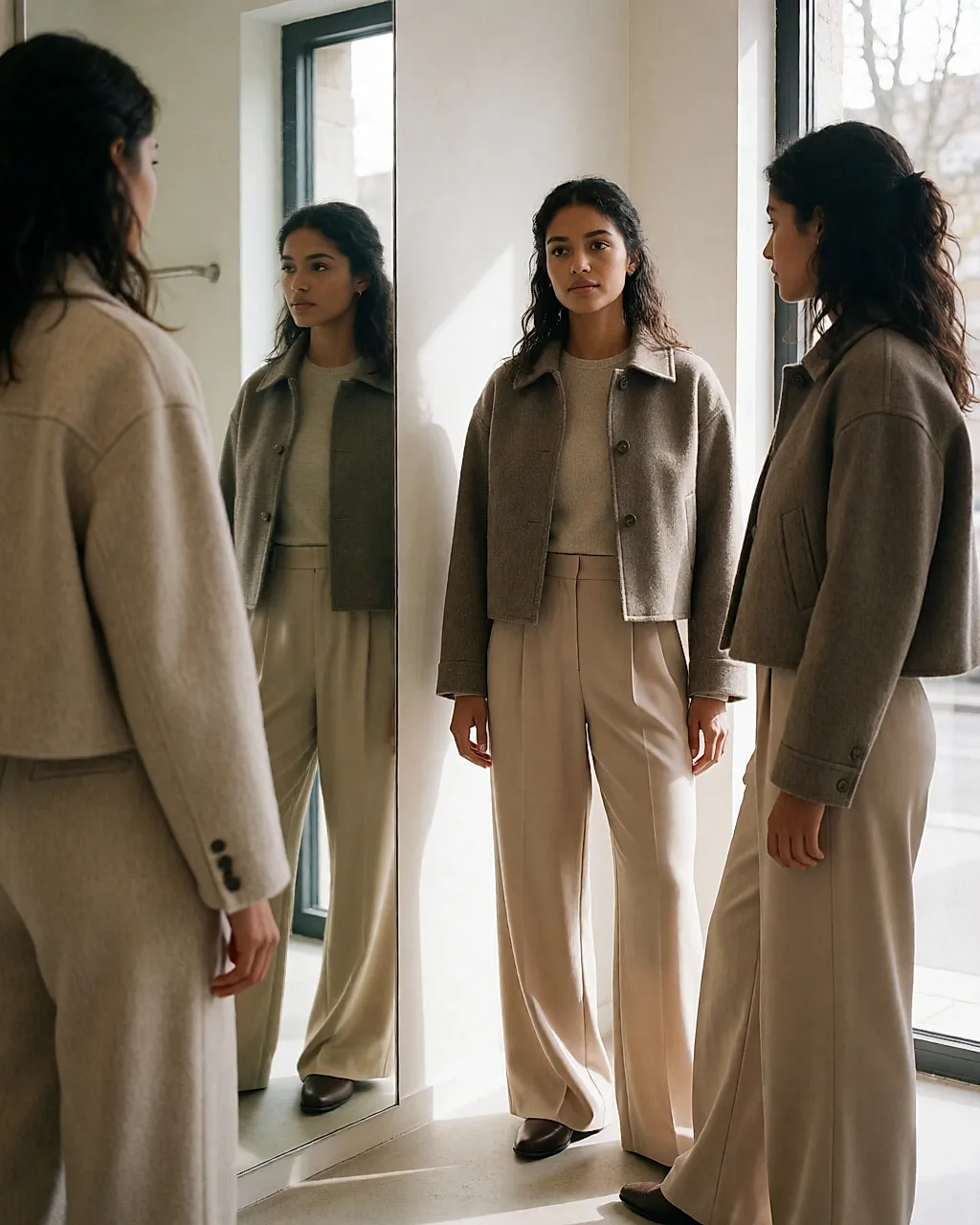
One caveat, though: not every old piece can be rescued. A blazer that is too nipped in at the waist, with sharp darts and heavily constructed shoulders, will still look like a 2010s uniform even after good alterations. Straight cuts with natural shoulders age best — and slip effortlessly into today's tailoring.
Preppy, without the school uniform
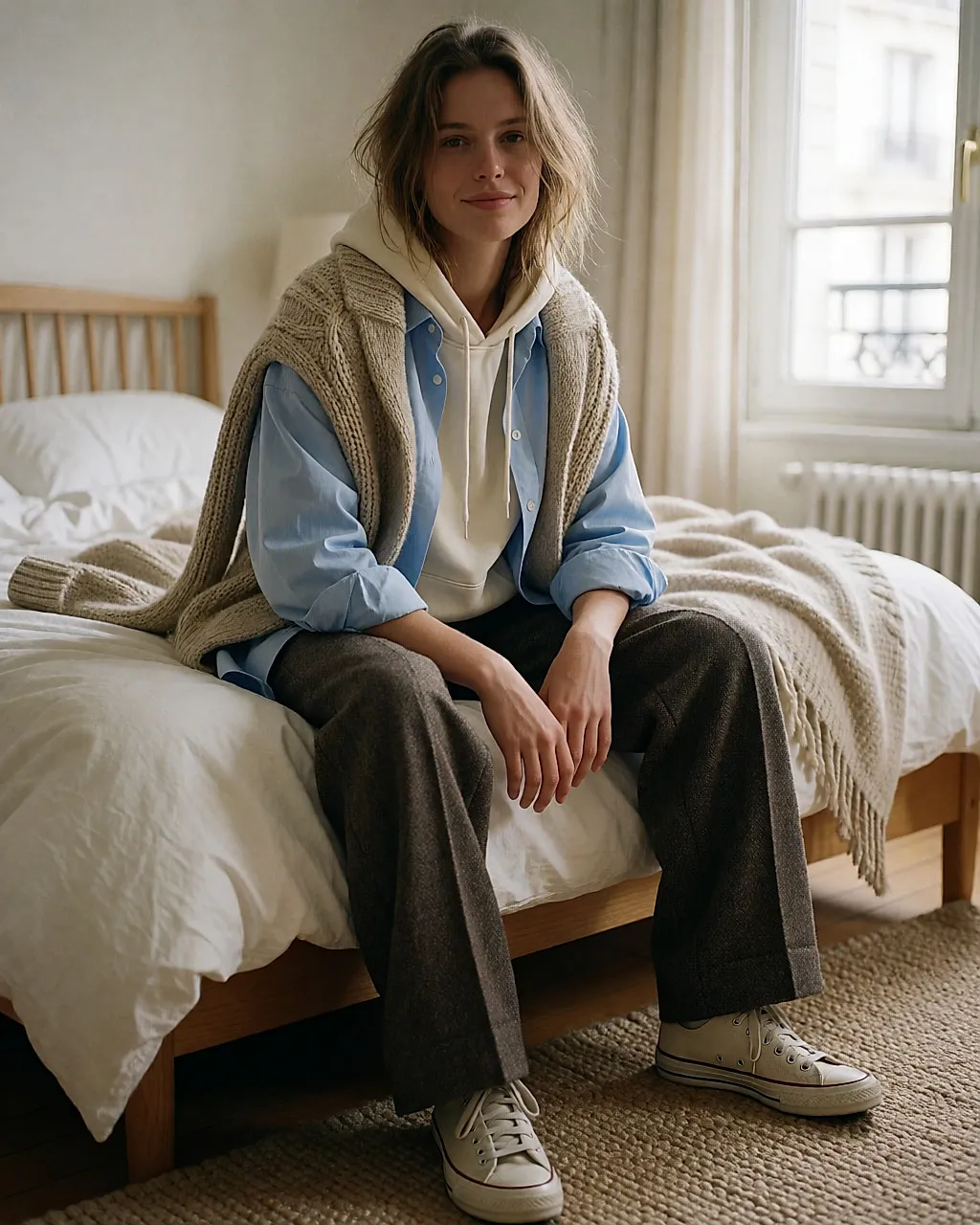
Preppy means polo collars, cable knits, flannel trousers, loafers. In truth, it has always been lurking in our wardrobes — we just used to call it 'my dad's jumper'. What the collections are bringing back is the styling: borrowed-from-the-boys polish, worn in a relaxed, almost thrown-on way. Layering does the rest, as long as you do not pile things on for the sake of it.
The nuance is there. This season's preppy is not a school uniform. If you layer a shirt, tie, waistcoat, blazer and loafers, you are in costume — and that is exactly where the cosplay starts. Break up the full look with one piece that does not follow the rules: a pair of worn trainers, a hoodie slipped under the jacket. That contrast is what makes an outfit feel credible rather than catalogue-ready.
The pieces to know
A few touchstones that last more than one season, and are worth spending on — or hunting down second-hand.
The straight wool jacket remains the foundation: natural shoulders, mid-hip length, a fabric with a good drape. The chunky knit, crew neck or V-neck, cable or plain — here the material does all the work, not the label. The poplin shirt, slightly oversized, worn open or buttoned to the top. The wide-leg pleated trousers, in flannel or thick cotton, which add polish without effort. The loafer, flat or with a small heel, or its Derby shoe cousin. And the midi pleated skirt, if skirts are your playground.
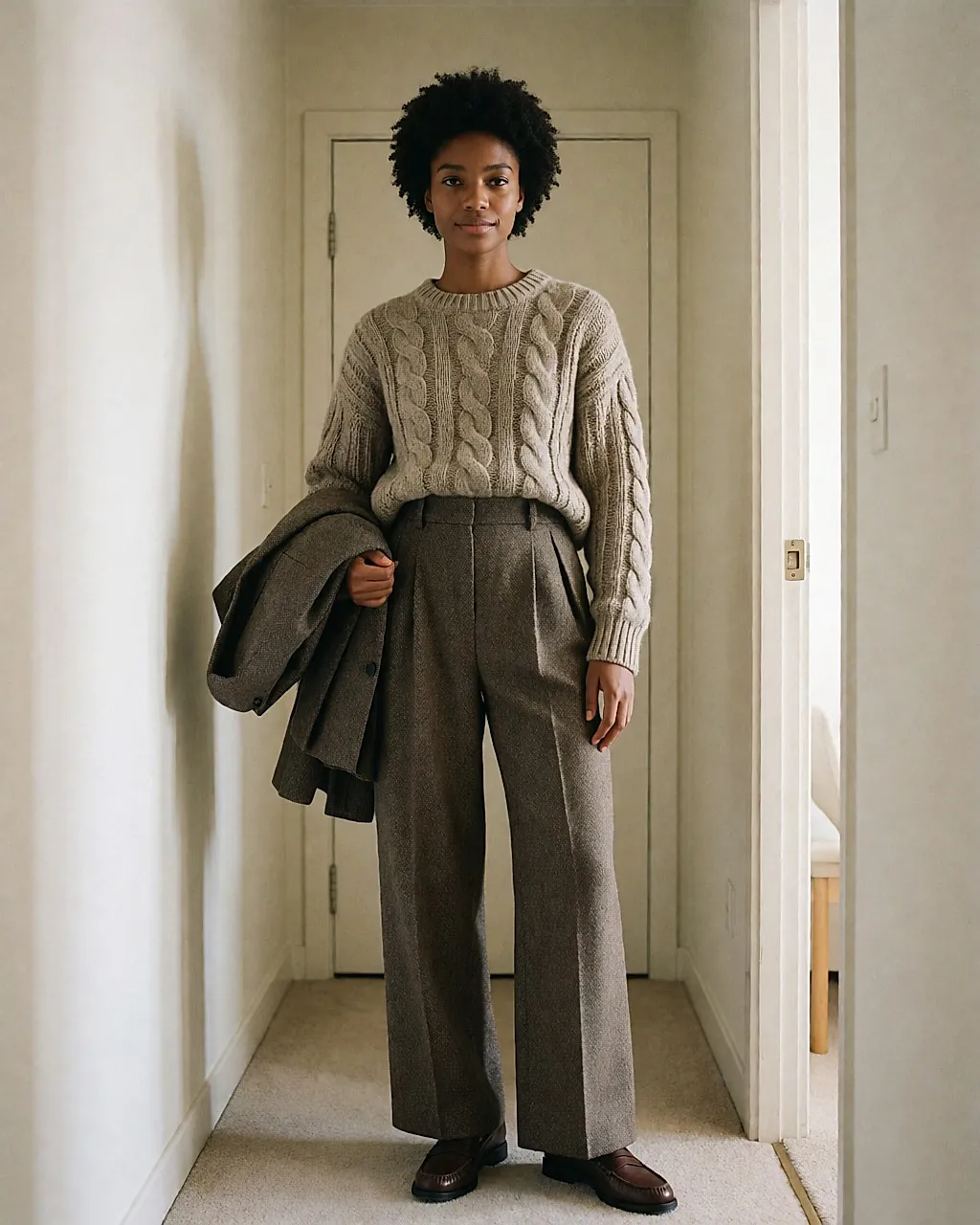
What to leave out? The skinny tie worn very seriously — unless that is your thing, in which case own it. The over-nipped blazer. And sets that are too matchy-matchy, which tip into uniform faster than they do style.
Budget
On price, expect to pay in the region of £80 to £250 for a new wool blazer, depending on the brand and how it is made, and more like £30 to £90 second-hand. The good news: this is also where real wool is easiest to find without blowing the budget. A chunky knit usually sits between £40 and £150 new, or £15 to £50 in a charity shop or on resale platforms. A decent poplin shirt starts at around £25 on the high street and rises to about £90 at mid-range brands. Flannel pleated trousers: £50 to £130. Leather loafers: £70 to £200, bearing in mind that a well-looked-after pair can be resoled and last for years.
Where to look? Local charity shops and second-hand platforms for tailoring and knitwear, mid-range brands online for basics, and high-street or value retailers for the shirt. Prices vary by city, composition (pure wool or a synthetic blend), finish and how much upkeep a piece demands. Before you get to the till, read the composition label: it is a test that does not lie.
The wardrobe test: before buying a tailored piece, try mentally styling it with three things you already own. If you get stuck at the second, you will not wear it.
The beauty side, kept simple
Tailoring calls for beauty that looks neat, not set in stone. Luminous skin, a well-defined brow, lips in brown or plum tones. If you want to lean fully into preppy, a matte lipstick and a low bun make more of an impact than heavy make-up. Nothing complicated: it is about finish, not the number of products. Your complexion keeps its natural glow, your make-up lasts the day, and the overall look stays understated.
The verdict
Is this trend worth it? Yes, but on one condition: that you adapt it to your life, not the other way round. If you spend your days in jeans and trainers, start with a single piece — a jacket or a chunky knit. The rest will follow, or it will not, and that is perfectly fine too. We like this season because it does not ask you to change everything: just to look at what you already own with fresh eyes.


Comments
Your opinion matters: rate the article, react and reply to comments.
Comments are moderated; AI-assisted comments are flagged. Text emoticons (8-), :-), <3…) are automatically shown as images.