
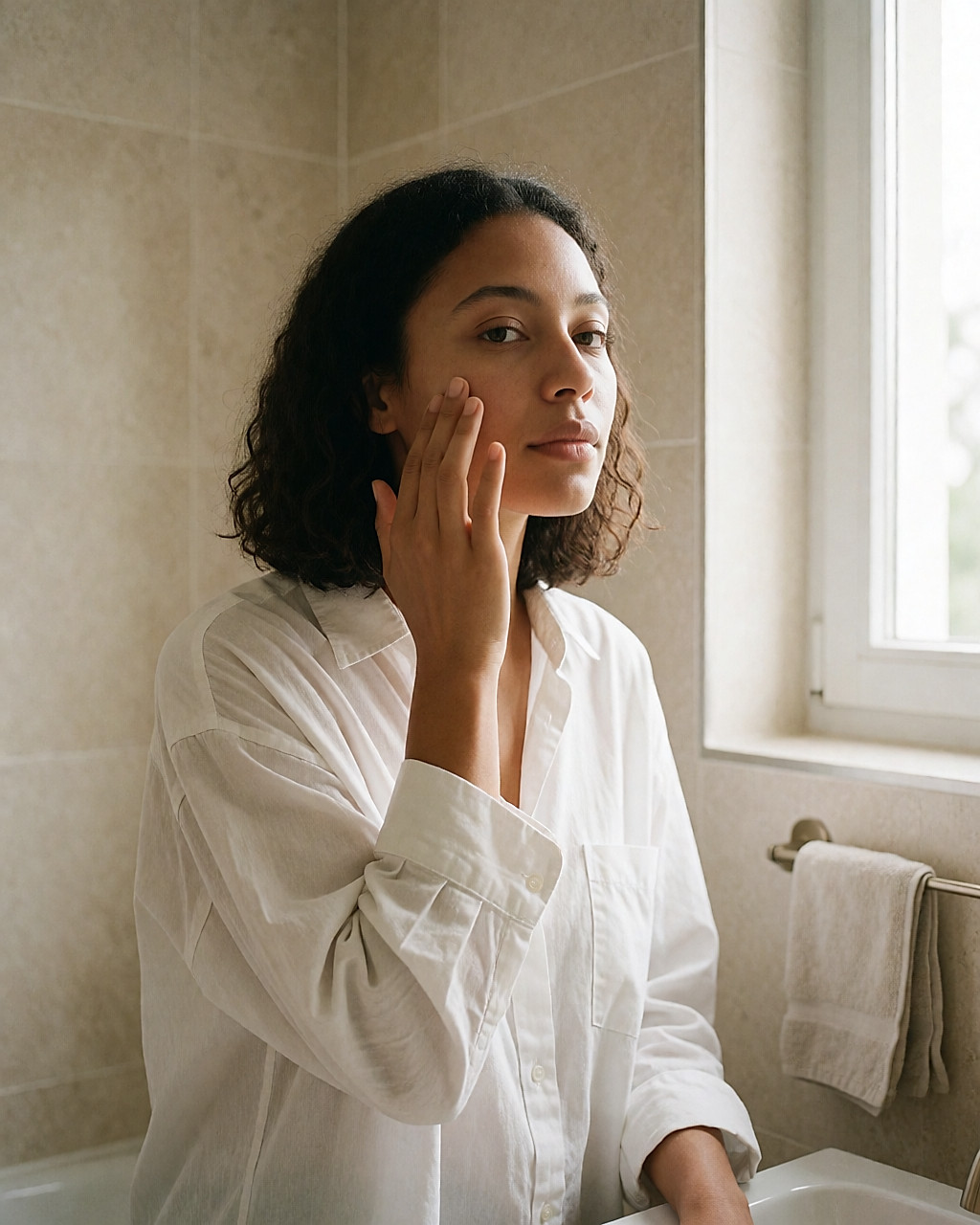
Two years ago, a 33-year-old friend asked me which anti-wrinkle cream she should buy. My answer disappointed her a little: the first thing to review isn't the jar, it's your morning routine. In truth, the wrinkle that settles in fastest is rarely the one you're watching for in the mirror.
Sun exposure: the lever you really control
Ultraviolet radiation remains the leading external factor in skin ageing. UVA doesn't take a holiday: it passes through clouds and windows, reaches the dermis and damages collagen and elastin. Skin loses elasticity, feels tight, dries out, and dark spots eventually appear. UVB, meanwhile, burns the surface.

The step that changes everything comes down to one line: every morning, winter included, a day cream with a high SPF, 30 or 50. Use the equivalent of two fingers of product on your face and neck, reapplying every two hours when you're outside. A hat and sunglasses remain more reliable than a tube: no sunscreen filters all UV, it reduces exposure. And when the UV index climbs — in the UK, in summer, especially between 11am and 4pm — that's the moment to move your walk to another time.
Evening: cleanse, nourish, then stop
Make-up, pollution, sebum: the day leaves a layer that weighs on skin renewal. Remove eye make-up with a gentle texture, a biphasic one if you wear mascara, pressing rather than rubbing. This very fine skin is damaged by friction.

Then the formula matters more than the packaging. Dry skin: a balm with glycerin or ceramides. Combination to oily skin: a light gel-cream with niacinamide or hyaluronic acid. The actives that shift things in studies — retinol above all — should be introduced one at a time, two evenings a week to start. Their maximum concentration is capped in the EU, which is a useful signal: these are not neutral ingredients.
The evening ritual that survives a busy week
- Gentle eye make-up remover, no rubbing.
- Soap-free cleanser, lukewarm water.
- One moisturiser, one active — not three.
- Targeted treatment twice a week, not every night.
On the buying side: few ingredients, organic standards (COSMOS Organic, Soil Association) that genuinely regulate the share of natural and organic ingredients, refills and glass containers. Verifiable criteria, not promises.
Diet and water: what works, what we fantasise about
No food erases a wrinkle, and that's good news: it saves us from absurd diets. On the other hand, an unbalanced diet soon shows in your complexion. Aim for variety — colourful fruit and vegetables, fish, nuts, wholegrains — and a few spoonfuls of plant oils a day, alternating rapeseed, walnut and olive. Rapeseed and walnut oils provide omega-3s that the body cannot make.

On water, a myth to put away: drinking three litres doesn't plump up your skin. It's mainly the humectants in a product, glycerin and hyaluronic acid, that hold water at the surface. Drink to thirst, and let skincare do its job where it helps.
Smoking, alcohol, sleep, exercise
Smoking narrows small blood vessels and accelerates collagen breakdown: a grey complexion, pronounced lines around the mouth. Alcohol dehydrates and disrupts sleep — and cell renewal follows a circadian rhythm, more active at night. Most adults need seven to nine hours.
Then there's exercise, the most likeable point on the list: moving boosts skin circulation, which gives you that fresh post-workout glow. Twenty minutes of brisk walking already counts.
Budget
Expect around £9–22 for a decent cleanser, £4–13 for an eye make-up remover. A simple moisturiser sits between £9 and £22; a serum with a well-documented active such as retinol, more like £22–52. High-SPF day cream: £9–22 in supermarkets or high-street beauty retailers, £13–30 in pharmacies — the top of the range often reflects mineral filters and certified organic formulas.
What changes the price: the number of actives, certification, format and where you buy it. A refill usually costs less per gram than a new jar, and own-brand products hold their own on basics — cleanser, moisturiser, sunscreen. Where to shop: pharmacies and pharmacy beauty aisles for reactive skin, supermarkets for budget options, beauty retailers and e-commerce for brands built around actives.
No tested brand selection here: these ranges are ballpark figures you might see in the UK, not guaranteed prices. And if your skin reacts or a lesion worries you, seeing a dermatologist — via your GP in the NHS pathway — is worth more than one more serum.
Sources
- NHS — sun safety and UV advice (nhs.uk)
- UK Health Security Agency — UV index and sun protection (gov.uk/ukhsa)
- British Nutrition Foundation — fats and essential fatty acids (nutrition.org.uk)
- Cancer Research UK and NHS Better Health — effects of smoking (cancerresearchuk.org, nhs.uk/better-health)
- UK cosmetics regulation and EU Regulation (EC) No 1223/2009 / (EU) 2024/996 on retinol — GOV.UK and European Commission (gov.uk, cosmetics.ec.europa.eu)
- COSMOS Standard (cosmos-standard.org) and Soil Association organic beauty standards (soilassociation.org)


Comments
Your opinion matters: rate the article, react and reply to comments.
Comments are moderated; AI-assisted comments are flagged. Text emoticons (8-), :-), <3…) are automatically shown as images.