
A moment's hesitation. That's roughly how long it takes to decide you love a perfume — sometimes less, if a packed Tube carriage has a say in it. What you never smell is the mountain of files, meetings and figures that had to fall into place before the first atomiser was ever pressed. Because before the pretty flower story printed on the box, there's a far less poetic chain of events. And, oddly, a fascinating one.
The verdict that lands before you've even tried it
The first jury a perfume faces is anything but romantic: it's made up of toxicology experts. In the EU, the Commission can ask its Scientific Committee on Consumer Safety (SCCS) for advice on a particular ingredient. The EU Cosmetics Regulation then governs what can be sold. In other words, your eau de parfum has to satisfy a set of rules — reassuring ones, you'd hope — before it's even allowed a name. In Great Britain, cosmetics follow a separate regulatory route. Different letterhead, much the same logic.
On the industry side, the work continues upstream, through industry bodies such as IFRA and the research institute RIFM. I wasn't in those meetings, and I'll happily admit it: all of this comes from public documents, not from a laboratory that opened its doors to me. But the thinking is clear enough. A perfume is an equation between the smell you want and a safety limit you mustn't cross.
Meanwhile, in Grasse and elsewhere, plenty of sniffing still goes on
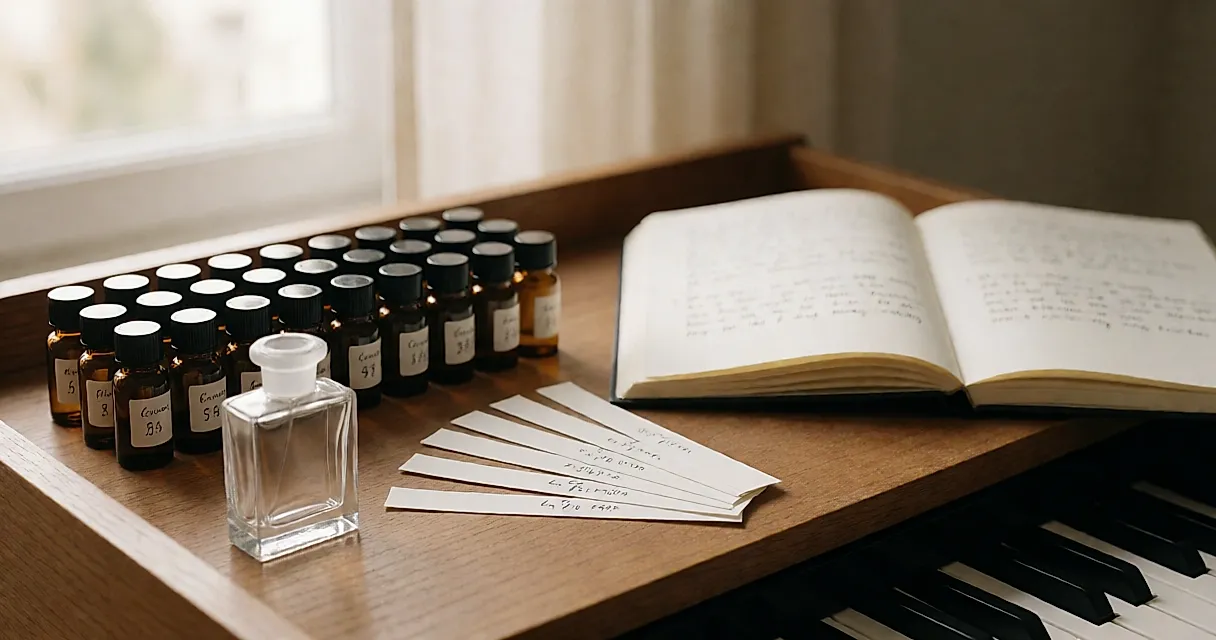
Fragrance houses — Givaudan, dsm-firmenich, Mane and a handful of others — bridge the two worlds. They create the formulas that brands buy, and they assess them relentlessly. The basic gesture? The blotter. You dip a strip of paper, smell it straight away and then again later in the day, once the top notes have flown off. What's being judged isn't simply "do I like it": it's longevity, fidelity, the way the sillage develops.
Then comes skin. A perfume on a blotter and a perfume on you are two different stories — pH, body heat, the dryness of January or the humidity of July all get involved. And there's the invisible part: does the formula yellow in its bottle? Does the citrus turn soapy after three weeks? A perfume that smells lovely the day it's bottled but falls apart afterwards has gained nothing. Behind all of it: labs, evaluation rooms, labelled bottles waiting their turn.
The soil around Grasse — quite literally — is where French fine perfumery grew. The region still grows roses, jasmine and tuberose.
The price is settled long before the till
Perfumery ingredients are paid for by the weight of the plant, and the yields are very low. An absolute — a highly concentrated extract — is a case in point. Rose, jasmine and iris above all: the rhizome has to dry for a long time before it gives anything up. That long wait for a smell strikes some people as beautiful and others as absurd; either way, it shows up in the price.
Then there's regulation. When the rules change, a formula has to be reworked, sometimes with several materials swapped out — and a perfume can quietly change, which explains vows of loyalty broken without warning. That reformulation work is expensive and never appears on the label. What does appear, sometimes, is a label that reads like a laboratory inventory.
What you'll actually pay
On the wallet front, ballpark figures for the UK: expect somewhere around £25 to £55 for a 50 ml eau de toilette from a chemist or supermarket, £70 to £130 for a 50 ml eau de parfum in a department store or specialist fragrance retailer, and £130 to £250 — sometimes more — for niche fragrances. Prices shift, so treat those as rough markers. Cost moves with concentration, volume, how rare the materials are and where you buy. An iris at the top of the pyramid doesn't cost the same as a fruity accord.
Where to shop? A physical perfume hall is still unbeatable for smelling before you pay; brand websites and beauty retailers sometimes offer travel sizes or refills. And if you're wavering, ask for a sample: it's a good way to find out what the formula does on you several hours later.
Spray it on skin, not on a blotter and not on a tissue. Give it time — ideally several hours — before you decide, and longer still before you reach for your card. And keep the bottle out of the light: that's what makes it last.
What you're left with once you've smelt the bottle
A perfume, then, is a chain of decisions: an expert opinion, a check, a blotter, a field of roses, a reformulation. All of that for a passing moment in a corridor. So next time you hesitate in front of a bottle, remember that the last opinion in the chain is yours — and the only one that really counts.
Sources
- European Union — Regulation (EC) No 1223/2009 on cosmetic products, 2009.



Comments
Your opinion matters: rate the article, react and reply to comments.
Comments are moderated; AI-assisted comments are flagged. Text emoticons (8-), :-), <3…) are automatically shown as images.