

Late September, a glimpse in the train window, and doubt creeps in: did that holiday colour ever really exist? Your complexion turns grey, skin feels tight, and your tan seems to have slipped away without a word. Truth is, a lasting tan isn't about luck. It's about ritual. Four well-placed steps and the colour holds.
First, build your tan gradually
A tan built slowly, in the shade and with an appropriate SPF, fades far less quickly than colour grabbed during two afternoons of sunburn. Skin produces melanin to defend itself, and sunburn damage is later paid for with peeling. In other words: sun protection isn't the enemy of a tan; it's the foundation. If you're heading back into the sun, reapply your sunscreen every two hours and stay in the shade during the strongest hours.

Hydration: the step that changes everything
This is the number one point. Dry skin flakes, and peeling skin loses its colour in patches. So apply your after-sun or moisturiser after a shower, while skin is still damp: skin holds on to water better. For textures, opt for an aloe vera and glycerine gel-cream for the body; for the face, choose something lighter and non-comedogenic. Twice a day for the two weeks after you get home is the minimum.
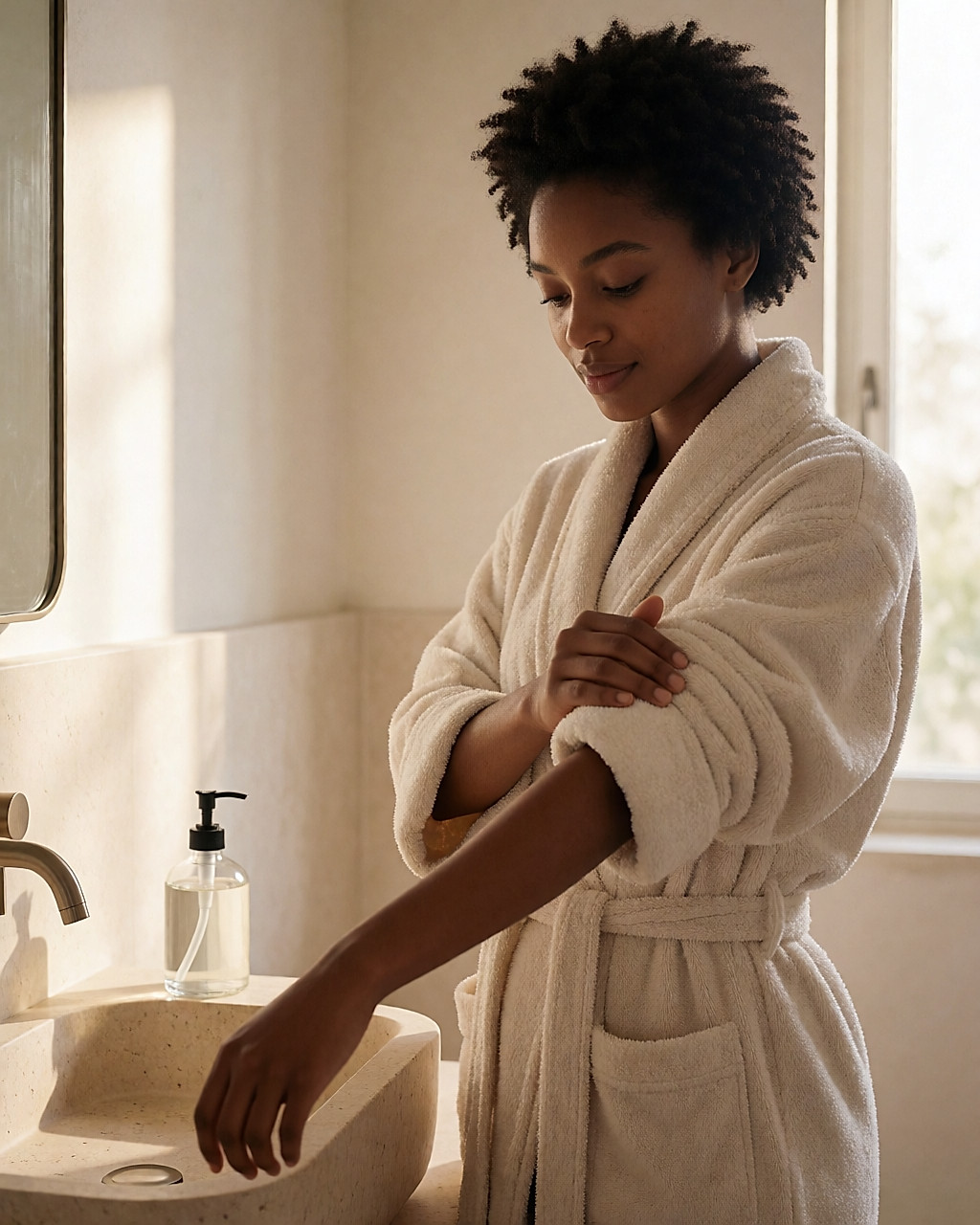
As for packaging, look for formulas certified by COSMOS ORGANIC or the Soil Association — standards that set rules on the share of naturally derived ingredients and limit synthetic ones — in glass or refillable bottles. Nothing is perfect, let's be honest: glass is heavy and awkward to transport. But for a product you use every day, refills really do change things.
Exfoliation: yes, but gently
Once a week is enough. The aim isn't to scrub hard: you're removing dead cells that dull your complexion, smoothing skin so your moisturiser sinks in better. A harsh scrub, by contrast, strips the surface layers and lightens your tan. So use sugar, fine salt or an exfoliating mitt — without pressing hard. And forget plastic microbeads: they've been banned in rinse-off cosmetics in the UK since 2018, which is better for your skin and the oceans.

Self-tan: your complexion top-up
It doesn't replace the colour you've already got; it extends it. Choose the gradual version for a healthy glow without mishaps; the classic version if you want more depth. Dihydroxyacetone colours the top layer of skin — hence the rule: exfoliate and moisturise first, otherwise the tint clings in patches on dry areas, elbows, knees and ankles. A useful reminder: self-tan doesn't protect against UV, and European rules recommend stating this on the packaging.
If self-tanning your face feels like too much, a sweep of bronzer over the cheekbones and tops of the cheeks wakes up a tired complexion in ten seconds.
What about your plate?
Carrots, sweet potatoes, spinach, red peppers, melon, apricots: beta-carotene gives a healthy glow, but it doesn't provide proven sun protection. Be cautious with high-dose supplements: EFSA has documented an increased risk of lung cancer in smokers. Eat your vegetables, yes; swallow capsules, be careful.
The real holiday trap: you moisturise every day on the beach, then come home and skip it after a week. That's exactly when the colour goes. Keep the bottle on the edge of the sink next to your toothpaste — a routine lasts because of the space you give it, not because of motivation.
Budget
- Moisturising after-sun lotion or gel: around £5 to £18 (supermarket, pharmacy, 200–400ml format). The price rises with organic certification and refill format.
- Gentle body exfoliant: £6 to £22 (supermarket, beauty retailer), a little more for a certified organic version.
- Self-tan for body or face: £8 to £30 (supermarket, beauty retailer, online). Mousses and serums sit at the top of the range.
- Bronzer: £12 to £45 (high street, beauty retailer, make-up brand).
- 'Sun preparation' supplements: £8 to £25 per course. Approach with caution: they don't replace sunscreen or shade.
The differences come down to format, brand positioning and where you shop. Pharmacies and chemists often offer the best compromise between price and ingredient list.
Sources
- NHS — sun safety advice and information on UV exposure.
- World Health Organization (WHO) — ultraviolet radiation and the UV index.
- European Commission — Recommendation 2006/647/EC on the efficacy of sunscreen products and the claims made about them.
- Regulation (EC) No 1223/2009 on cosmetic products.
- EFSA — opinion on beta-carotene and the risk of lung cancer in smokers.
- COSMOS ORGANIC and Soil Association — standards for natural and organic cosmetics.
- UK Government — ban on plastic microbeads in rinse-off cosmetics, in force since 2018.
Food supplements do not replace a varied, balanced diet and a healthy lifestyle.


Comments
Your opinion matters: rate the article, react and reply to comments.
Comments are moderated; AI-assisted comments are flagged. Text emoticons (8-), :-), <3…) are automatically shown as images.