

The suitcase isn't even unpacked and the mirror has already delivered its verdict. On one side, skin that still looks like it's just come back from the beach. On the other, hair that squeaks and skin that tightens the moment you smile. Nothing to worry about: three weeks of sun, salt and chlorine leave their mark, on the skin barrier and on the hair fibre alike. Here's the routine I run through when I get home, tried out on myself over the past few summers.
Hair: a mask, but applied properly
UV, salt and chlorine pull water out of the hair fibre and lift the cuticles. The step that changes the most is still a nourishing mask — as long as you don't slap it on any old way. On towel-dried hair, work it through the mid-lengths and ends, then leave it for twenty to thirty minutes. The overnight version? Only if your hair is genuinely very dry, and rinse thoroughly when you wake up, otherwise you'll be left with greasy roots and a style that falls flat. If your roots get greasy quickly, keep it away from the scalp.
On formula, two things matter to me. First, what's in it: plant oils, glycerin, panthenol, rather than a fragrance that takes over everything. Then what happens to the packaging. A Cosmos Organic certification guarantees a minimum share of organic ingredients and rules out several families of substances — the standard is public, so you can look it up. Glass jar, cardboard sleeve or a refill: that counts for something.
Body: oil and lotion, on damp skin
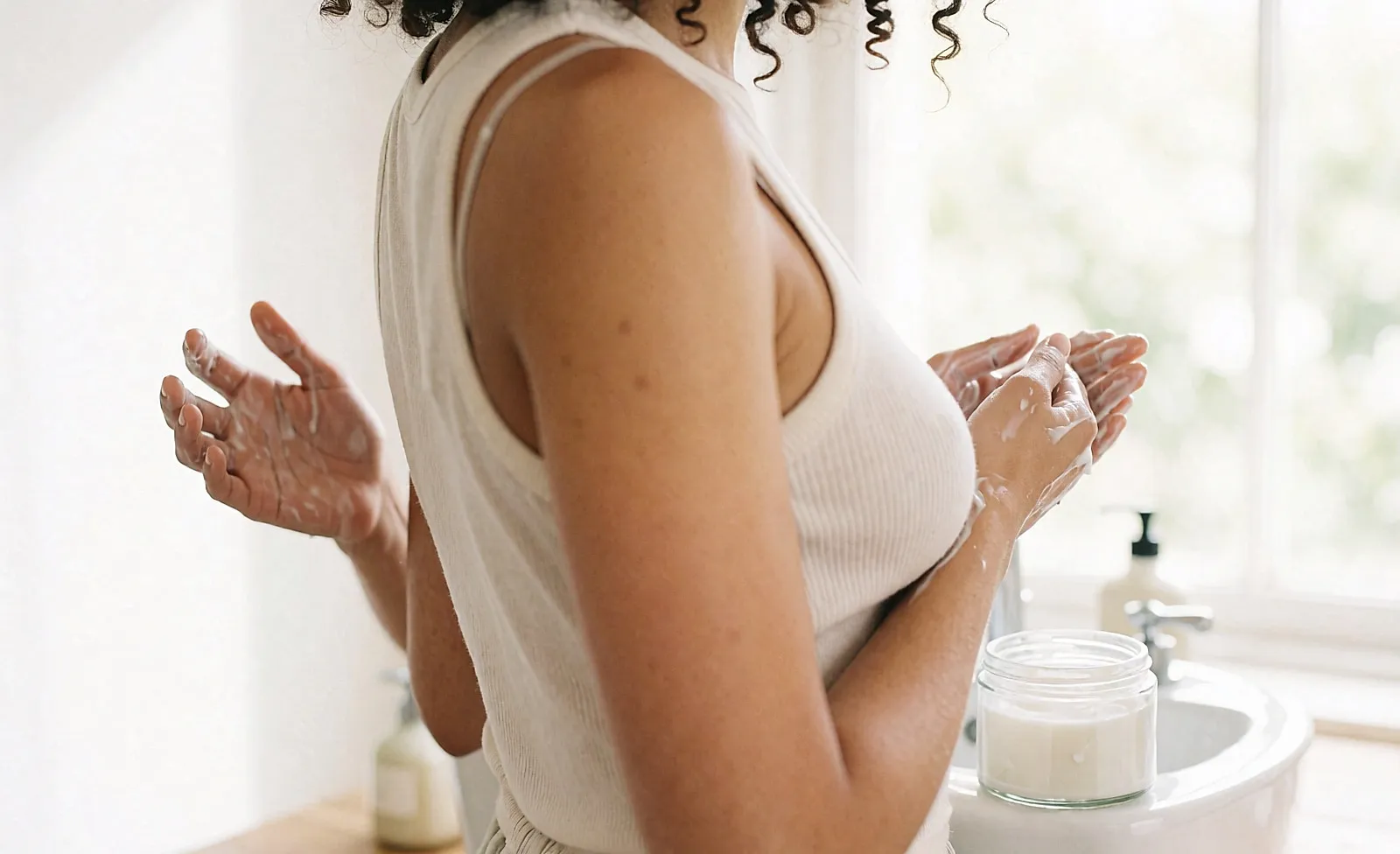
Skin that has tanned is still sensitised. One part sweet almond oil to two parts body lotion still holds up. But the timing matters as much as the recipe: within three minutes of getting out of the shower, while your skin is still damp, morning and evening. The oil holds the water in, the lotion supplies the humectants. And shop-bought after-sun? Useful for the first few days, if it's soothing. After that, if the formula is heavily fragranced or high in alcohol, you can switch to a simpler lotion. Not because it has somehow become "too active" — simply because it's no longer the right fit.

Face: it depends on your skin
Dry or mature skin: a hyaluronic acid serum under your moisturiser, morning and evening. Blemish-prone skin: a gentle exfoliant once or twice a week, and an AHA or PHA rather than abrasive grains. Exfoliating too hard speeds up how quickly a tan fades; it doesn't prolong it. Moisturise, yes. Scrub, no.
Hands and feet: the catch-up
Hands: a light scrub, then a face mask in a very thin layer, once or twice a month, plus a sweet almond oil massage if the skin feels tight. Feet: scrub, urea cream (10 to 25%, depending on how thick the skin is), cotton socks overnight. Once a week is plenty.

The three-minute rule. Oil, lotion or cream: apply it to damp skin, straight after the shower. That's when you lose the least.
Budget
Prices vary, so these are rough UK figures, for guidance only:
- Nourishing hair mask: expect around £8–£25 in the supermarket or a high-street beauty retailer; £30–£60 in a salon for a treatment applied there.
- Organic plant oil (100 ml bottle): £7–£20.
- Hydrating body lotion: £5–£15.
- Hydrating face serum: £15–£45.
- Body or face scrub: £10–£25. Urea cream: £8–£15, from a pharmacy.
What shifts the price: the concentration of actives, organic certification, the format (refill or glass rather than a plastic pump) and where you buy it. Online, prices often come down — but you can't test the texture first.
Sources
- NHS — sun safety and the effects of UV (nhs.uk).
- Cosmos Standard — certification standard for organic and natural cosmetics (cosmos-standard.org).
- Ecocert — cosmetics certification body (ecocert.com).



Comments
Your opinion matters: rate the article, react and reply to comments.
Comments are moderated; AI-assisted comments are flagged. Text emoticons (8-), :-), <3…) are automatically shown as images.