
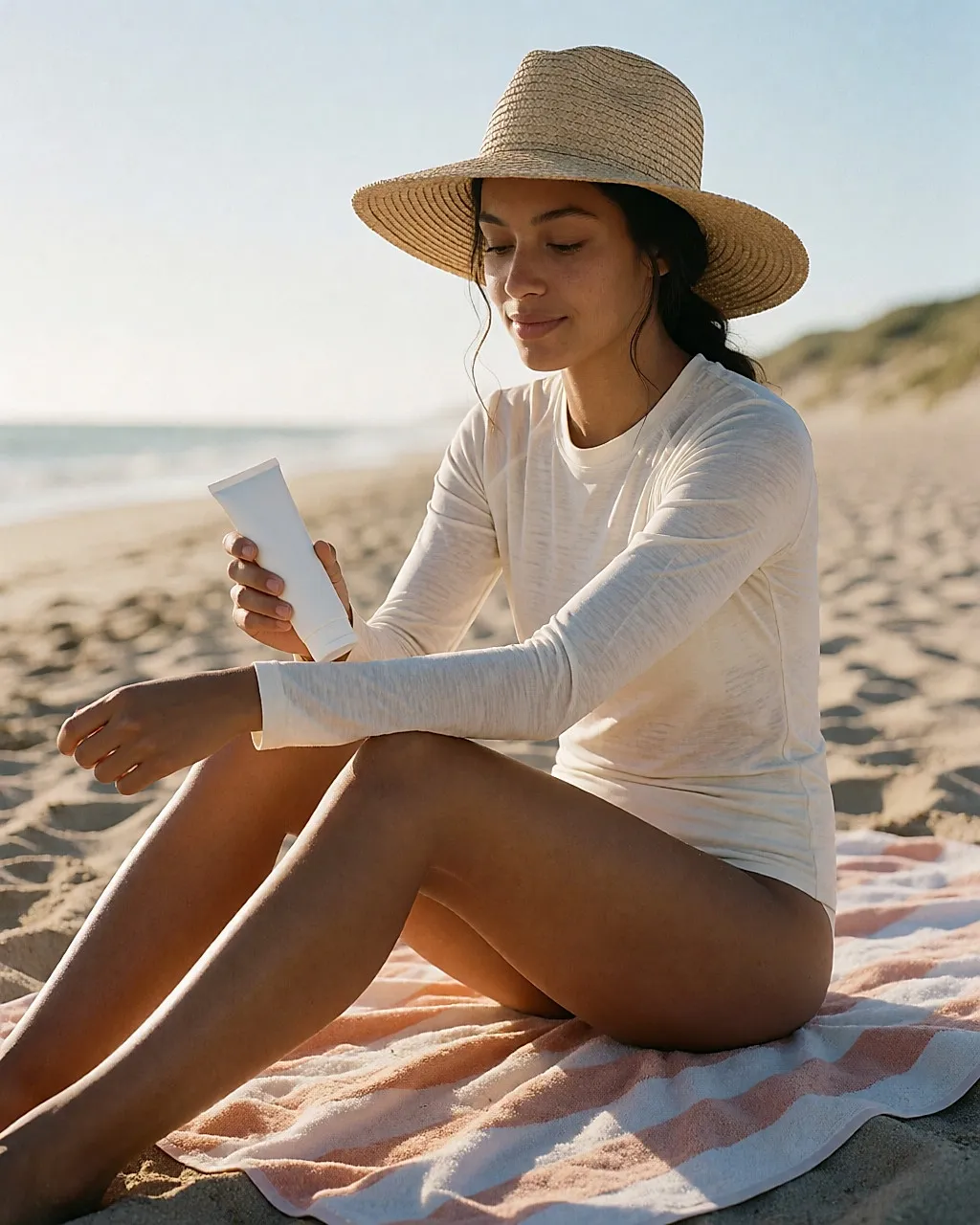
Last summer, my three-year-old daughter ended the day with red shoulders. She was wearing a T-shirt, too. Except it was soaked — and wet cotton loses much of its ability to filter UV. That was the day I realised the UV-protective top needed to live in the beach bag, next to the armbands, not at the back of the cupboard.
Not that it means spending the summer under a parasol. Tanning is lovely, and nobody wants to turn the beach into a waiting room. But a few markers are worth setting down before you unroll the towel.
A tan draws down your sun capital
Every exposure leaves a mark on what is known as your sun capital. Sunburn, especially before the age of 15, increases the risk of melanoma later in life. The International Agency for Research on Cancer (IARC) classifies UV radiation — from the sun and sunbeds — as a known human carcinogen, and melanoma incidence continues to rise in the UK. Not a reason to panic, but a reason to protect yourself properly.
In the mirror, sun exposure is also one of the main culprits behind pigmentation marks, deeper wrinkles and skin that loses elasticity. A three-week tan, and skin texture that never quite bounces back. That golden glow is paid for later — never at the moment you enjoy it.

Your phototype sets your margin for manoeuvre
Skin, hair, eyes, reaction to first sun: with three questions, you can place your phototype on the scale from I to VI. Very fair skin, blonde or red hair: your margin is slim — SPF 50 and shade between 11am and 3pm, when the UV index rises. Fair to olive skin: you can tan, but avoid long or repeated exposure. Brown and Black skin: less sunburn, but not zero risk — and lesions are often spotted later, so skin checks matter just as much.

The step that changes everything (and the ones that go with it)
- Shade, a hat, CE- or UKCA-marked sunglasses, category 3.
- UV-protective clothing certified UPF 50+, more reliable than cream on a child's back.
- On exposed skin: SPF 50, and don't skimp on the amount (5 ml for each area), reapplied every two hours and after every swim.
- Cloud and wind reduce how hot it feels, not the radiation: up to 80% of UV passes through a cloudy sky.
- Watch out for photosensitising ingredients — retinol, AHAs, some medicines and perfumes.

A mole that changes shape, colour or size, or that itches or bleeds, is not an appointment to put off. The ABCDE rule (Asymmetry, Border irregularity, Colour variation, Diameter greater than 6 mm, Evolving) helps you spot what should be seen by a dermatologist. With a family history of skin cancer, annual check-ups are the norm.
Vitamin D: sunshine is not a prescription
Yes, skin makes vitamin D when exposed to UVB. No, health agencies do not recommend sunbathing for this: a few minutes outside each day are enough for synthesis, and if you are deficient, supplementation is prescribed, not a tanning session. For children, this is a conversation with your GP or health visitor.

Budget
- SPF 50 mineral-filter sun cream, certified organic (Cosmos Organic or Ecocert): expect £13 to £22 for 100 ml from a pharmacy or beauty retailer. The label guarantees a proportion of organic ingredients and a set of standards for the rest of the formula — not superior efficacy. Texture-wise, expect a white cast sometimes, especially on olive or darker skin tones.
- Conventional family-size format in supermarkets: £7 to £13 for 200 ml. I haven't tested it, but the compromise is in the formulation, not the stated SPF.
- After-sun with organic aloe vera: £7 to £15 for 200 ml.
- UV-protective top UPF 50+: £9 to £22 for a child, £17 to £35 for an adult.
- Category 3 sunglasses: £13 to £26 in supermarkets, £52 to £130 from an optician.
- Dermatologist consultation: free on the NHS with a GP referral; private consultations typically cost £150 to £250.
What changes the cost: the certification, the size and where you buy it. On packaging and disposal, cardboard tubes and refillable bottles are still rare in sun care — something to look at when buying, not a claim to take at face value. The real lever remains quantity: a decent cream applied generously protects better than a premium product spread too thinly.
Sources
- NHS — sun safety and skin cancer prevention (nhs.uk)
- Cancer Research UK — melanoma and skin cancer statistics (cancerresearchuk.org)
- NHS — vitamin D and supplements (nhs.uk)
- International Agency for Research on Cancer (IARC) (iarc.who.int)
- Met Office — UV index (metoffice.gov.uk)
- UK Health Security Agency — UV and vitamin D advice (gov.uk)
Food supplements do not replace a varied, balanced diet and a healthy lifestyle.

Comments
Your opinion matters: rate the article, react and reply to comments.
Comments are moderated; AI-assisted comments are flagged. Text emoticons (8-), :-), <3…) are automatically shown as images.