
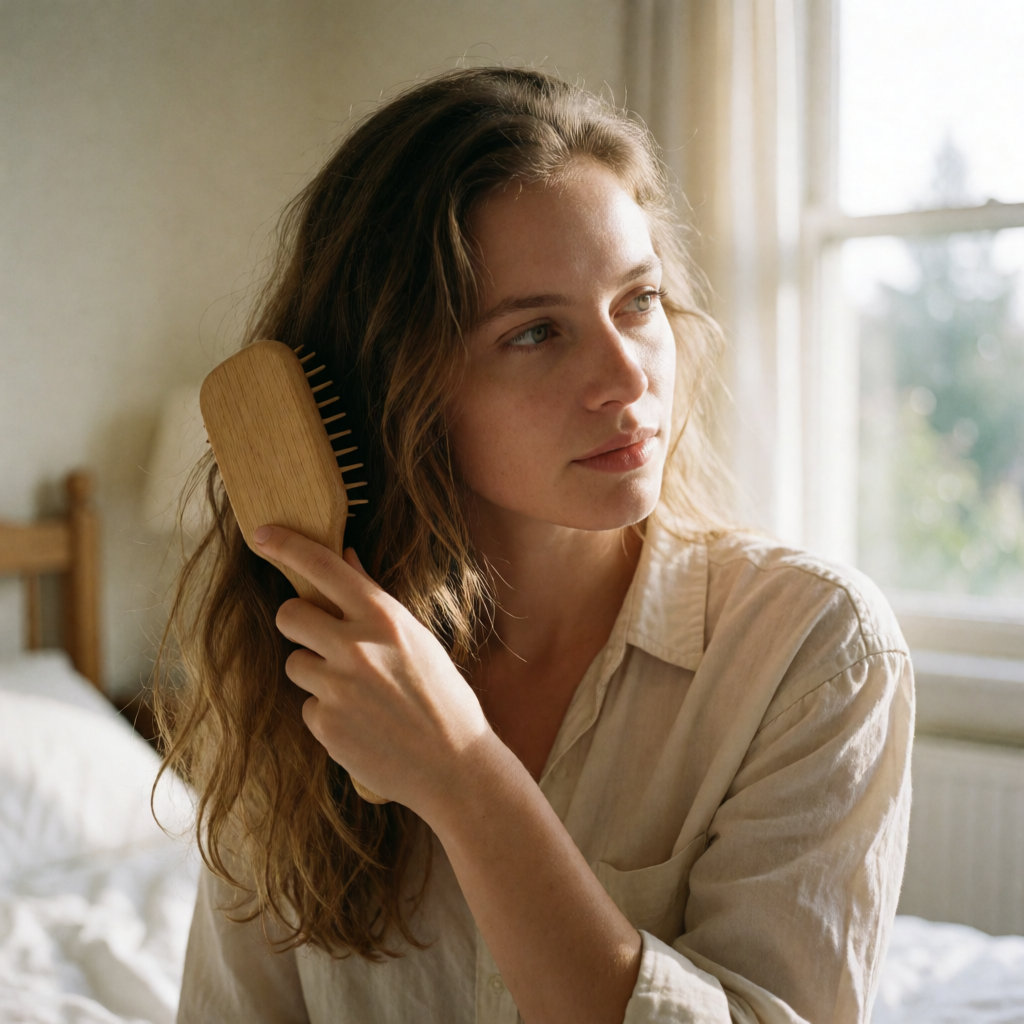
My seven-year-old daughter screams the moment I reach for the brush. To be fair, I'd rather asked for it: I was detangling dry hair, starting at the roots, on tangles to boot. Another way of saying I was yanking out everything in my path. So how do you get the knots out without leaving half her hair on the bathroom floor? It's an everyday gesture, yet it comes with rules.
What brushing actually does
First thing to get straight: hair isn't alive. It doesn't breathe, and no brush will feed it oxygen, whatever the advertising claims. What brushing does do is very concrete: it lifts out dust, product residue and hairs that have already come loose, then spreads the sebum made at the scalp down the full length of the hair. The payoff is shinier strands, with nothing applied.
The trick is not to overdo it. Brushing to excess causes damage: the cuticles rub against each other, lift, and the hair turns dull. The old myth of a hundred strokes before bed has had its day. A minute or two, morning and night, is more than enough. And if your hair is curly or coily, put the brush down: on dry hair you break the curl and tug at the roots.

The technique, step by step
It all starts in the shower. After your conditioner or hair mask, run a wide-tooth comb through from ends to roots, section by section. Thirty seconds that spare you a quarter of an hour of agony later on.
Then comes the everyday brush. Tip your head forward and brush from the nape towards the ends. On long, tangled hair, always start at the ends, then work upwards. Never the other way round.
Wet hair swells, which makes it more fragile. If you really must detangle it, use a wide-tooth comb with a leave-in conditioner, not a brush.
Which brush for which hair
I haven't tested the ten brushes on the market: what follows comes from dermatological guidance and my own daily use.
Avoid bare metal bristles, which scratch the scalp. A detangling brush with soft bristles does the job on fine hair; a flat brush with wooden bristles suits thicker hair better. The real test is comfort — if it tugs, it isn't the right brush.
As for materials, a wooden or bamboo handle lasts for years. If the wood carries the FSC label, that certifies managed forestry; it says nothing, though, about how the product ends its life. A wooden handle isn't necessarily compostable, because of the glue and the varnish: it usually ends up at the tip. And since a brush generally can't be refilled, the only real lever is to buy something solid once and look after it.
A dirty brush puts sebum, dust and residue straight back — exactly what you've just removed. Clear out the hair after every use, wash the bristles in warm soapy water once a month, and dry the brush head down. And don't share it: dandruff isn't contagious, but head lice pass very easily through brushes and combs, even though direct contact remains the main route.
Budget
- Detangling brush with soft bristles, supermarket: around £7 to £13.
- Wooden or bamboo handle, wooden bristles: £13 to £30.
- Boxwood comb: £13 to £35.
- Professional brand model, salon or department store: £22 to £43.
What moves the price: the material of the handle, the fineness of the bristles, the brand, where you buy. Online, prices often come down, but you can't test the feel — and with a brush, that's the only thing that counts.
Sources
- American Academy of Dermatology, hair care advice and habits to avoid (aad.org).
- dermato-info.fr, the French Society of Dermatology's public information site.




Comments
Your opinion matters: rate the article, react and reply to comments.
Comments are moderated; AI-assisted comments are flagged. Text emoticons (8-), :-), <3…) are automatically shown as images.