

The polo neck is back out of the wardrobe, and the décolletage has been handed its notice: nothing. We cleanse, we moisturise, we sweep the face cream up to the jaw — then stop dead, as if the skin had handed in its resignation at the neckline. Below that, no-man's land: the morning shower, a slightly scratchy scarf and a lot of good intentions. In November, that's the first place to feel tight.
The boundary sits lower than you think
There's a comfortable assumption that the face ends at the chin and the body begins at the neck. In practice, the dividing line is nearer the collarbones. Above it, skin that's thin, uncovered and often left in the sun without a second thought — and rarely made up, so rarely protected. Below it, skin that's thicker, more often covered, and puts up with far richer textures without complaint.

Hence the dosage deal: face cream in a thin layer down to the collarbones, then a richer body cream picking up below. Not two products designed for two worlds — just two textures handing over where the skin's demands change. Sounds too simple? Good ideas usually are.
The movement that carries on to the collarbones
In practice, use whatever is already going on your face. A pea-sized amount, maybe half a pump more if you're carrying on down to the bust. Warm it between your palms — thirty seconds, the length of a sigh — then smooth from the chin downwards, remembering the sides of the neck and the nape, which nobody ever sees and which goes red under wool.
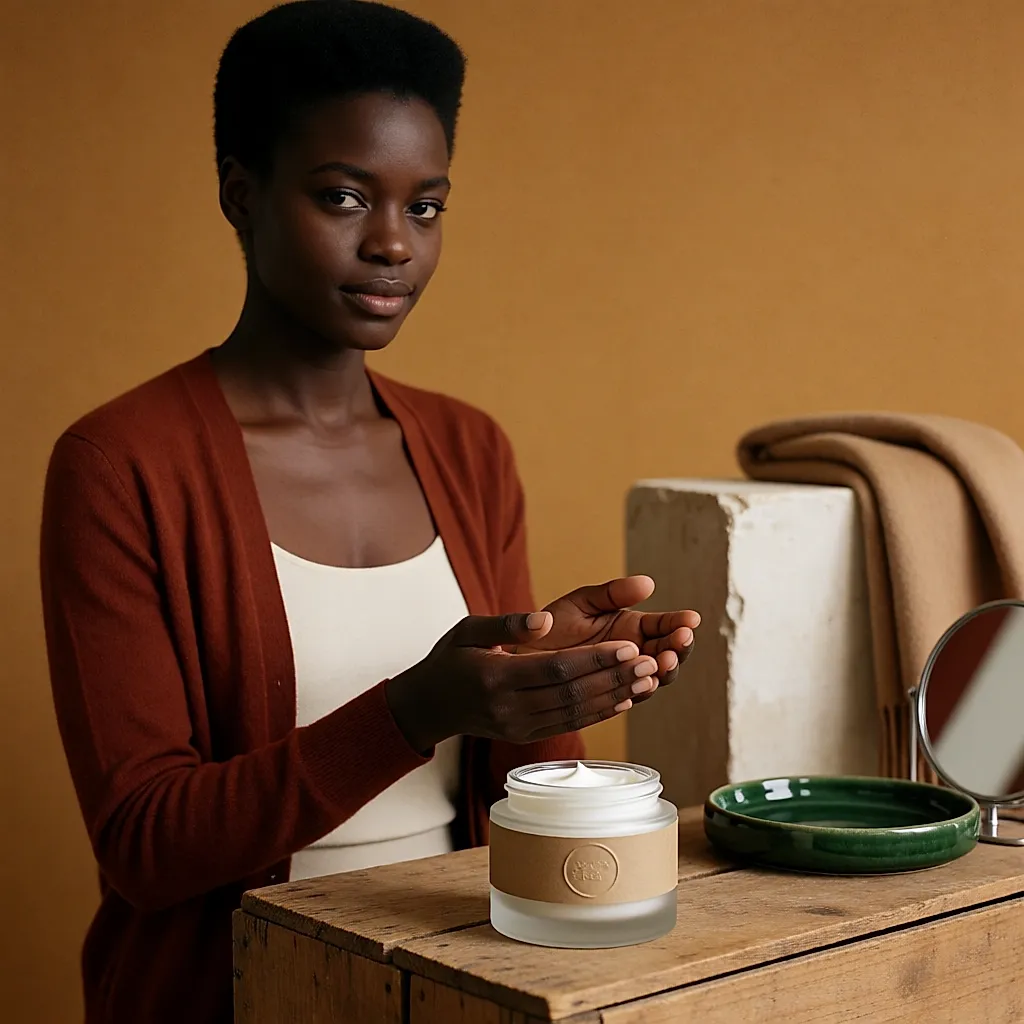
Which direction? Keep it simple and gentle: I'm not going to sell you a drainage story for three strokes of the hand. Quantity and consistency are what count, not choreography. And if your cream is thick, pat it in rather than rubbing — it sinks in better, and your shirt collar will thank you.
Below the collarbones, you change jars
Down there, richness is an ally again. A slightly richer body cream, a balm, an oil for winter: on the bust, upper arms and back, these textures deliver comfort without leaving a visible film on a décolletage you actually show. On the neck, the same texture marks the polo neck and shines under office lighting — which is exactly why it's worth not going above the collarbones.
And while we're here: the top of the back and the back of the shoulders are the great forgotten zones. Nobody sees them in the bathroom mirror; everybody sees them in a backless dress in December. Two extra minutes, once a week, and the subject never comes up again.
Would a fourth jar really change anything?
"Neck and décolleté" creams exist, and some are genuinely lovely. Their advantage is mostly texture: finer than a body cream, richer than a face fluid. But if you already struggle to finish the three open jars in your cupboard — and let's be honest, we all have a half-empty specimen from last winter — adding a fourth is collecting, not skincare.
The reverse is true too: if your face cream is a very light gel that isn't enough on a neck battered by the cold, a dedicated product may be worth it. I don't have a study to pull out that settles it either way; it comes down to season, comfort and what your skin tolerates. The right test is yours: does it feel tight? Does it feel sticky? Do you actually want to go back to it tonight?
Budget
On price, no need to bring out the big guns. Expect to pay around £15 for a comfortable body cream from a chemist, pharmacy or supermarket — £8 to £25 depending on size and range. For the face, £12 to £40 buys a classic nourishing cream from a pharmacy or online; dedicated neck and décolletage creams climb more readily towards £30 to £80 in the beauty halls.
What really moves the bill: size (a 200ml tub is nearly always better value per ml than a 50ml jar), the retailer and the packaging. A refillable glass jar, a solid format or a cardboard bottle can cost a little more the first time, but saves you a collection of plastic. On labels, COSMOS Organic and COSMOS Natural guarantee a proportion of naturally derived ingredients and a defined set of standards — not a free pass, just a starting point for reading the label.
The white collar test: if your cream leaves a mark on your lightest shirt, it's too rich for the neck. Keep it for the body and go back to your face cream above the collarbones.
The one step that survives a five-minute morning
If you take one thing away: face cream doesn't stop at the chin — it goes down to the collarbones in a thin layer, and body cream takes over from there. No purchase required, no ten-step ritual, just a boundary moved ten centimetres. Tonight, after you cleanse, take the movement two knuckles further down and look at your polo neck differently.


Comments
Your opinion matters: rate the article, react and reply to comments.
Comments are moderated; AI-assisted comments are flagged. Text emoticons (8-), :-), <3…) are automatically shown as images.