
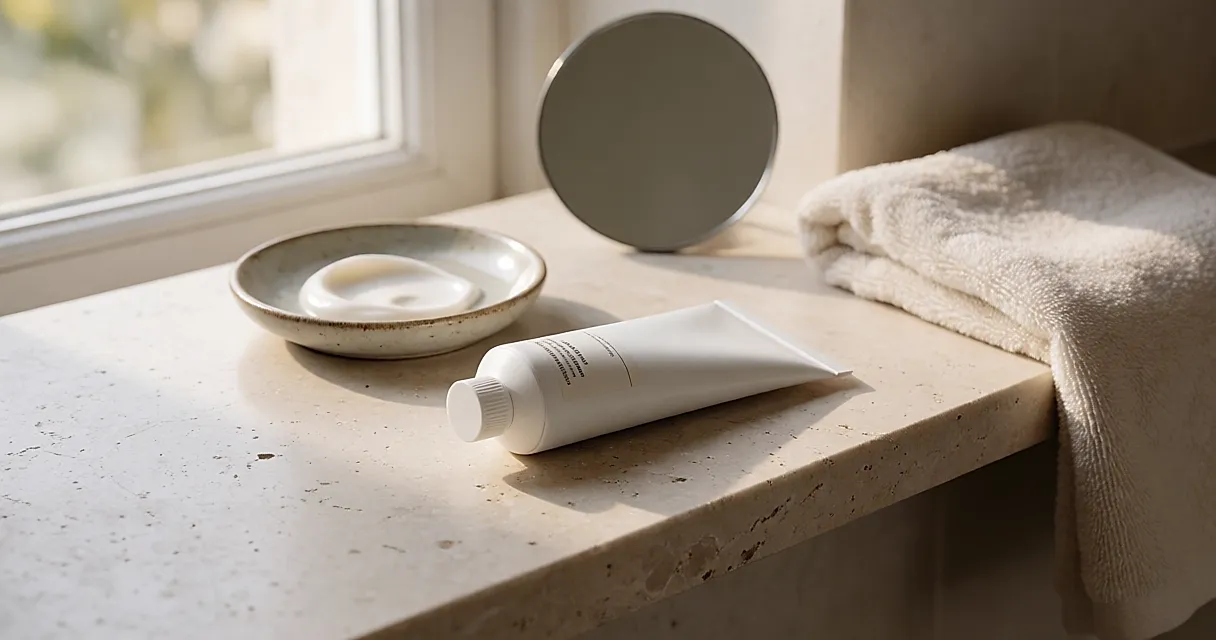
An oestriol cream that promises to act on skin thickness: that is the kind of claim served up with every change of season, between serums and masks. Except the cream in question is not used like ordinary skincare. Oestriol, a weak oestrogen, is considered for topical use within a medical setting. What it does—and what it will never replace—deserves a closer look.
Two areas, two levels of evidence
The area we know best is not the face. Local oestrogens are studied for the vaginal lining; even so, that cannot be turned into a promise of benefit for facial skin. This is a matter for medical advice, not a hasty conclusion.

Facial skin is a different category. Skin has oestrogen receptors, and the idea of a local effect on thinning and dryness is not absurd. But the data specific to an oestriol face cream are limited. In practice, remember this: a local effect is plausible, but the evidence base for an oestriol face cream—especially over the long term—is limited.
What it does not replace
First, it does not replace skincare. A gentle cleanser, a moisturiser, sun protection: that is the base, chosen over the counter and kept up every day. For sun-related skin ageing, daily photoprotection remains the measure with the best-established benefits. No hormonal cream stands in for it.
Nor does it replace treatment: for rosacea, eczema, or menopause symptoms such as hot flushes and broken sleep. Those are managed elsewhere, and sometimes differently. Finally, it does not replace time. This kind of treatment is not usually judged over a few days. And if nothing has changed by the deadline you agreed with your GP, that is information in itself—not a reason to pile on more product.
Why it should not be used lightly
Its use belongs within medical care, and it is not something to start on a whim. It is better not to treat it like an ordinary moisturiser—and that is exactly as it should be.
The benefits and risks have to be weighed, too. Some situations—a personal history of hormone-dependent cancer, unexplained bleeding, pregnancy or breastfeeding, among others—call for medical advice, not a midnight internet search. And there is an uncertainty to acknowledge: on thin skin, over a large area and for years, the actual systemic absorption of an oestriol cream is poorly documented. That is exactly the sort of question a doctor asks out loud, and an article cannot settle.
Ask before you say yes: what is the precise goal (dryness, thinning, discomfort)? How long should you give it before judging? Which signs mean you should stop? And what is the alternative if oestriol is not indicated—because alternatives exist, starting with emollients and rigorous sun protection.
The everyday habits that do the real work
The first is hardly dramatic: gentle, soap-free cleansing with lukewarm water. Mature skin tolerates aggressive stripping and five-step routines badly—a fact skin tends to point out quickly, usually on a Monday morning. Next comes a rich cream with glycerine, ceramides or shea butter, applied to slightly damp skin to hold in water. Then sun protection every morning, winter included: it is what protects what oestriol does not repair.

When it comes to formulation, look for short ingredient lists, clear labelling and packaging that won’t be in the bin within three weeks: refills, glass or cardboard. One honest caveat, though: with sunscreen, the best product is still the one you actually wear, and the most pleasant textures are sometimes the conventional ones. That is a compromise you can accept—provided you know you are making it.
Budget
The figures below are indicative UK price references, not quotes. A first private dermatology or gynaecology consultation usually costs roughly £150 to £300, with follow-ups often around £75 to £150, depending on clinician and location; an NHS GP appointment remains free at the point of use. If an oestriol product is prescribed, costs depend on whether it is private or NHS: in England a prescription charge may apply unless you are exempt, and arrangements differ elsewhere in the UK, so check costs and exemptions case by case. Privately, a prescribed oestriol product often costs around £20 to £50, depending on formulation and pharmacy. Supporting products—a gentle cleanser, a rich moisturiser and sun protection—are widely available from pharmacies, beauty retailers, supermarkets or online; as a rough guide, expect around £8 to £30 for a cleanser, £10 to £40 for a moisturiser and £8 to £25 for sunscreen, with prices varying by brand, size and outlet.
The takeaway: an oestriol cream is not something to improvise, and it is no transformation. What it does not replace: a diagnosis, follow-up, and the daily habits that remain within your reach.

Comments
Your opinion matters: rate the article, react and reply to comments.
Comments are moderated; AI-assisted comments are flagged. Text emoticons (8-), :-), <3…) are automatically shown as images.