
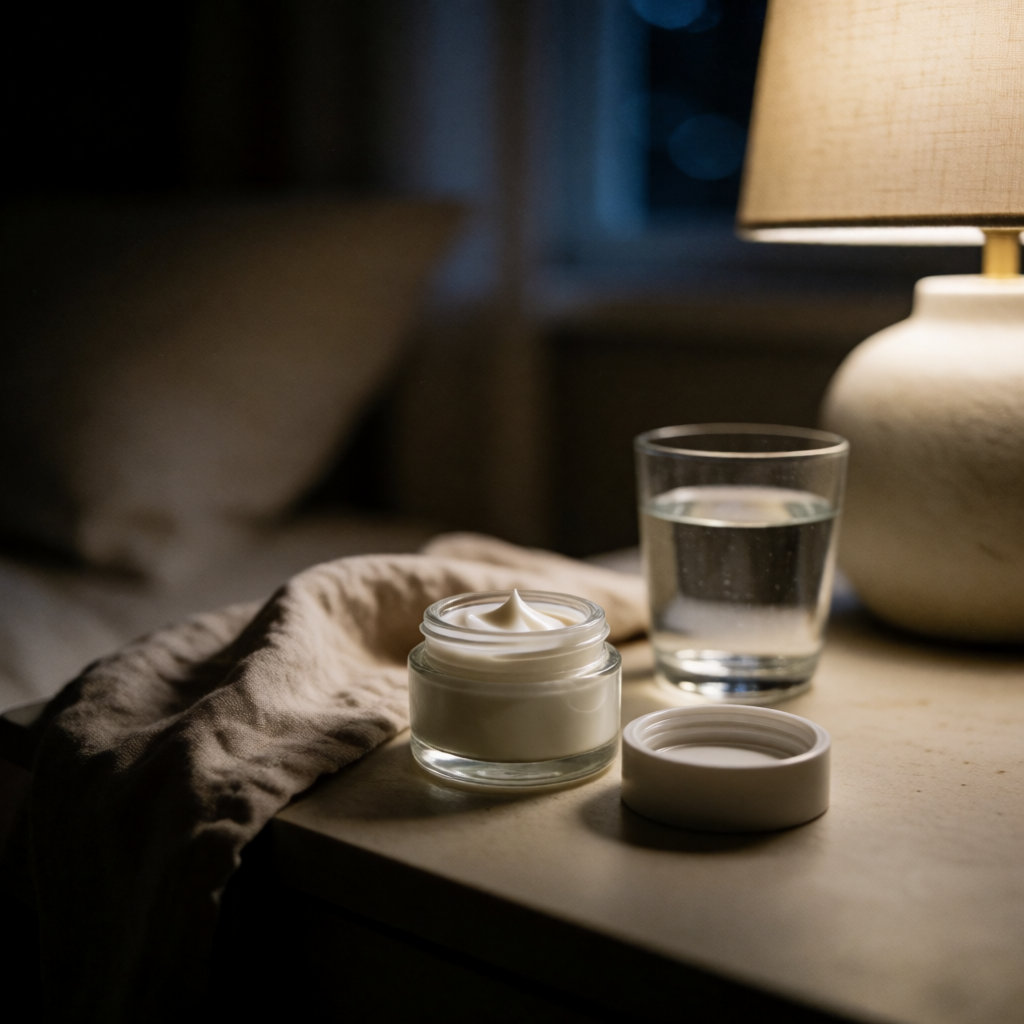
A Tuesday evening, 11pm, the exact moment when you have spent twenty minutes putting off taking your make-up off. A reader wrote to me one evening in that frame of mind, a little irritated: she had read that you should 'let your skin breathe' at night, except that without cream at bedtime she woke up with a tight face. So who is right — those who sleep bare-skinned, or those who never fall asleep without their jar? In truth, both. And the answer is not in the jar, but in what your skin tells you when you wake up.
At night, your skin is working (but it is losing water)
You read everywhere that skin 'rests' at night. That is false, or rather the opposite: during sleep, its temperature rises, blood circulation increases, and transepidermal water loss — the water that evaporates without you noticing — climbs above its daytime level. As a result, your skin barrier becomes slightly less sealed between midnight and 4am. Sebum, though, does not follow this rhythm at all: it is produced at its highest around the middle of the day, not at 2am.

Add the skin's internal clock. Research on the skin's circadian rhythm places the peak of epidermal cell proliferation in the late afternoon and early night. Hence the seductive idea of a cream 'that works while you sleep'! In principle, that is true. Does it make night-time skincare compulsory? No.
Two schools of thought, and neither is completely wrong
On one side, devotees of the evening ritual: because skin is more permeable in the evening, a rich texture would have more time to sink in. On the other, fans of bare skin: between moisturiser, serum, sunscreen and make-up, the day already does a lot, so why add another layer?
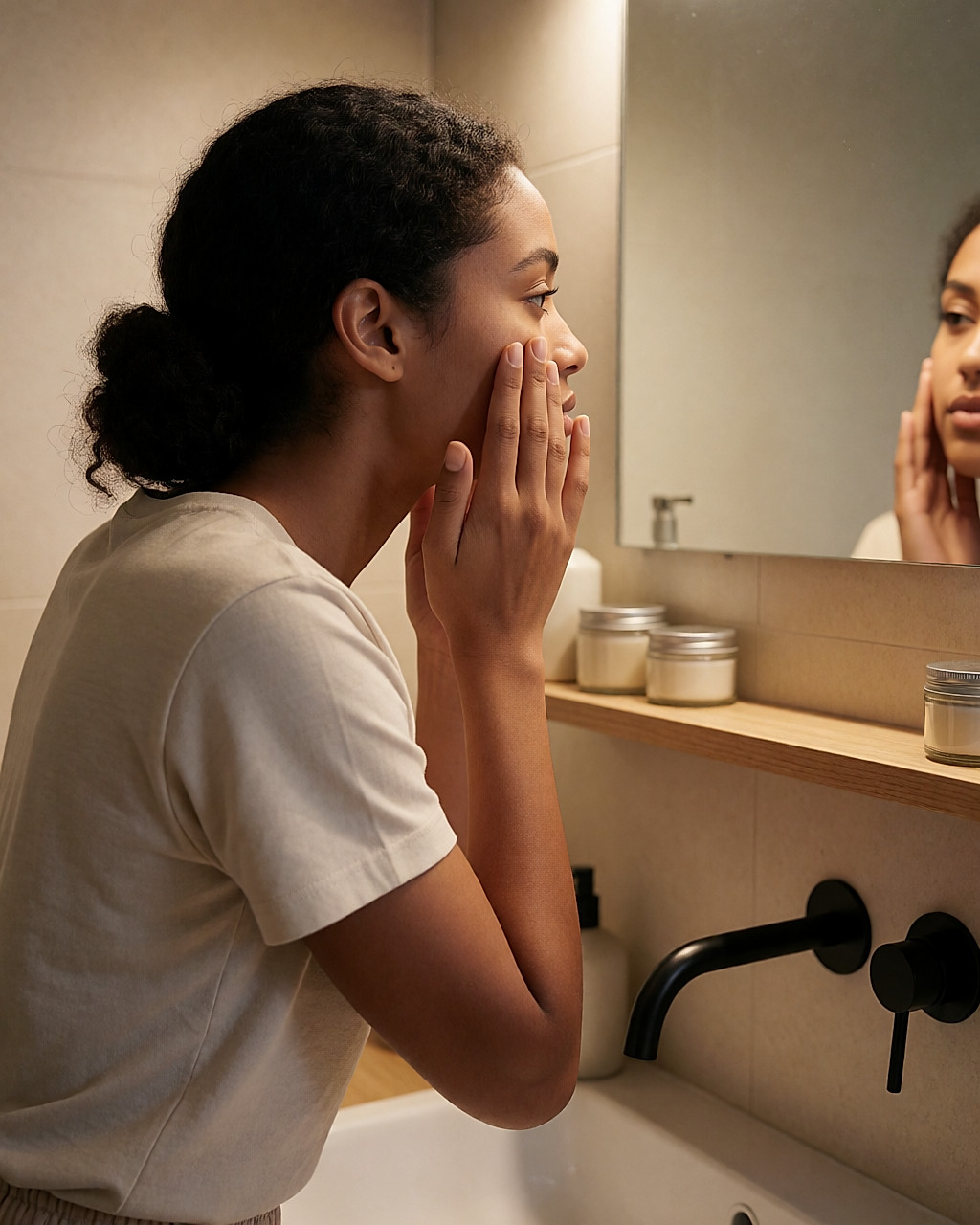
Cross-checking dermatological recommendations, the verdict fits into one sentence: it depends on your skin, and above all on how comfortable it feels when you wake up. Skin that feels tight, flakes or reddens needs oil and water at night. Oily, comfortable skin can quite happily sleep bare.
Why some actives are applied at night
There is, however, one case where evening use is not a choice but a necessity: retinoids. Retinol and tretinoin are sensitive to light and sun, which is why these actives are generally reserved for the evening, with sunscreen the next morning — as general information, not as instructions for use. Tretinoin is a prescription-only medicine, to be used under dermatological supervision. Exfoliating acids are a different story: increased UV reactivity is mainly documented for AHAs (glycolic, lactic…), and does not necessarily apply to BHAs (salicylic acid), generally considered non-photosensitising. In all cases, sunscreen is still recommended. Here, it is not the night-time product that is essential, but the time at which you apply it.

The three-morning test. For three evenings, sleep with nothing on your skin after cleansing. On waking, observe: tightness, fine flaking, redness? Your barrier needs an occlusive product at night. Skin supple and comfortable? You can stay bare-skinned. One morning is not enough to decide: stress, hormones, heating, hard water and diet can move your skin's needs within a few days.
Your skin, your routine
For dry skin, a nourishing night cream — richer in emollients than a day cream — helps limit morning tightness. Keep it for the evening, precisely because it leaves a shiny film.
For **combination skin**, the trap is a product that is too rich and suffocates the forehead-nose-chin zone without necessarily drying out the cheeks. Use a light fluid all over, and an extra layer on any areas that feel tight, if needed.
For oily skin, there is no need to overload: a light serum, or even nothing at all. The sebum your skin produces naturally already protects it. A non-comedogenic, mattifying day cream remains useful, however.
The step that changes everything: cleansing
Evening cleansing, though, is non-negotiable — even if you apply no skincare afterwards. Pollution, sebum, sunscreen and make-up all remain on the skin and block pores. A gentle make-up remover, then a soap-free cleanser, without rubbing, without denatured alcohol that leaves skin tight. An alcohol-free toner can finish the job. And if you do only one thing tonight, do that.
On the packaging front, the natural options are quite clever: plant-based cleansing oil, solid cleansing bar, refillable glass bottle. Solid formats avoid plastic bottles, refills limit packaging — provided you check the ingredients, because a poorly formulated product labelled 'natural' can also irritate.
Budget: what a night cream costs
In the UK, in supermarkets and pharmacies, expect to pay around £7 to £18 for a simple night cream. In beauty halls and dermatological skincare ranges, the range usually rises from £22 to £55, and above £70 at luxury brands. A retinol serum often sits between £18 and £40. What makes the price vary: the concentration of actives (retinol, niacinamide, ceramides), the format of the container, whether a refill exists, and the distribution channel — supermarket, beauty hall, pharmacy or online.
Note: I do not test every product mentioned here. These are ballpark figures gathered in stores and online. The right instinct is to look at the container: a refillable jar or glass bottle creates less waste to throw away than a single-use plastic pot. On labels, the COSMOS standard (COSMOS ORGANIC / COSMOS NATURAL), used by certifiers including Ecocert and Cosmébio, sets rules for the share of naturally and organically sourced ingredients. Be careful, though: 'natural' does not mean 'risk-free'. Essential oils, for example, can sensitise reactive skin. And with retinoids, the choice comes down mainly to concentration and tolerance: this is a case where a well-dosed conventional formula can remain the best compromise, even if you favour refillable packaging.
Sources
- French Society of Dermatology — public information sheets on skin, retinoids and sun protection
- M. S. Matsui et al., 'Biological Rhythms in the Skin', International Journal of Molecular Sciences, 2016
- Vidal — tretinoin (cutaneous use) monograph, mentions of photosensitivity and sun protection
- EU Cosmetics Regulation (EC) No 1223/2009 and Regulation (EU) No 655/2013 on claims — EUR-Lex


Comments
Your opinion matters: rate the article, react and reply to comments.
Comments are moderated; AI-assisted comments are flagged. Text emoticons (8-), :-), <3…) are automatically shown as images.