
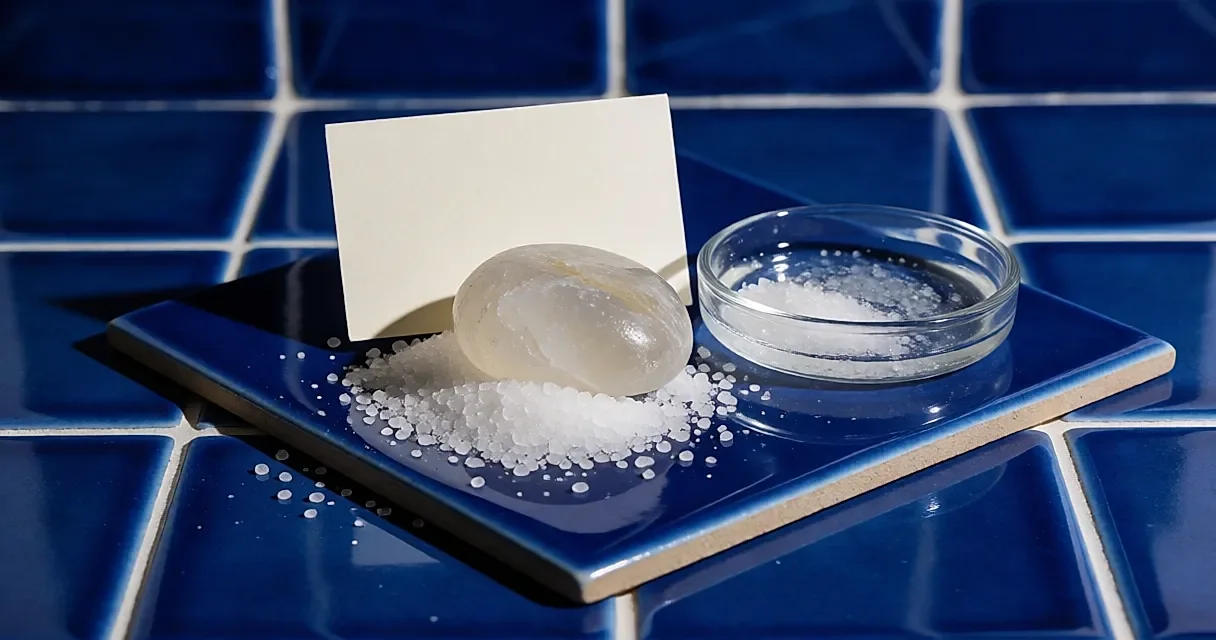
An alum stone fits in the palm of your hand, often costs under £10 and promises peace in the underarm department. On the cardboard sleeve, in tiny letters: 'no aluminium salts'. Two lines further down, in the ingredients list: 'Potassium Alum'. Two statements, one truth: it is an aluminium salt, and the label says so without quite saying it.
Nothing here is a shadowy conspiracy, though. It is just that the language of the beauty aisle and the language of chemistry do not speak the same tongue. And when the two meet on a supermarket shelf, chemistry rarely wins.
Alum belongs to the aluminium family
The word 'alum' refers to a family of salts: a double sulphate of aluminium and potassium, or of aluminium and ammonium. In both cases, aluminium is part of the formula. On the label, it hides behind Potassium Alum or Ammonium Alum: two names that do not contain the word 'aluminium', and that the eye skips over when it scans the INCI list diagonally between two glances at your phone.
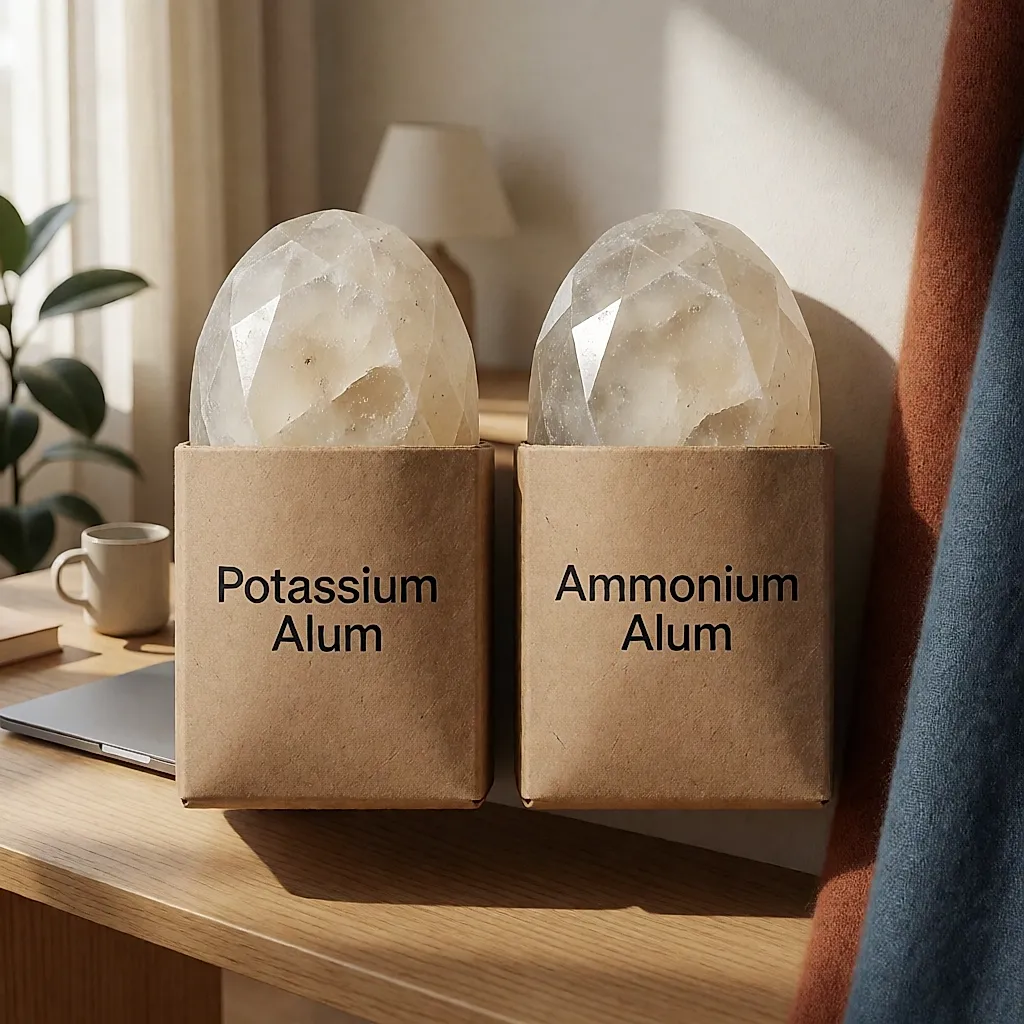
That is where most of the confusion comes from, along with a rather fuzzy phrase: 'free from aluminium salts'. On the shelves, in practice, that phrase is aimed at antiperspirant actives — aluminium chlorohydrate, aluminium and zirconium salts — the kind found in classic sticks and roll-ons. Alum stone, however, is sold as a deodorant: it deals with odour more than with sweat itself. Two uses, two families of molecules, one broader chemical family. Which is why the packaging ends up contradicting itself.
What it actually does under your arm
Let's be clear about what it does: the stone is not an antiperspirant. If you sweat a lot, in a glass-walled meeting room or on a packed train at the end of the day, it will not stop you feeling the heat rise. It helps out, it limits odour, it costs next to nothing — but it does not work wonders, even if a few rather lyrical product pages suggest otherwise. Is it really worth it? Yes, if you are after a gentle, long-lasting deodorant rather than anti-sweat armour.
Using it takes a little discipline. Apply the stone to clean, damp skin: in practice, wet it, glide it over your underarms and let it dry before getting dressed — otherwise, hello white marks on a black T-shirt. Some people find it stings on freshly shaved skin; others have sworn by it for years. No one can give you a reliable figure for how well it performs next to a standard antiperspirant: results vary too much between skin types, seasons and sweat levels.
How to spot the contradiction in ten seconds
The claim on the front is contradicted by the list underneath, and that is exactly what makes reading it so instructive. The carton tells the story the brand wants to tell; the INCI list works like this: as a general rule, ingredients are listed in descending order of concentration; those present at less than 1% can appear in any order. That is where the two names sit: in water-based formulas, Potassium Alum appears among the first ingredients; in a solid stone, it may be the only ingredient.
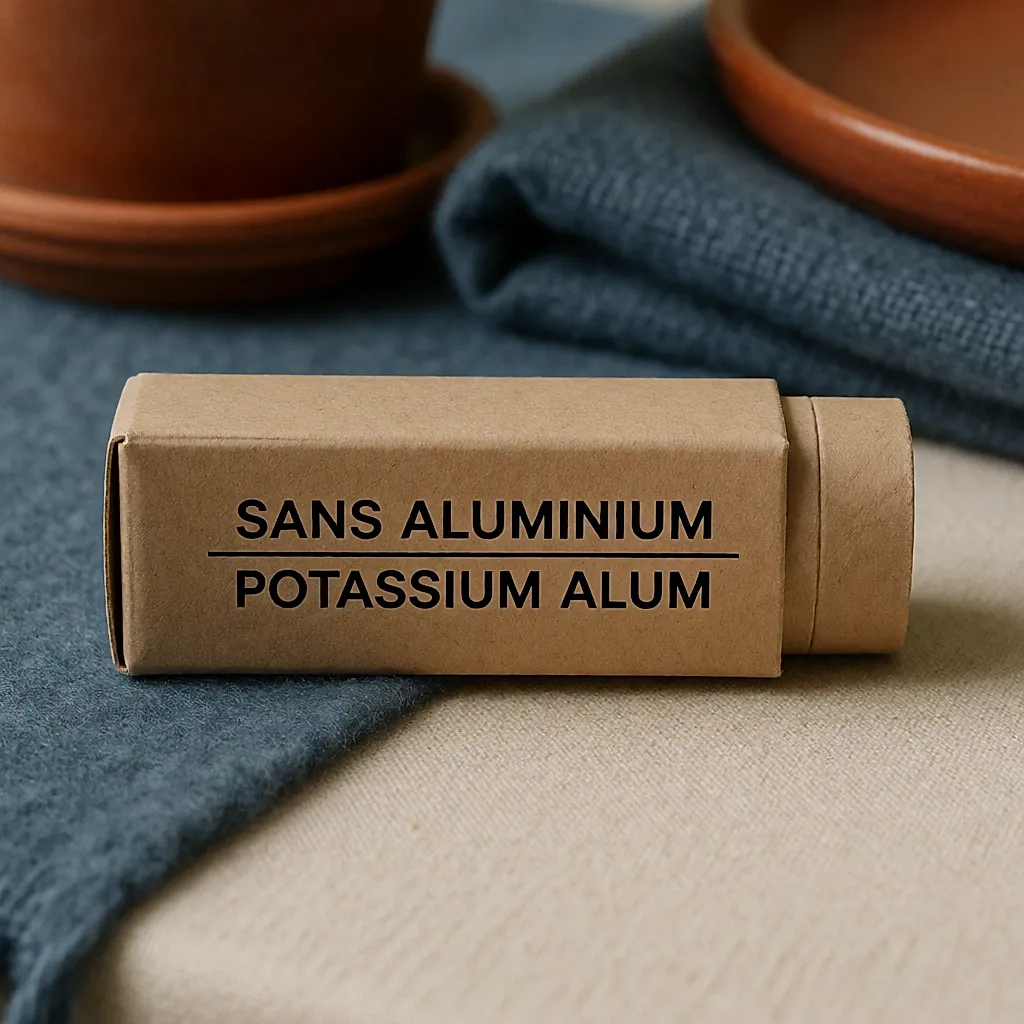
Three checks are all it takes, and none of them requires a degree. First, check whether the product is labelled 'deodorant' or 'antiperspirant' — they do not do the same job. Then look for the two alum names in the list, knowing that 'natural' or 'mineral' does not mean 'aluminium-free': a crystal is still a chemical salt even when it is natural. Finally, if the box carries an organic certification, remember that it certifies a way of formulating and manufacturing, not the absence of a specific ingredient — only the ingredients list tells you for sure. A bit tedious? Five extra seconds, and you know exactly what you are buying.
Budget
When it comes to price, an alum stone remains one of the cheapest deodorants on the market: expect to pay around £3–£10 in a supermarket or health food shop for a standard size, and more like £8–£20 in a pharmacy or specialist shop for larger or engraved stones. A solid natural stick sits between £8 and £20, while a cream deodorant in a pot costs between £10 and £25. The stone has another advantage: it can last for months, wears down slowly and leaves no bottle behind.
Do watch out for drops, though. A stone that slips onto a tiled floor can crack, and your investment can end up in the bin. Keep it upright on a small stand or dish, and it should see you through the season without complaint.
Three checks before you buy
- Read the INCI list closely and look for Potassium Alum or Ammonium Alum.
- Check whether it says 'deodorant' (odour) or 'antiperspirant' (sweat): they are not the same product.
- Be wary of an 'aluminium-free' claim on a product whose base ingredient is an alum.
The real lesson is not that alum stone is a bad idea — it is a simple, economical deodorant that is honest about what it does. It is that a natural product is still a chemical product, with a formula, scientific names and promises that sometimes contradict each other on the same carton. So next time you run the stone under the tap, let it dry for an extra second and take a look at the box: you will know exactly what you are putting under your arms, which, in beauty, is a promise worth trusting.



Comments
Your opinion matters: rate the article, react and reply to comments.
Comments are moderated; AI-assisted comments are flagged. Text emoticons (8-), :-), <3…) are automatically shown as images.