

Foam doesn't remove make-up on its own. The thing that does the work is the surfactant: a molecule with two parts, one that loves water and one that loves oil, which lets your rinse carry away make-up and sebum. The rest — that froth spilling between your fingers — is pure theatre. Persuasive theatre, mind: admit it, you've turned your nose up at a cleanser because it didn't lather enough.
Foam is just the special effect
We learned cleanliness from shampoo and shower gel: it lathers, therefore it cleans. It's normal for the face to follow the same reflex. Except that on skin, foam adds nothing to the cleansing. A surfactant works by attaching to oily matter — sebum, foundation, mascara — to lift it and carry it away with water. Whether it foams a lot, a little or not at all tells you little about the job.
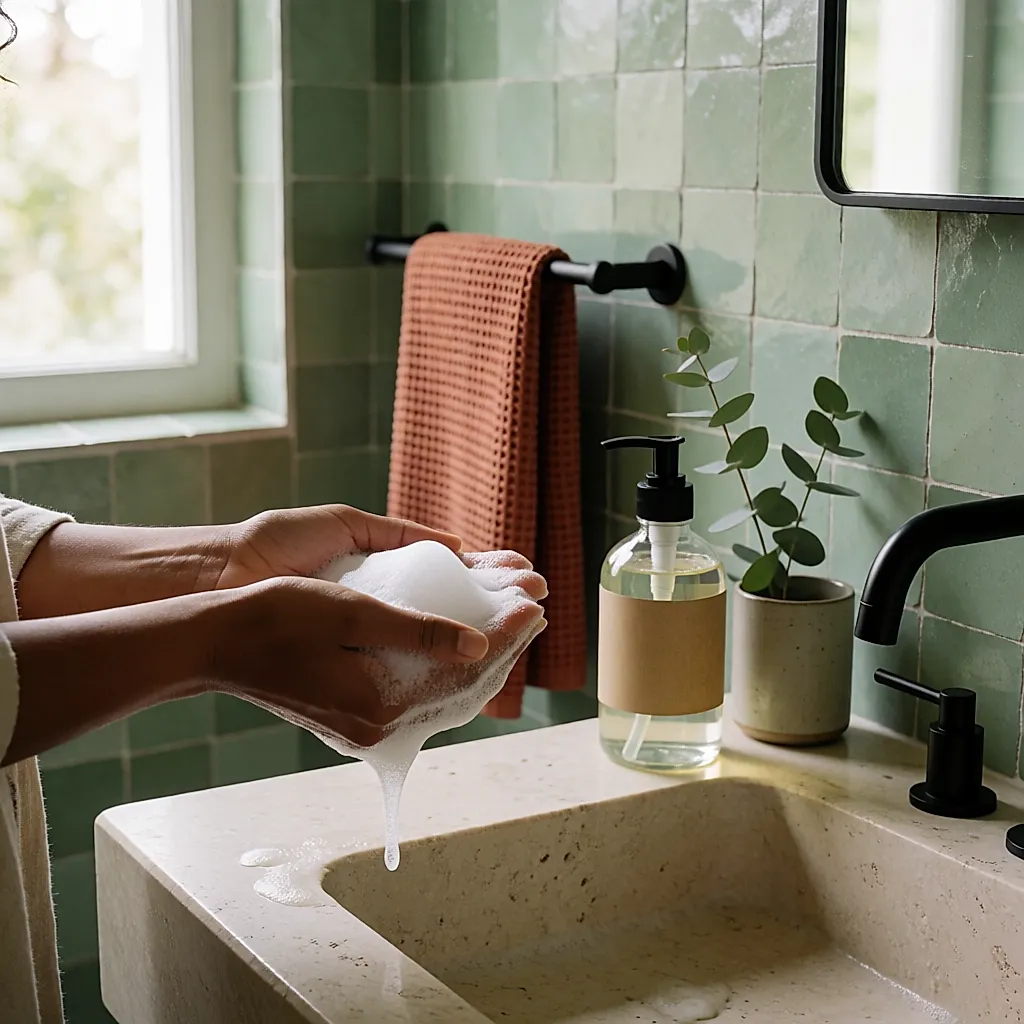
Why do some cleansers foam so much, then? Because foaming surfactants — often sulphates — are added, and people like lather. That's not a flaw in itself: some foaming cleansers are very well formulated. But the height of the lather tells you little about how much oil is removed. A gel that barely foams can remove stubborn foundation; a very foamy cleanser, on the other hand, can leave a film. It all comes down to the formula, not the show.
What really matters is time and temperature
The step that makes the difference isn't lathering, it's letting it sit. In real life, we tend to apply, rub quickly and rinse — whereas surfactants need a little time to lift oily matter. In practice, leave your cleanser on for a few seconds on dry skin (oil, balm) or slightly damp skin (gel, milk), long enough for make-up to loosen. No need to scrub as if you're scouring a saucepan.

Then there's temperature. Very hot water lifts oil faster, but it also lifts the hydrolipidic film that protects your skin — which is often why skin feels tight after a hot rinse. Aim for lukewarm water, and rinse thoroughly: a cleanser that isn't rinsed properly leaves a film that will make you think it hasn't worked. I can't give you a universal leave-on time: each formula has its own recommendations, and brands often keep quiet about it.
The low-foam cleansers that do the job
Cleansing oils, milks, balms, sulphate-free gels and cleansing bars: the low-foam family is wide, and each format has its own place. An oil or balm removes heavy make-up well, provided you emulsify it with a little water before rinsing — otherwise the oily residue stays on the skin. A milk suits dry or reactive skin; a sulphate-free gel suits combination skin that wants a fresh feeling without tightness.

When it comes to the formula, look for mild surfactants and a short ingredient list. Labels such as COSMOS or Soil Association can be a useful guide, but they don't guarantee a result on your skin. And if you want to cut down on bathroom clutter, look at solid cleansing bars — often waterless and wrapped in cardboard — or refillable glass bottles, provided the refill is genuinely available near you. Otherwise, the whole idea loses much of its point.
What to expect to pay
A low-foam cleanser is easy to find, and the price mostly depends on where you buy it and how concentrated it is. At a supermarket or pharmacy, expect to pay around £8 to £20 for a 200 ml milk or gentle gel. At health and beauty retailers and specialist organic online shops, the range often rises to more like £15 to £30, sometimes more for a cleansing oil. A solid bar often sits between £8 and £15 and can last longer than a bottle — a calculation that matters.
The most expensive isn't always the most effective: a simple, fragrance-free milk can do the job very well. Is it really worth paying more? Not necessarily. The extra cost often goes on texture and packaging (glass, refill, solid). It's up to you to decide what matters most.
The cotton-pad test: after rinsing, sweep a cotton pad soaked in floral water over your face. If it comes away clean, your cleanser — foaming or not — has done its job! If it comes away coloured, make-up is still there, and foam isn't to blame: it's the technique.
Ultimately, giving up foam means trusting what you can't see. You no longer feel the lather, you no longer hear the scrubbing — and yet the surfactant is getting on with the job. The real luxury is taking those few seconds to let it sit, with lukewarm water and a careful rinse. When you only have five minutes, the one step that still counts is this: let it do the work rather than scrubbing harder. And if your cleanser does foam, it's not a crime — just check it doesn't leave your skin tight.

Comments
Your opinion matters: rate the article, react and reply to comments.
Comments are moderated; AI-assisted comments are flagged. Text emoticons (8-), :-), <3…) are automatically shown as images.