
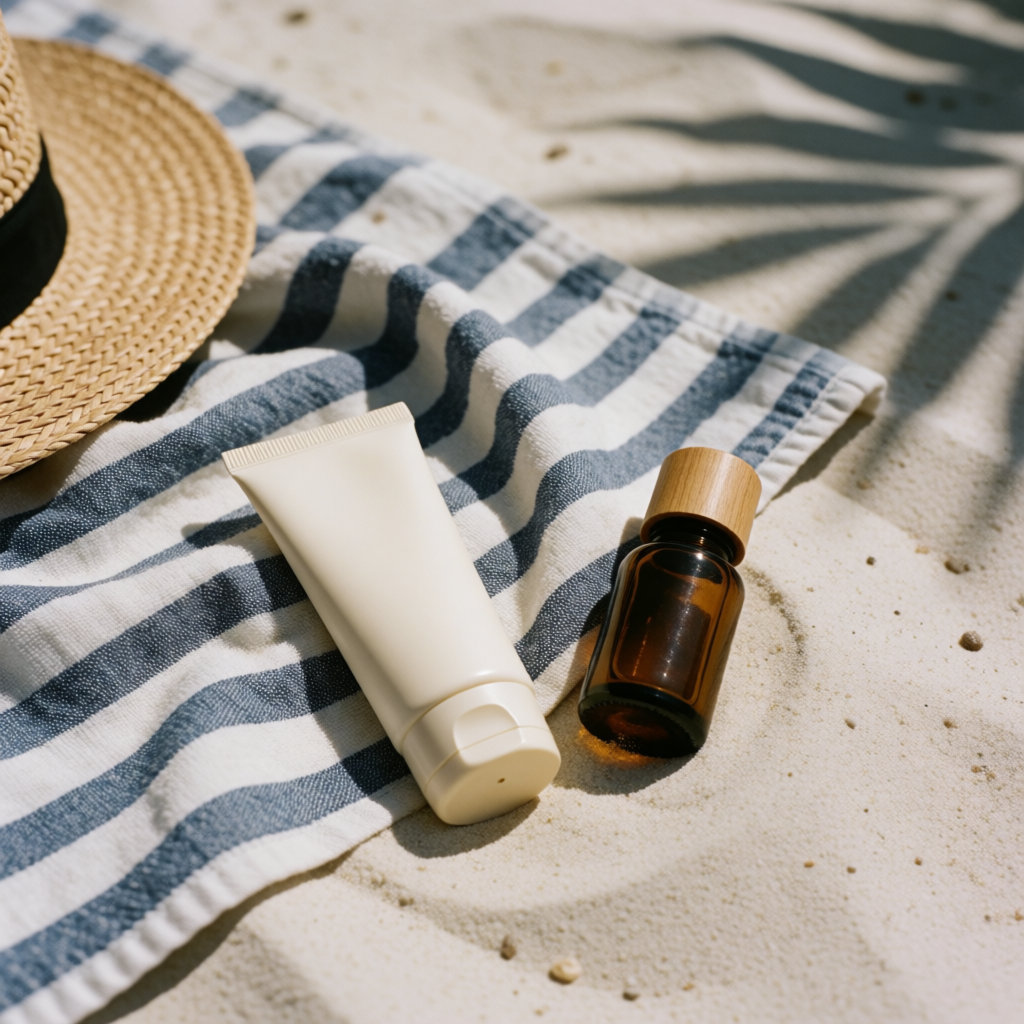
First day of the holiday, a dollop of sun cream slapped on your shoulders, and by the evening your skin is burning. You know the scene, admit it. The sun gives no warning: UV rays cannot be felt or seen, and that is the trap. So rather than promising you perfect protection — which does not exist — let us go back over the essentials, tube in hand, without any wonder-product promises.
SPF, UVA, UV index: decoding the label
SPF, or sun protection factor, mostly measures protection against UVB — the rays that burn. It says almost nothing about UVA, which ages the skin and contributes to skin cancer risk. Since 2006, a European recommendation has required UVA protection to be at least one third of the stated SPF: this is what the circled UVA logo on the tube indicates. And 50+ remains the maximum allowed, because no cream blocks 100% of rays — which is also why the term 'total screen' is banned.
Before you go out, check the UV index from the Met Office. From 3 upwards, protection is justified; at 8 and above, it is no longer optional. Good news: this takes ten seconds on your phone, and it is often worth more than yet another bottle bought in a hurry.
How your skin type changes things
It is your skin type that matters, not the tan you are hoping for. Very fair skin, blonde or red hair, freckles: SPF 50 or 50+, and shade during the hottest hours. Fair skin that tans slowly: SPF 30 to 50. Olive or brown skin: SPF 30 remains the prudent benchmark, because darker skin burns too, even if it is less obvious. Very low indices, around 9 or 15, are not enough for prolonged exposure.
Other risk factors come into play: a family history of melanoma, many moles, certain medicines that make skin photosensitive. In these cases, step up prevention and speak to a healthcare professional, who can also examine a mole that is changing. In practice, remember this: your skin type sets the trend, your actual exposure does the rest — there is no point aiming for a record tan and hoping the index will keep up.

The method matters more than the number
Quantity first: allow about 30 ml for the whole body, or 2 mg/cm², the dose on which SPF ratings are based. In practice, many people apply less than the recommended amount — and that is where the maths stops adding up. Next, the rhythm: reapply every two hours, and after every swim, every sweat, every towel-dry. Dry off before applying another layer: 'water-resistant' does not mean waterproof.
Cloud, haze and wind are no excuse to skip sun protection, and sand, water and snow reflect rays — people often think they are safe under a cloudy sky, and that is a classic mistake. A hat, sunglasses and covering clothing remain more reliable than any tube. For a baby, no direct exposure: shade, clothing, and advice from a healthcare professional.

Two hours, no longer. Apply generously at the start (about 30 ml for the whole body), then reapply every two hours, and always after swimming, sweating or towelling off. A high SPF protects better; it does not protect for longer.
Filters, labels, refills: sorting the promises
An organic product is not a better sun protector: a certified SPF 30 protects less than a conventional SPF 50+. In other words, the label does not make the SPF. A label such as COSMOS or Soil Association relates to the formulation — a minimum share of natural ingredients and organic plant ingredients — not to sun efficacy or to what happens to filters in water. On that last point, current data suggest a real but complex issue: documented effects mainly concern high local concentrations, and research is ongoing.
What is verifiable, however: a refillable container, a glass bottle or cardboard case, European manufacturing, mineral filters (zinc oxide, titanium dioxide) when your skin tolerates them. These criteria reduce packaging and transport; they do not remove the need to reapply. On efficacy, a conventional tube applied well is better than a pretty format poorly spread...

Budget
Expect to pay around £10 to £25 for a 50 ml facial sunscreen at SPF 50, and £13 to £25 for a 200 ml body or child's sun lotion, in a pharmacy or health and beauty retailer. In supermarkets, 200 ml tubes are more likely to be between £7 and £15. For organic brands, in health food shops or online, budget £13 to £25 for a 100 to 200 ml format, often more expensive per millilitre; a refill usually costs less than the full bottle. The price varies according to format, SPF, water resistance, type of filter, refillability and brand.
Top tip: a large bottle for the body, a small one for the face — easier to slip into your bag — and check the expiry date and the period after opening, often 12 months. A tube forgotten at the bottom of a bag since last summer has usually had its day.
Sources
- NHS, Sun safety
- Cancer Research UK, UV and skin cancer risk
- UK Health Security Agency, UV and sun protection
- European Commission, Recommendation 2006/647/EC on the efficacy of sunscreen products
- Met Office, UV index
- COSMOS, COSMOS standard



Comments
Your opinion matters: rate the article, react and reply to comments.
Comments are moderated; AI-assisted comments are flagged. Text emoticons (8-), :-), <3…) are automatically shown as images.