
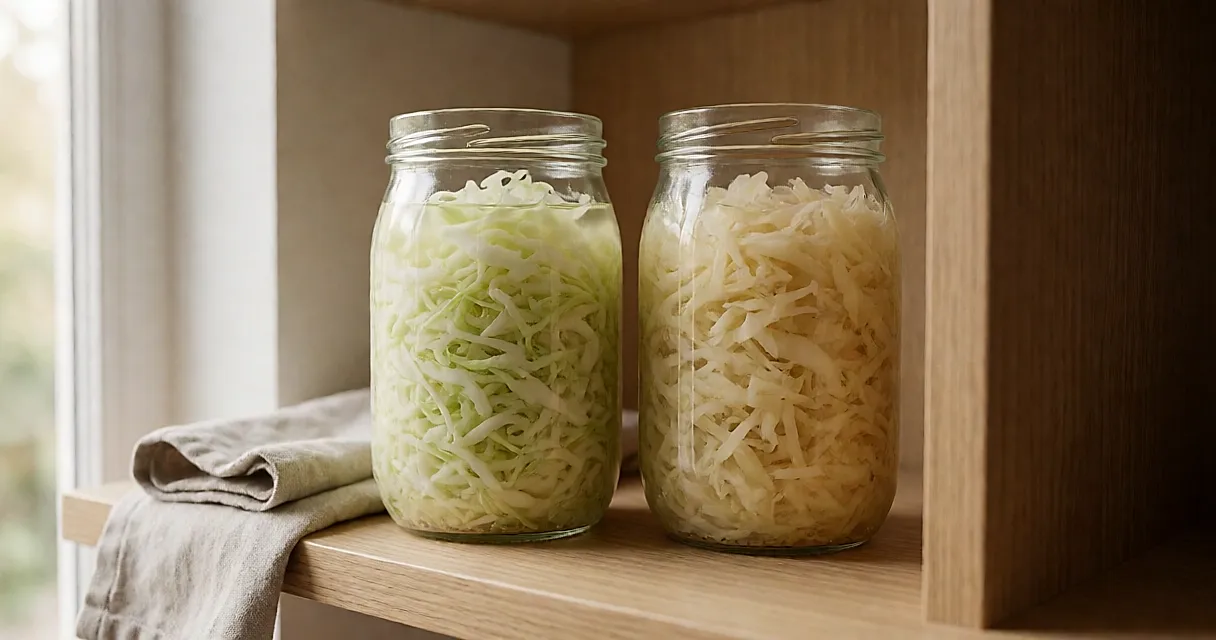
Unscrew the lid on a jar that fizzes, catch a smell that makes your nose tingle, bite into cabbage that still crunches: raw sauerkraut has character. Right beside it, on the same shelf, a second jar waits, silent and obedient, ready to sit quietly in a cupboard for months. Same name on the label, same vegetable to begin with. The difference often comes down to one small word: 'raw'.
What salt sets off
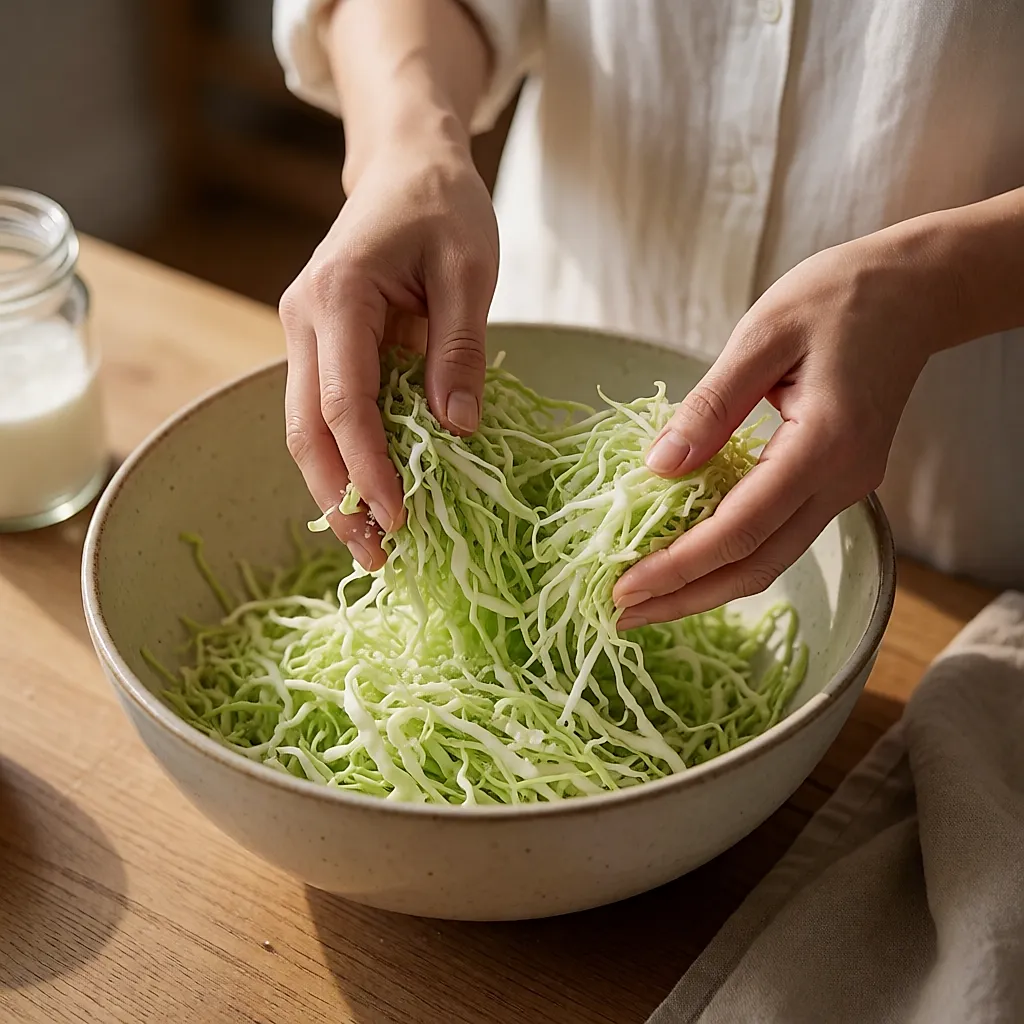
It begins with water. The cabbage is shredded and massaged with salt, and the salt draws water out of the leaves: the brine forms by itself. In that salty bath, lactic acid bacteria naturally present on the leaves turn the cabbage's sugars into lactic acid. This is lactic fermentation, the same principle at work in Korean kimchi or salt-brined pickles. In practice, a good rule of thumb is to keep the brine at about 1.5–2% salt: enough to slow down unwanted microbes, not enough to stop the good bacteria.
The result shows on the plate: acidity rises, the sauerkraut becomes distinctly sour, with very little sweetness—the sugars have been used up—and it stays crunchy. That is not a minor detail. This natural acidity is what made it possible to keep cabbage through the winter, long before freezers. You may not like that sour edge; it is hard to deny it has a logic.
What pasteurisation stops
The other jar has taken the opposite route. After fermentation—or sometimes without a long fermentation, depending on the process—the cabbage is heated. Pasteurisation destroys micro-organisms, live cultures included, and brings all activity to a halt. The product becomes stable, can be kept at room temperature before opening, and its flavour softens: less sharp acidity, a more tender texture. Many people prefer this version, and there is nothing wrong with that.
What you gain in keeping quality, you lose in microbial life. A pasteurised jar no longer contains active cultures—that is more or less the point of the process. It remains an interesting food, with cabbage, fibre and some of its vitamin C. But if you are looking for live cultures, this is not where you will find them.
What we know, and what we don't yet
This is where caution is needed. Current evidence suggests that the gut microbiota—the community of micro-organisms in our intestines—plays a role in digestion and immunity. That live fermented foods might contribute to it is a serious hypothesis. But we still do not know very well how many cultures survive the digestive tract, or in what quantities they would need to be eaten to produce a measurable effect. No one can promise you a precise result.
Another, more down-to-earth point: sauerkraut is salty, and a generous portion quickly adds to the day's salt intake. That is not a reason to avoid it, but rather to treat it as a side dish, not as a fridge staple eaten by the spoonful. If you are on a low-salt diet, have high blood pressure, are pregnant or are taking a particular medicine, talk to a healthcare professional: they alone know your situation.
Three clues on the label
The first is a single word: 'raw'. Look for it, sometimes alongside 'unpasteurised' or 'naturally fermented'. Be careful: 'with salt' guarantees nothing—a salted product may still have been heated afterwards. The second clue is the ingredient list: cabbage, salt, perhaps a little water and some juniper berries for the Alsatian tradition. The shorter the list, the clearer it is what you are buying.
The third clue is the chill chain. Raw sauerkraut is found in the chilled section and should be kept in the fridge, including before opening. Once the jar is opened, put the lid back on, keep the cabbage under its brine—this limits surface mould—and serve it with a clean utensil. If a suspicious film appears and the smell seems frankly unpleasant, there is no debate: throw it away. The pasteurised version can wait in the cupboard until opening, then goes into the fridge like the other one.
What it costs
On price, there is a difference, though not a dramatic one. Expect roughly £4–£8 for a 500g–1kg jar of raw sauerkraut from the chilled section or a grocery shop, against around £2–£5 for a pasteurised version in a supermarket. Buying direct from a producer brings prices down, and prices are lower in its Alsatian homeland, where the product is everywhere; local grocery shops and premium brands push them up.
And if you want to keep costs under control? A head of white cabbage costs a few pounds a kilo, salt costs next to nothing, and a glass jar can be reused indefinitely. Home fermentation is mostly a matter of time and a little method: another story, one worth taking seriously rather than improvising.
Raw sauerkraut is a food, not a remedy. If you have high blood pressure, follow a low-salt diet, are pregnant or immunocompromised, ask a healthcare professional before making it a regular habit: salt content and live cultures need to be discussed case by case.
If you remember only one thing, make it this: the word 'raw' on the jar, and the fridge afterwards. Everything else follows—the crunch, the acidity, the cultures that are still alive. That clue is no substitute for medical treatment or for professional advice about your diet, but it will save you paying for bacteria that are already dead.
Sources
- World Health Organization — Salt reduction


Comments
Your opinion matters: rate the article, react and reply to comments.
Comments are moderated; AI-assisted comments are flagged. Text emoticons (8-), :-), <3…) are automatically shown as images.