
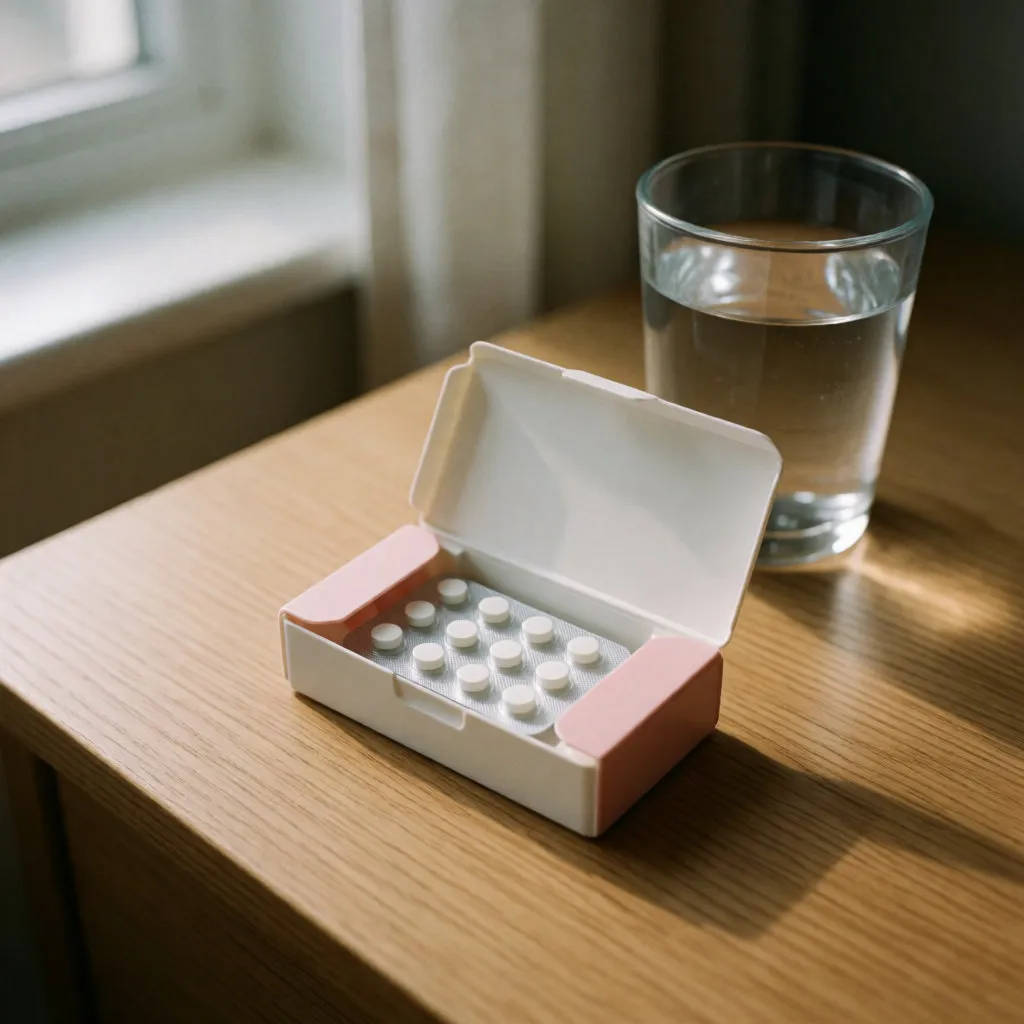
A condom splits. A missed pill in a week that’s already too full. Sex without a condom, on impulse or not. These moments happen, and they don’t make you reckless or a bad person. Emergency contraception exists for exactly this. You just need to know what it can do, what it can’t, and who to turn to for advice that truly fits your situation.

An emergency pill, not a pill like any other
The principle is simple: it delays or prevents ovulation. In other words, it works before a pregnancy starts — it doesn’t end a pregnancy that has already begun, and it never replaces ongoing contraception.
In the UK, two medicines are available from pharmacies and sexual health clinics. Levonorgestrel can be used within 72 hours after sex, ideally within the first 24. Ulipristal acetate has a window of up to five days. There’s also a third option, often forgotten: the copper intrauterine device (IUD), fitted by a doctor or nurse, which remains the most effective emergency method — also within five days.
One point that’s often missed: none of these methods protects against sexually transmitted infections. For that, there’s only one barrier: condoms, external or internal.
How much time do you have?
This is the question that decides everything. Current data suggest that the sooner you take it, the lower the risk of pregnancy. After 72 hours, levonorgestrel loses most of its usefulness, while ulipristal and the IUD keep a window of up to 120 hours.
There’s no reason to wait until the next morning to find out your options. If the pharmacy is closed, other routes exist: NHS 111 or a sexual health clinic. Emergency contraception should remain accessible, whatever the hour — that’s the least you can expect.
Missed pill: what the guidance says
If you miss one or more doses of your usual pill, what to do depends on the type of pill, how many pills you’ve missed and whether you’ve had unprotected sex. Emergency contraception isn’t automatic: it’s recommended when there’s a risk of pregnancy, especially after unprotected sex and a risky missed dose. A single missed combined pill, less than 12 hours late, doesn’t require it. Protection may be reduced for a few days; condoms are often recommended for 7 days (or 2 days depending on the pill), according to the guidance.
And if the missed pill falls in the last week of the pack, when only six or seven pills are left? What to do varies depending on the type of pill: a doctor or nurse may suggest running packs together. Typically, this is the kind of decision not to make alone.

Side effects: common, rarely serious
Nausea, headaches, abdominal pain, tiredness, irregular bleeding. These discomforts sometimes occur in the hours after taking it, and usually ease within a day or two. In the vast majority of cases, they aren’t serious. If you’re worried, a healthcare professional can advise you.
One point to watch, though: after vomiting within three hours of taking the pill, absorption isn’t guaranteed. In that case, seek advice quickly, from a pharmacy or a doctor.
Your period may also arrive a few days early or late. A delay of more than five days, unusually light, short or painful periods: again, turn to a healthcare professional, who can discuss a pregnancy test if needed.
In practice, remember this: emergency contraception is more effective the sooner it’s taken, and it is never a regular method of contraception. It doesn’t protect against STIs. If you’re unsure about a time frame, a missed pill or a dose, talk to a healthcare professional — pharmacist, nurse, doctor or sexual health clinic. Nothing you say will be judged.
Cost: what it really costs
Good news on that front: in the UK, emergency contraception is free from NHS services, including many pharmacies, sexual health clinics and GP practices. For under-18s, it is free and confidential. In other words, in the vast majority of cases, you won’t pay a penny.
At a pharmacy, it’s available without a prescription, for adults and under-18s — that’s exactly the point of the service. It’s also available through some school nurses and young people’s sexual health services, who can see under-18s confidentially. That’s the law, and it’s also a matter of trust.
Condoms, on the other hand, aren’t automatic: expect to pay a few pounds for a box, from a supermarket or pharmacy, though they’re often free from sexual health clinics and some GP practices. If you’re allergic to latex, look for latex-free versions — they’re the only method that also protects against STIs.
And afterwards?
Emergency contraception isn’t a failure. But it isn’t a comfortable solution either: repeating it in the same cycle is possible, but it remains much less reliable than ongoing contraception. If you use it several times in a few months, it’s often a sign that a review of your regular method with a healthcare professional could help.
What we know, what we don’t yet know: effectiveness seems slightly lower in people with a high body mass index. One more reason to ask for personalised advice, rather than sitting alone with your questions.
Sources
- World Health Organization — Emergency contraception, who.int
- NHS — Emergency contraception, nhs.uk
- Faculty of Sexual and Reproductive Healthcare — Emergency contraception, fsrh.org



Comments
Your opinion matters: rate the article, react and reply to comments.
Comments are moderated; AI-assisted comments are flagged. Text emoticons (8-), :-), <3…) are automatically shown as images.