
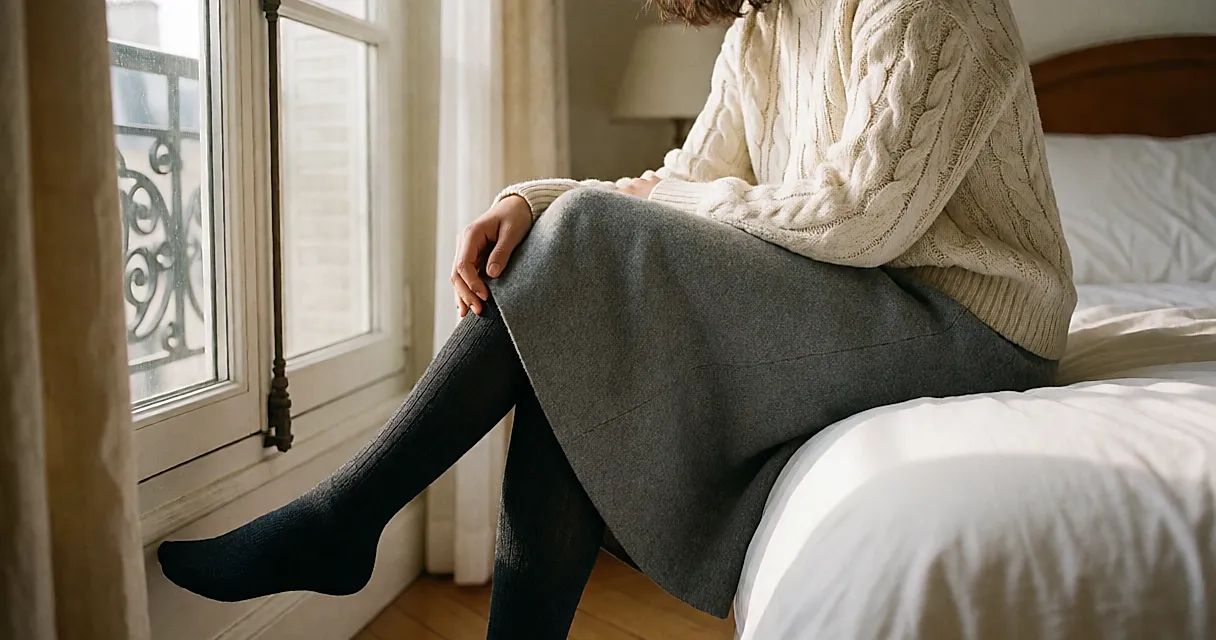
40 denier. It's printed in large type on the packet, it promises warmth, and then on Monday morning, on the platform, it doesn't deliver. We've all had a pair of tights let us down like that — no malice intended, just a misunderstanding. The number alone tells you nothing about warmth.
The number measures yarn, not temperature
Denier is a measure of yarn thickness: it is the weight in grams of 9,000 metres of that yarn. Generally, the higher the number, the thicker the yarn and the more opaque the leg. In practice, 20 denier usually reads as very sheer, 40 as semi-opaque, 70 to 80 as properly covering, and anything over 100 usually gives a dense, almost opaque finish. So why is it still the first thing we reach for in a shop? Because it's big, easy to read, and gives the illusion of a reliable scale.
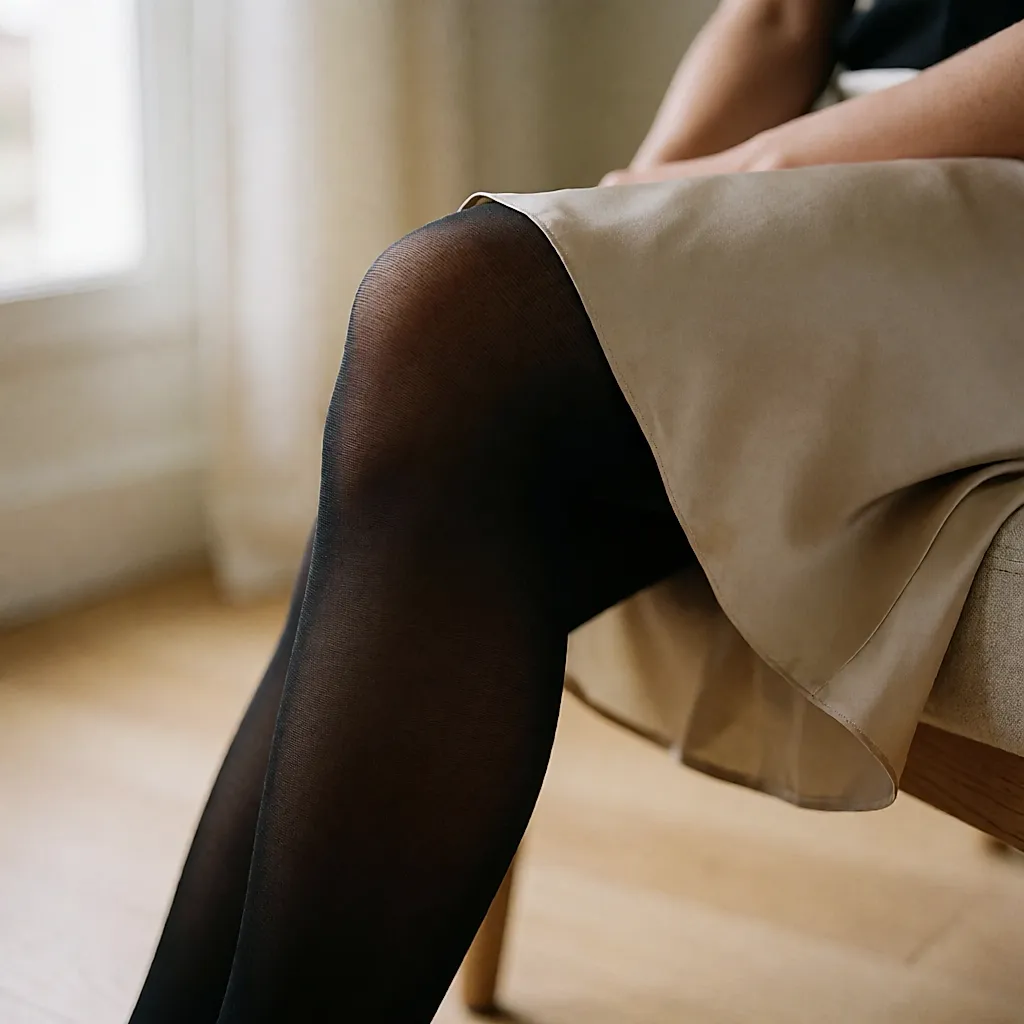
But what actually keeps you warm? The material, and the way it's knitted. A tight knit traps air, and that air insulates; a loose knit lets it escape. A thick synthetic yarn can give you opacity and a smooth finish; for warmth, it's the knit and the air it traps that decide, not the fibre type alone. Denier tells you how thick the yarn is, not what it's made of.
Check the label, not just the packet
So turn the packet over and read the composition. Three families share the shelf. Wool is warm and honest, but can be fragile: it felts in the wash and wears where the thighs rub. Merino, a very fine wool, is usually soft, less itchy and warm without bulk, but you pay for it. Polyamide is strong and often there to reinforce the heel and toe. In other words, warm tights aren't necessarily the pair with the highest number: they're often the pair that genuinely contains wool in a reasonably tight knit.
And what if the label is wordy? A pair labelled 'wool' may contain only a small percentage, with the rest there for strength and sheerness. Look at the percentages in order: the first fibre listed is the most present by weight. If the composition is almost entirely synthetic, you'll mainly be buying opacity; warmth will depend on the knit — and there's still time to put the packet back.
Let your fingers be the judge
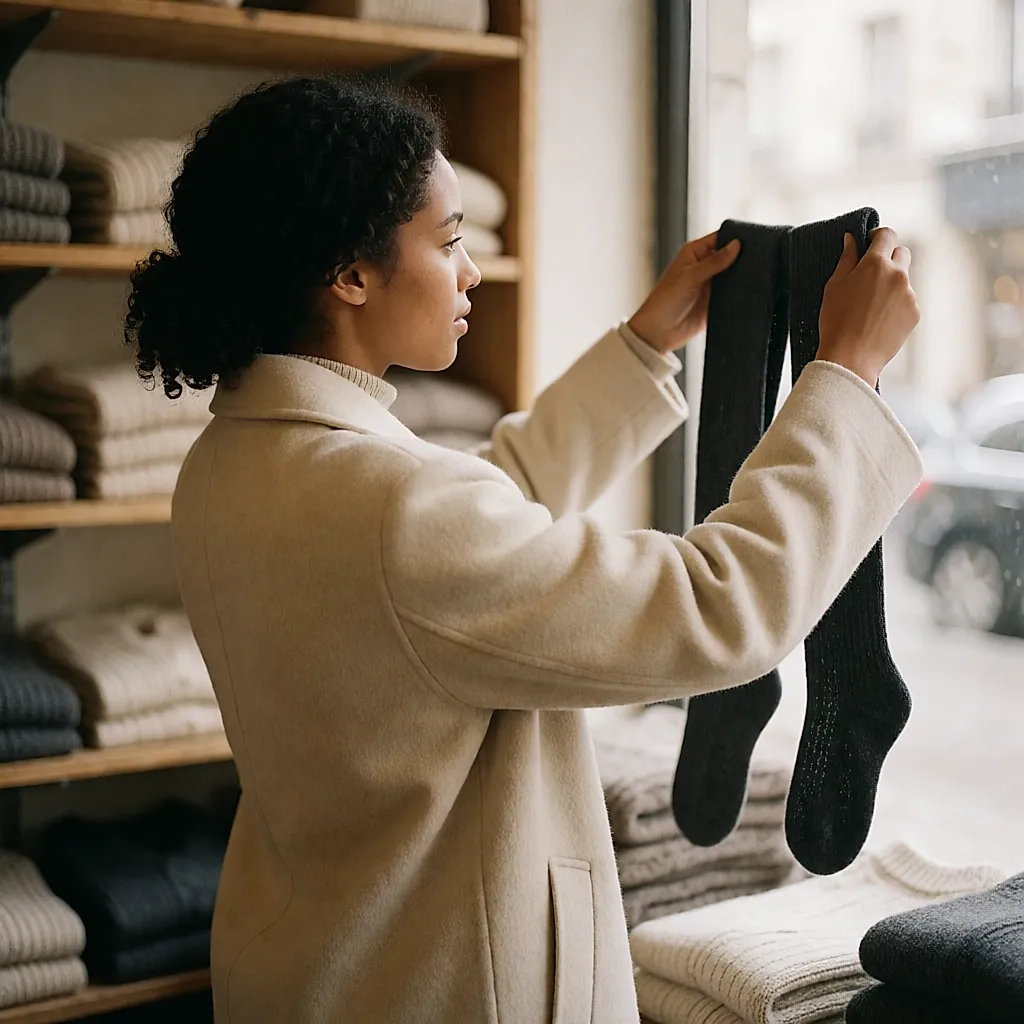
Now for the feel test. At a hosiery counter, in a department store or in an independent shop that sells tights singly, take the pair between thumb and forefinger and rub gently: a tight knit feels dense, slightly firm, and springs back when you stretch it. Then hold it up to daylight. If your hand is clearly visible through it, the knit is loose; if light barely gets through, you're holding proper winter tights.
The rest comes down to three details we forget at the till. A flat waistband that doesn't roll, discreet reinforcement at the heel, and a well-placed gusset seam: these help decide whether a pair lasts the season or ladders after three wears. And remember that tights insulate by trapping air; a dense knit beats a thick, loose yarn.
The shop check: turn the packet over (composition), rub the pair if it's displayed singly (density), hold it up to the light (opacity). Three quick checks, and you'll have a much better idea.
Where to find a pair worth buying
Where can you find a pair you can actually touch before buying? Independent hosiery shops and the hosiery departments of traditional department stores can be good hunting grounds for wool: you may find pairs sold singly, you can feel them, and staff can often tell you about the brands. Fashion boutiques and concept stores can offer a tighter edit, often in merino, at prices that climb quickly. As for brands, look for tights whose composition genuinely mentions wool or merino; product pages often give the details, so you're not buying blind.
Once you've found the pair, care is everything. Hand wash or wash in a mesh bag on a delicate cycle, then dry flat: wool hates spinning and radiators. Treated well, a merino pair can last several winters, which makes the price a little less painful.
Budget
In the UK, expect to pay around £8–£20 for everyday opaques from a supermarket or high-street chain, £15–£30 for a pair with a real wool content, and £25–£50 for merino from a hosiery brand. The step up is clear: merino often doubles the bill, and very fine finishes push it higher still. Location, stockist and timing all play a part — a London hosiery counter may not have the same prices as a brand's website at the end of the season.
So is it worth the money? If you wear tights five days out of seven from October to March, merino earns its keep: real warmth, a fine gauge, and impeccable drape under a slim skirt. For two winter Sundays and one evening a year, a wool-blend opaque will do very well. The truly bad buy in this story is the pair that scratches, slips down and never gets worn — that one is expensive whatever the price on the packet.


Comments
Your opinion matters: rate the article, react and reply to comments.
Comments are moderated; AI-assisted comments are flagged. Text emoticons (8-), :-), <3…) are automatically shown as images.