

A fashion show is no longer judged on its silhouettes alone: it's judged on its viewing figures. Before a buyer has signed off a single order, audience rankings and search graphs have already installed the season's jacket in our conversations. A trend is no longer a stylist's hunch; it's a number we discuss — and sometimes a number we're stuck with.
Now the podium has to prove itself in numbers
The moment the last model leaves the runway, the platforms that track mentions, saves and searches are already tallying it all up. Within hours a ranking is doing the rounds, before the samples have even reached the showroom. In buyers' offices the question has changed shape: it's no longer 'did I love it?' but 'did it perform?'. A sharp cropped sleeve, very black leather, a long, sensible skirt: these are no longer proposals, they're candidates.
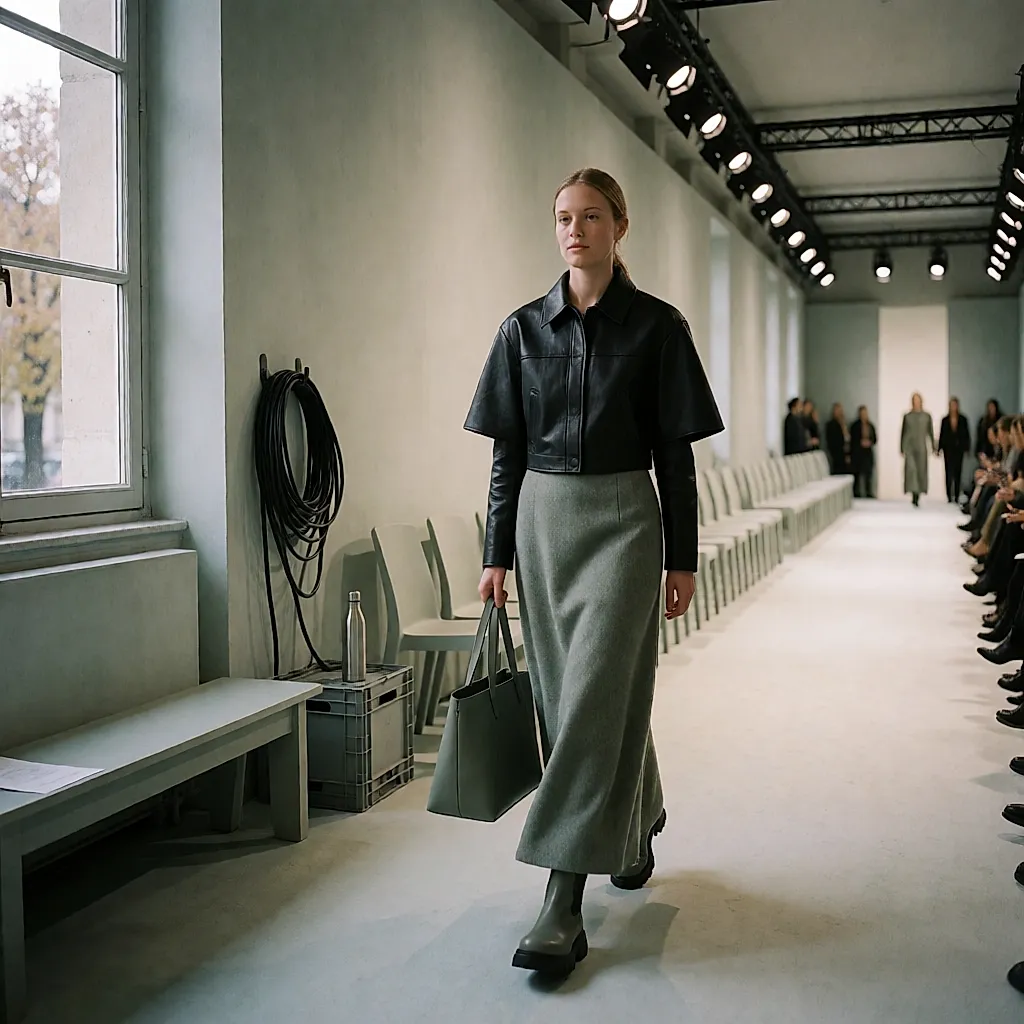
None of this is scandalous, mind. The data doesn't design the collection; it decides what gets made in larger quantities, in which colour, at what entry price. What the ranking does is move the moment of judgment: it now lands before manufacture, rather than when the first real outfit is worn on the street.
What the numbers catch, and what they miss
Data measures attention, not drape. A top can be everywhere and itch by the third hour; a knit can rack up the saves and pill on its first wash. A ranking tells you nothing about the weight of the cloth, the set of the shoulder, or whether the seams will hold or give. Those are the things that decide whether a piece ends up at the bottom of the wardrobe or in Monday-morning rotation.

The second blind spot: numbers adore the recognisable. The more a piece looks like something we've already seen, the more it's shared and the higher it climbs. A ranking amplifies; it doesn't anoint. So when a silhouette turns up everywhere, the right question isn't 'is this the trend?' but 'does this suit me?'. Sizeable difference.
How to read these rankings without being taken in
There's a very simple way to sort the wheat from the chaff: look at repetition, not position. A piece that appears at three different houses, in completely unrelated fabrics and at entirely different prices, is a seasonal signal. A piece sitting at number one in a single ranking may just be a well-run campaign. Read the ticker, ignore the podium.

Then come back down to earth — and to the hanger. A ranking happily rewards a full look; your wardrobe will only take one piece. Ask yourself whether it works with three things you already own. If the answer takes more than ten seconds, it's usually a no.
The three-question test before you buy the piece you've seen everywhere: can I wear it at least twice a week? Does it go with the bottom half I wear most? Am I buying it for the colour or for the ranking? Two yeses are enough — but never zero.
Check the fabric before the ranking
A measured trend usually arrives compressed: the same shapes, with fabrics downgraded to keep the prices down. That's where your eye has to take over again. Wool, cotton, silk, linen: check the fibre before you check where a piece sits in the ranking, and look at the synthetic content on the label. A slightly pricier wool piece that hangs beautifully will usually beat a near-identical version that won't survive the winter.

Then there's the most cost-effective restraint of all: wear it, look after it, keep it. A piece already in your wardrobe, woken up with a new belt or a polo neck underneath, ticks the trend box without spending a penny. You don't have to comment on the ranking, you know.
Budget
To try a trend the numbers have approved without spending a month's rent, think in three tiers. Start with the accessory: a belt, scarf or beanie will set you back roughly £20 to £45 at a specialist chain or a makers' market — the price moves with the material and where you buy it.
The middle tier, the one that really earns its keep, usually sits between £70 and £180 for a pair of trousers, a thick jumper or a lined skirt. Expect to pay considerably more, £220 to £450, for a coat or a hard-wearing wool knit: there, it's the fibre, the construction and where it's made that set the price, not the ranking.
Sources
- Lyst — The Lyst Index, the quarterly ranking of the most searched-for brands and products
- Google — Google Trends, a public tool for comparing searches
A ranking is a tube map: it shows you the busy lines, not your destination. Take an idea from it — a colour, a length, a shoulder — then go back to your wardrobe and decide with what you already own. The season is being measured; your style doesn't have to be.

Comments
Your opinion matters: rate the article, react and reply to comments.
Comments are moderated; AI-assisted comments are flagged. Text emoticons (8-), :-), <3…) are automatically shown as images.