

The jumper I bought in February looked like a dishcloth by April. Perfect cut, beautiful drape, composition on the label, reasonable price — and yet it was covered in bobbles by the third wash. The truth is, the problem was not the price. It was the label, read in a hurry.
Since then, I have a method. Two minutes in the fitting room, and it has freed up more wardrobe space than any spring clear-out. Shall we run through it?
The composition label, how to read it
In the UK, as in the EU, a textile label must name each fibre and its percentage, in descending order. It comes from Regulation (EU) No 1007/2011, and it is your best weapon.

What are we actually looking for? First, the order of the fibres. If polyester comes before wool, you are not buying a wool jumper: you are buying a polyester jumper with a memory of wool. Then the exact fibre names. 'Wool' alone is not 'virgin wool'. And 'cotton' is not 'organic cotton', even if the product title says otherwise.
Don't forget the care symbols, which are standardised internationally. A label that rules out the machine and the tumble dryer is warning you: this garment will need looking after. That is not a deal-breaker — but better to know before you get out your card!
Fabrics that age well
No fibre is good or bad in absolute terms. It is all about context.
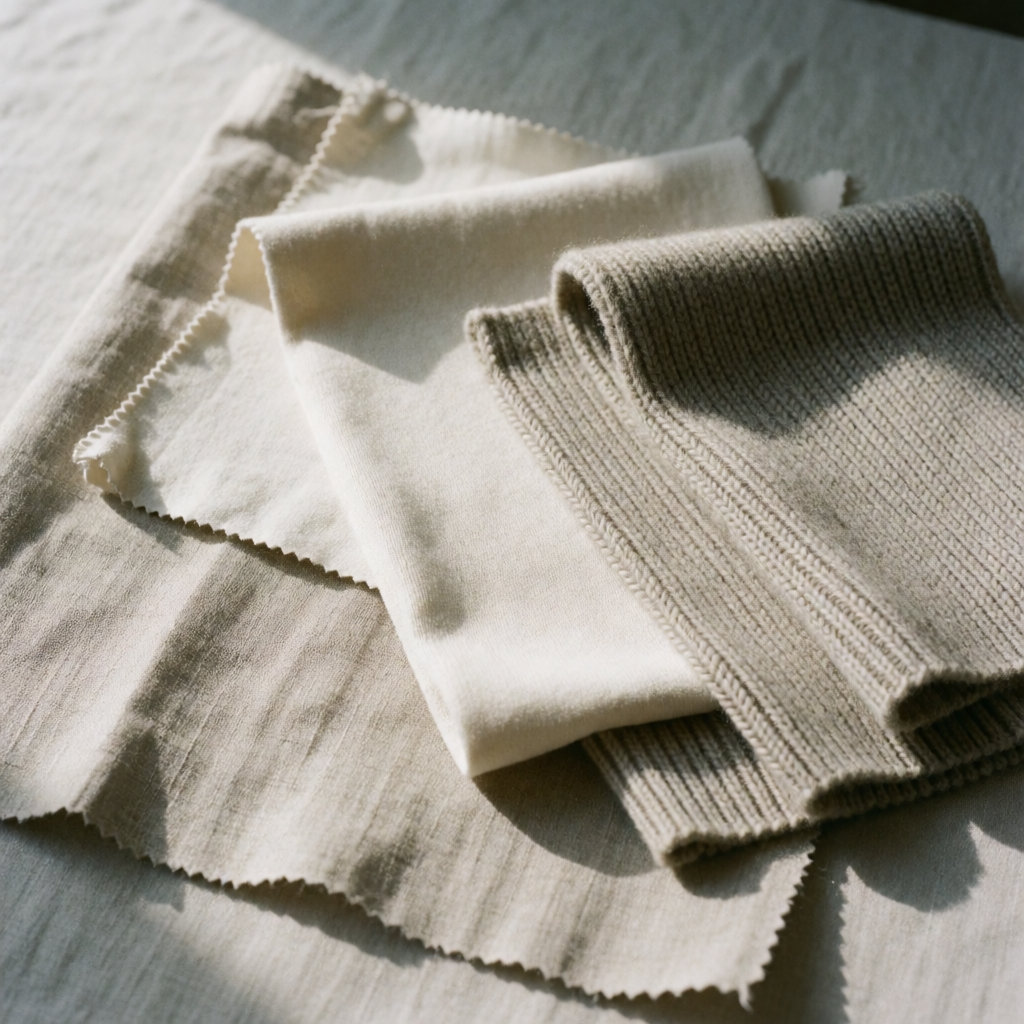
Cotton, linen and wool are fibres that, when tightly woven and long-staple, wear slowly and hold their shape better. Linen creases, yes — that is how it lives, not a fault. Wool regulates temperature and can be brought back into shape with careful washing. The thick cotton of a sweatshirt or jeans keeps its shape, whereas a fine jersey stretches at the elbows.
Where it goes wrong is with vague blends. Wool and acrylic in almost equal parts: rub them together and hello, bobbles. Cotton and polyester made from short fibres: the cotton goes, the polyester stays, and the piece loses its soul. Brushed fleece and very loose knits also bobble faster, simply because the fibres work free.
Beware of the lazy shortcut, though. Pure polyester is strong, dries quickly and does not crease — on a sports jacket shell or a bag, that is very good. On a T-shirt you want to wear for ten years, it is less fun: it holds its shape, but it holds on to odours and pills.
The ten-second test, in the fitting room
You go in, you turn the garment inside out. The inside tells the whole story.

Gently pull at a side seam, as if you were putting the garment on a little too quickly. If the stitches gape and show skin, the seam is fragile. A good seam is tight, even, with enough seam allowance — and thread that holds.
Now look at the finishing. Loose threads everywhere? Topstitching that waves? A hem that is bonded rather than sewn? These are not details; they are signals. Check the stress points too: armholes, crotch, waistband — that is where things give first.
Feel the buttons: the thread should be knotted securely, not just tacked on with two stitches. Zip it all the way up, then back down — if it catches, it will catch even more in six months. On a jersey, stretch the fabric gently and let go: it should spring back.
A garment that demands hand washing, flat drying and low-temperature ironing is not necessarily bad. But ask yourself the real question: will you actually do it? If the answer is no, the label is more honest than you are.
Online, the clues before you click
E-commerce makes everything harder, but it leaves traces.
Zoom in on the photos. Look for a view of the inside, the seams, the hem. A brand that shows its finishing close up knows what it is selling; a brand that only shows the garment worn, in motion, may be hiding the essentials.
Read the composition in the specifications, never in the title. Then go to the reviews and search for 'bobbled', 'stretched', 'after washing'. You will soon see whether the piece wears well or badly. And check the returns policy: ordering two sizes to send one back is not waste — it is editing.
Budget: what a good basic is really worth
Let's talk numbers, because quality has a price — but not always the one you imagine.
For a basic thick cotton T-shirt, expect about £10 to £25 in a supermarket or high-street chain, £30 to £60 from a British brand, and sometimes up to £80 for traceable organic cotton. A wool jumper: £35 to £80 on the high street, £100 to £200 for traceable merino or British-spun wool. Raw denim that lasts three winters: £50 to £100 depending on the weight and where the denim comes from. And for a statement piece — a trench coat, a wool coat — aim for £120 to £350 and keep it for ten years.
These ranges vary a lot depending on the city, the sales channel and the range: online, in an independent concept store or in a charity shop, the differences are considerable. On a small budget, second-hand remains the best school: specialist or general platforms, local consignment shops. A well-chosen second-hand basic can cost a third of the new price — and it has already passed the test of time.
The small habit that changes everything
Take a photo of the label of every garment in your wardrobe that has gone wrong. After three or four, your personal blacklist starts to take shape: the compositions that always let you down.
It is more effective than any general guide — and it will stop you buying, two years from now, the same jumper that ends up as a dishcloth.
Sources
- European Union — Regulation (EU) No 1007/2011 on textile fibre names and labelling, EUR-Lex.
- International Organization for Standardization — ISO 3758: care symbols for labelling textile articles.
- ADEME — Fashion and textiles files, French Agency for Ecological Transition.


Comments
Your opinion matters: rate the article, react and reply to comments.
Comments are moderated; AI-assisted comments are flagged. Text emoticons (8-), :-), <3…) are automatically shown as images.