
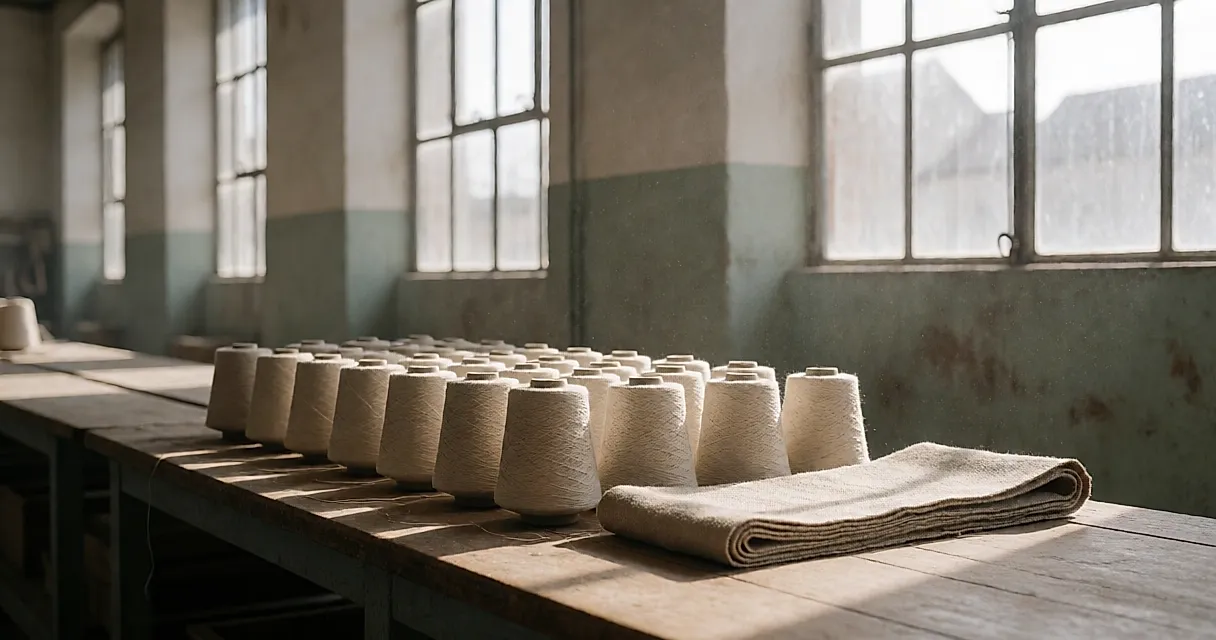
You've probably stroked a jacket labelled 'hemp', braced for tarpaulin, and found something soft and almost fluid instead. Then you've turned over the label: 12% hemp, the rest cotton. The real secret of this fabric isn't in the field but in the machines that process it — and that is exactly what decides whether your autumn trousers look sharp or make you want to take them off before lunch.
The plant isn't what makes it fine
In a hemp stalk, the fibres are not all created equal. The longest fibres run along the outside; the shorter ones — the tow — stay inside. After harvest, retting (leaving the stalks in the field until the fibres separate), scutching and combing decide what you end up with. A long fibre, carefully combed, can be spun fine and woven into a smooth cloth with a tight grain, sometimes almost silky. Tow, being shorter, goes into rustic, irregular, thicker yarns.
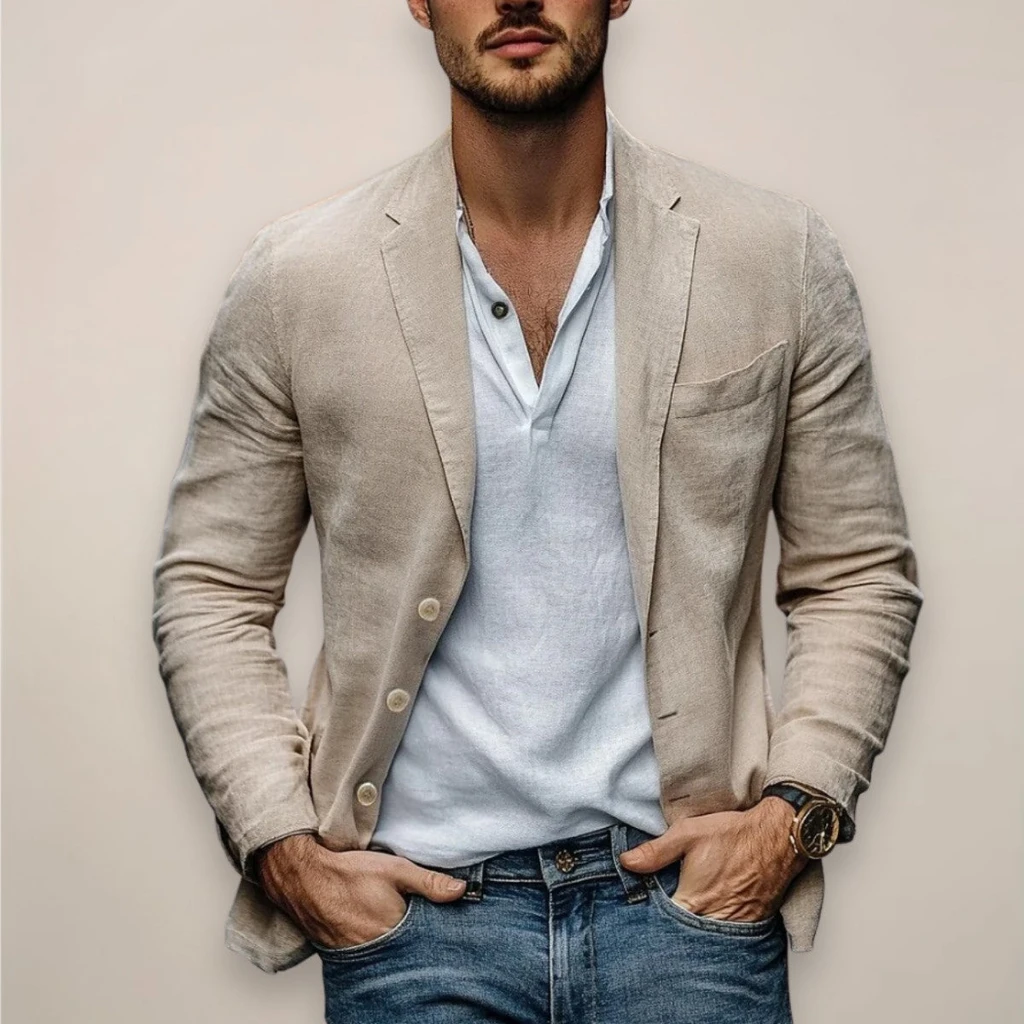
That is why two jackets both labelled '55% hemp' can feel as if they come from different planets. One has the dry handle and drape of workwear canvas; the other scratches at the wrist and stands up like cardboard. The plant hasn't changed, the yarn has. And yarn is a mill decision.
Another detail that matters: spinning hemp fine takes skill and machinery that isn't found on every corner. Specialist European spinning mills are not exactly common, and a serious brand tends to be upfront about it — the name of the mill, the country where the yarn was spun, sometimes the exact fabric weight. If the label is silent on all that, it isn't a crime, but it leaves you guessing. And guessing in a fitting room gets expensive.
Three things to check before you pay
First check: the hemp content. In practice, a minority share of hemp is often there mainly for texture and a nice word on the product page; once it is the majority fibre, hemp is genuinely what makes the cloth. Neither is a trap — as long as you know what you're buying. The question to ask in front of the mirror is simple: am I paying for the material, or for the word?
Second: fabric weight, given in grams per square metre (gsm). The higher it is, the more structure the cloth has and the more it sits on the shoulders; the lower it is, the more fluid the piece will be, and the more it will show creases. Hemp creases — that's its nature — and a light cloth will crease far more visibly than a heavy canvas. For autumn trousers, a generous weight holds the line of the leg; for a shirt, you're after suppleness.
Third: blends. Cotton and hemp give a softer, slightly more well-behaved handle; linen and hemp add backbone and grain. While you're there, check the share of synthetic fibres slipped into the composition: it changes the feel and the way the piece will age, and it isn't always announced in large print on the label.
How to choose a hemp jacket or trousers
For jackets, hemp is at its best in straight cuts: a heavy overshirt, a chore jacket, an unlined blazer with a soft shoulder. The fabric has body and structures the silhouette without needing to be nipped in — and it works over a fine roll-neck, which is no bad thing in November. A very fitted cut in a stiff cloth, by contrast, will turn you into a suit of armour. If you're between sizes, take the one that lets you raise your arms.
Trousers follow the same logic: a wide or straight leg in hemp canvas holds a crease and forgives days spent sitting down; a slim cut in the same fabric, much less so. The real plus is that it can be repaired: a heavy cloth can be mended, darned and patched without it showing — provided you check the seams and seam allowances when you buy. Hemp softens with wear and washing; allow a few weeks before it really relaxes, and wash it cold, inside out.
On the brand front, it's worth looking at Patagonia, which uses hemp in its workwear range, or Jungmaven, an American specialist in hemp jersey for basics.
In the fitting room, scrunch the sleeve in your hand and let go: you'll see straight away whether the cloth will forgive a day at a desk. Look at the reverse too — a very irregular weave signals a more rustic handle, so keep it for outerwear.
What to budget
Expect to pay around £80–£180 for a hemp or hemp-cotton jacket, depending on the brand and fabric weight, £60–£130 for trousers and £50–£95 for a shirt. What moves the price: where the yarn comes from (a European spinning mill costs more), the thickness of the cloth, the cut and the level of finish. Below about £50 for a jacket, be sceptical about how much hemp is really in it.
As for a bargain, second-hand is surprisingly good for this kind of piece: £20–£55 for a pair of hemp canvas trousers that have already been broken in, so they have softened. And if the length is perfect except at the ankles, getting a hem done at your local alterations shop will cost around £10–£22 — often less than a full resizing.
Hemp is often presented as drought-resistant, but its water needs depend on farming practices; that isn't where the real story lies. It lies in the yarn, the fabric weight and the years you're going to wear the piece. So next time, before you fall for a piece, turn over the label. The field is behind you; the mill still has a say.

Comments
Your opinion matters: rate the article, react and reply to comments.
Comments are moderated; AI-assisted comments are flagged. Text emoticons (8-), :-), <3…) are automatically shown as images.