

It’s a familiar truth: once you go past a C cup, finding a bra that is both decent and a little bit feminine can feel like hard work. As a result, fuller busts often settle for dull, lacklustre underwear because there is little else around — and plenty of us know that feeling. But the gap has finally started to make noise, and more lingerie brands are turning their attention to fuller busts: the ones that need proper support and plenty of femininity. One fuller-bust specialist once offered a collection for larger cup sizes along with some pointers for working out your true bra size. The advice below started there.
I say true size because, by all accounts, many women are not wearing the bra size that actually suits their bust. Which is a bit of a paradox, isn’t it?
So it is time to relearn — or learn from scratch — how to work out your underwear size. Off we go, tape measure in hand.
Your bra size comes down to two things. First, your underband: measure just beneath your bust, where the bra band normally sits. Keep the tape horizontal and don’t pull it too tight or leave it too loose — exactly how a well-fitting bra band should feel.
Before you even reach for the tape, a quick look at the bra you are wearing can give you half the answer. A cup that is too small makes the bust spill over the top and the wires gape in the middle. A cup that is too large floats and supports nothing. In both cases, the band is taking the weight, and you will feel it: tension across the upper back, red marks, straps you keep tightening to compensate.

Take a soft tape measure and stand in front of a mirror, with your top off, arms by your sides. Ideally, ask someone to help: the measurement is more reliable when someone keeps the tape properly horizontal.

Your underband measurement will point you towards your band size. In the UK, band sizes are usually written in inches — 30, 32, 34, 36 and so on — while many tape measures show centimetres. As a rough starting point, a 68–72 cm underband often points towards a 32 band, 73–77 cm towards a 34, 78–82 cm towards a 36, 83–87 cm towards a 38, 88–92 cm towards a 40, 93–97 cm towards a 42, 98–102 cm towards a 44, 103–107 cm towards a 46, 108–112 cm towards a 48, 113–117 cm towards a 50, and 118–122 cm towards a 52. UK brands vary, though, and some use different fitting methods, so always check the brand’s current size guide.
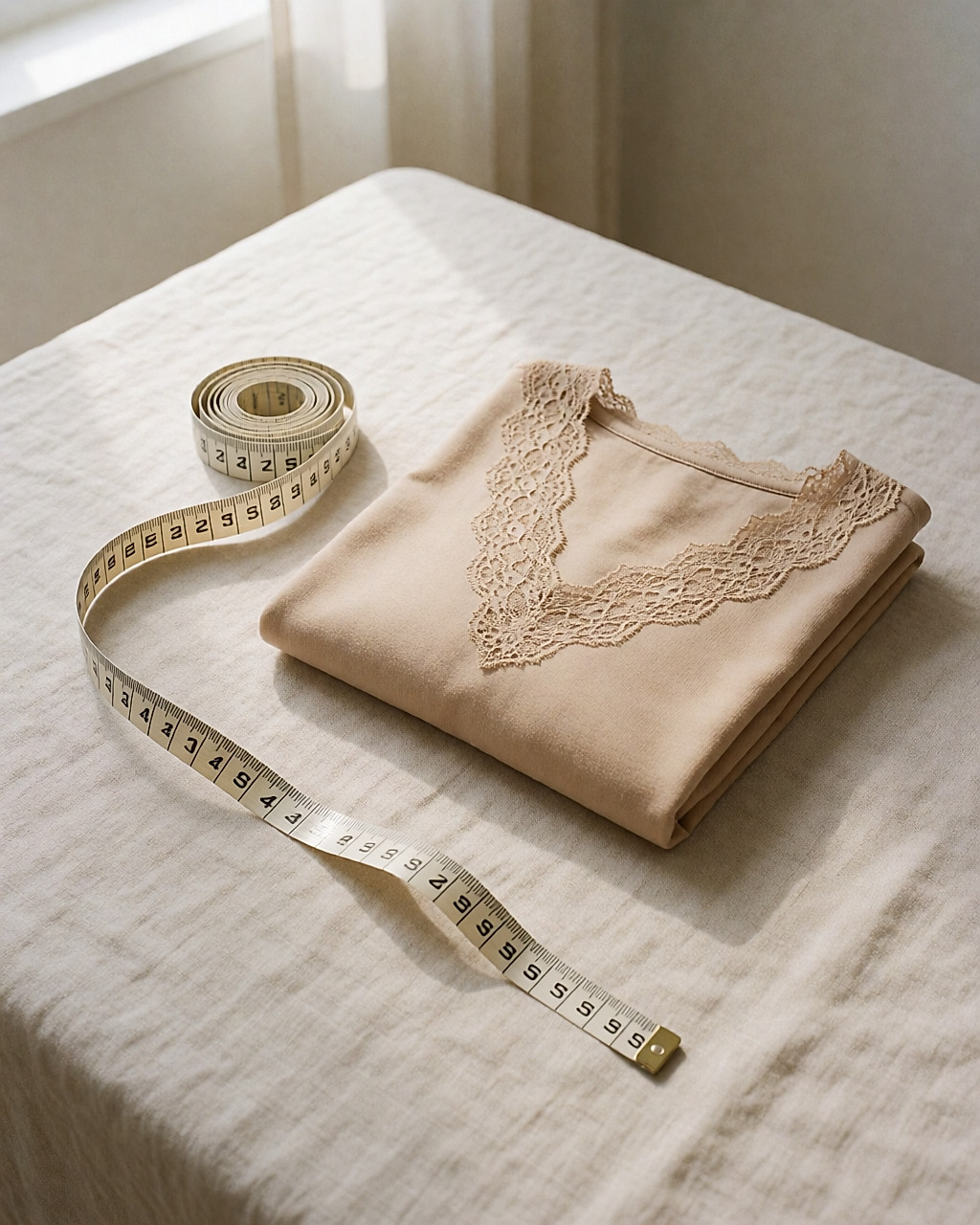
The second measurement is cup depth, which corresponds to a letter — A, B, C, D and so on. The further along the alphabet you go, the deeper the cup. To find it, measure your bust: keep the tape horizontal and level with your nipples, without squashing them.
Once you have your bust measurement, subtract your underband measurement to find your cup size. Again, this can be especially useful for fuller busts, because working out the cup size of a larger bust is often trickier than for a more standard size. In UK sizing, cup size is usually based on the difference between bust and underband in inches. Roughly: 1 inch (2.5 cm) is an A cup, 2 inches (5 cm) a B, 3 inches (7.5 cm) a C, 4 inches (10 cm) a D, 5 inches (12.5 cm) a DD, 6 inches (15 cm) an E, 7 inches (17.5 cm) an F, 8 inches (20 cm) an FF, 9 inches (22.5 cm) a G, 10 inches (25 cm) a GG, 11 inches (27.5 cm) an H, 12 inches (30 cm) an HH, and 13 inches (32.5 cm) a J. Ignore any chart that puts a D cup at 8–9 cm; that was a brand-specific quirk. Always check the current guide for the brand you are buying.
Then simply pair your band size with your cup size to get your bra size, for example 34C. Bear in mind that these equivalents can shift by a cup size from one brand to another, so the manufacturer’s guide is the final word.
When you try on a bra, check that the wires sit flat against the skin, both underneath the bust and in the middle, at the centre gore. If the bra is stretched between the breasts without touching the skin, it is too small — and the same goes if the wires ride up onto the breasts or the cups cut in at the top.
Likewise, if your bust does not fill the cups, the bra is too big: go down a size. To keep your bust looking good over the years and to feel completely comfortable in your lingerie, your bra needs to do its job and support your bust.
One last trick that saves a lot of fitting-room time: sister sizes. If you go down a band size, the cup usually goes up a letter, and the other way round — a 34B is also a 32C or a 36A. Handy for end-of-line styles, travel, or a style that runs small or large. Note that this is not a perfect adjustment: it is a stopgap, and only works if the band stays stable.

Finally, too many women assume their underwear size stays the same year after year, forgetting that with age, pregnancy, weight gain and weight loss, the body changes — and so does the bust. So measure yourself from time to time (yes, it can sound funny, but it matters) and change your lingerie when you notice discomfort: support that is getting worse, painful wires, compressed breasts. These are all signs that it is time to renew your lingerie.
Materials are worth sorting through, too. Natural or bio-based fibres tend to let skin breathe more easily. Flat seams and wider straps are more comfortable on deeper cups, and a touch of elastane in the band helps it keep its shape after repeated washing. The OEKO-TEX Standard 100 label tests for harmful substances, but it says nothing about whether the fibre is organic — two different things that are often confused on the shop floor. Packaging counts, too: a cardboard box rather than a plastic bag is a small win.

Finally, fitting rooms are going digital, with 3D scanning, interactive guides and virtual try-on. These can be a useful pointer, but nothing replaces trying a bra on in real life, especially in deeper cups.

The original charts came from a French fuller-bust specialist that, at the time, was praised for offering refined lingerie in French band sizes 80 to 130 and D to J cups. It also had an online shop, which made things easier — though any old address is worth checking before you visit today.
Budget
On budget, expect around £12–£25 for a simple style from a lingerie chain or supermarket, £25–£50 for a well-made deeper cup from a specialist, and more like £50–£85 from fuller-bust brands, with bespoke costing more still. The price rises with cup depth, the quality of the band and wires, and European manufacturing. End-of-line styles and sister sizes remain the best bargain, as long as you do not compromise on support.




Comments
Your opinion matters: rate the article, react and reply to comments.
Comments are moderated; AI-assisted comments are flagged. Text emoticons (8-), :-), <3…) are automatically shown as images.