
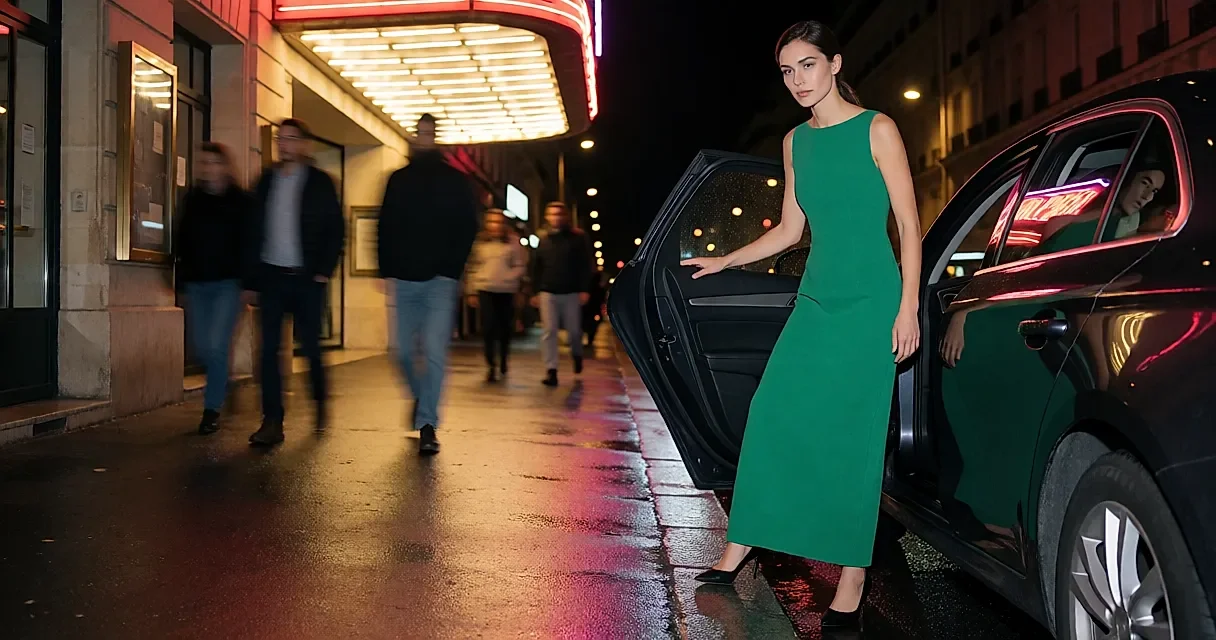
Two dresses can share a colour, a length and a fabric and still tell completely different stories. One complicates the silhouette; the other draws it in a single stroke. It is the second we are interested in: clean lines, decisive lengths, structure you can see. Everything else — jewellery, bag, hair — is there to punctuate, never to rescue.
A straight line as the backbone
Evening wardrobes rarely rely on layering. The starting point looks more like a structured bodice, a column dress, a piece that takes the body and follows it, with no extra layer added to correct anything. The result is not a "perfect" silhouette: it is a legible one. The eye finds a starting point — shoulders or neckline — and an end point, the hem, without getting lost on the way.
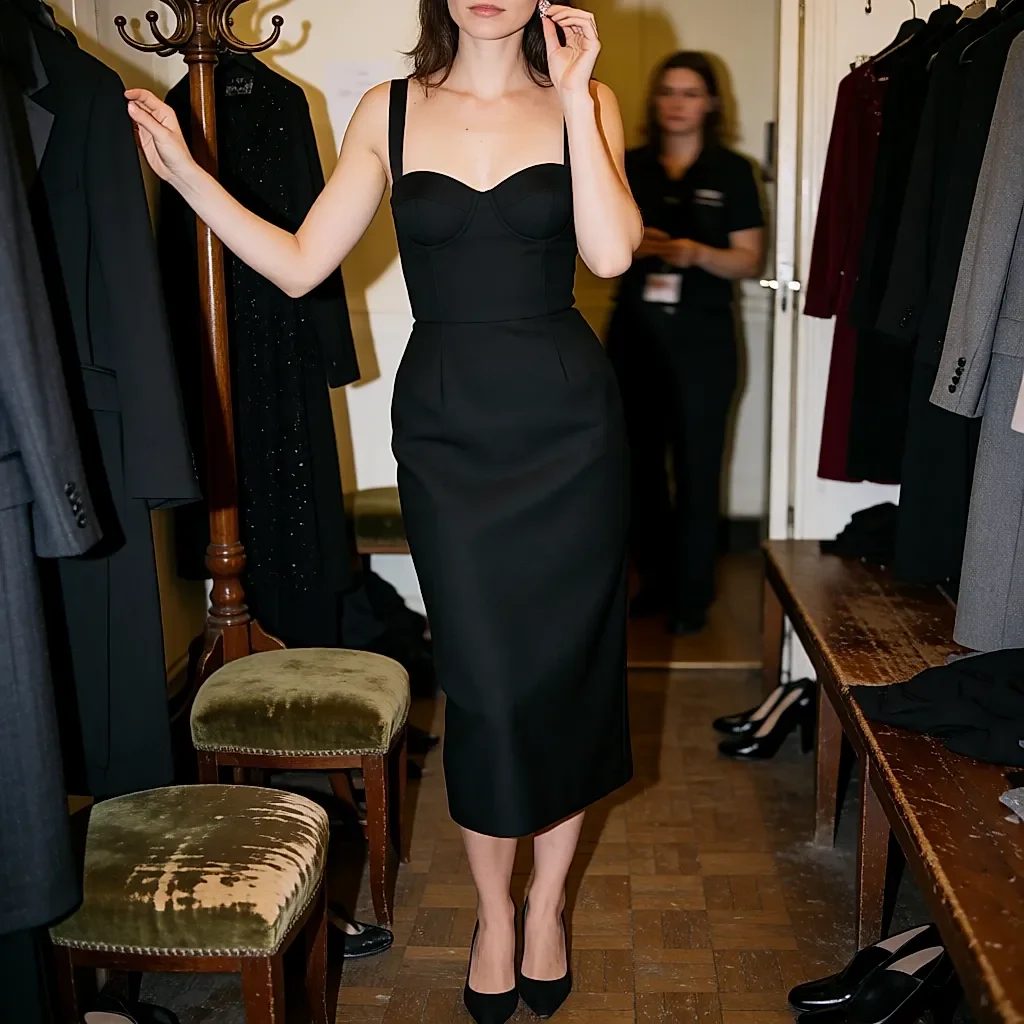
And that is where the lesson earns its keep, because in the evening we tend to overdo it. A jacket over the dress in case it turns chilly, a necklace "to finish it off", a pair of shoes that clash a little but change everything. Yet one well-chosen structure does more work than three stacked accessories. The test takes ten seconds: step two paces back from the mirror. If your gaze travels down in one block, you are there.
Length is never an accident
Two families keep coming back: the dress that falls to the floor, and the short piece, cut high, worn with a sharp bottom half. This is not a matter of taste, it is a matter of proportion. Floor-length lengthens the line; a short cut pulls attention back to the upper body and lets the legs breathe.
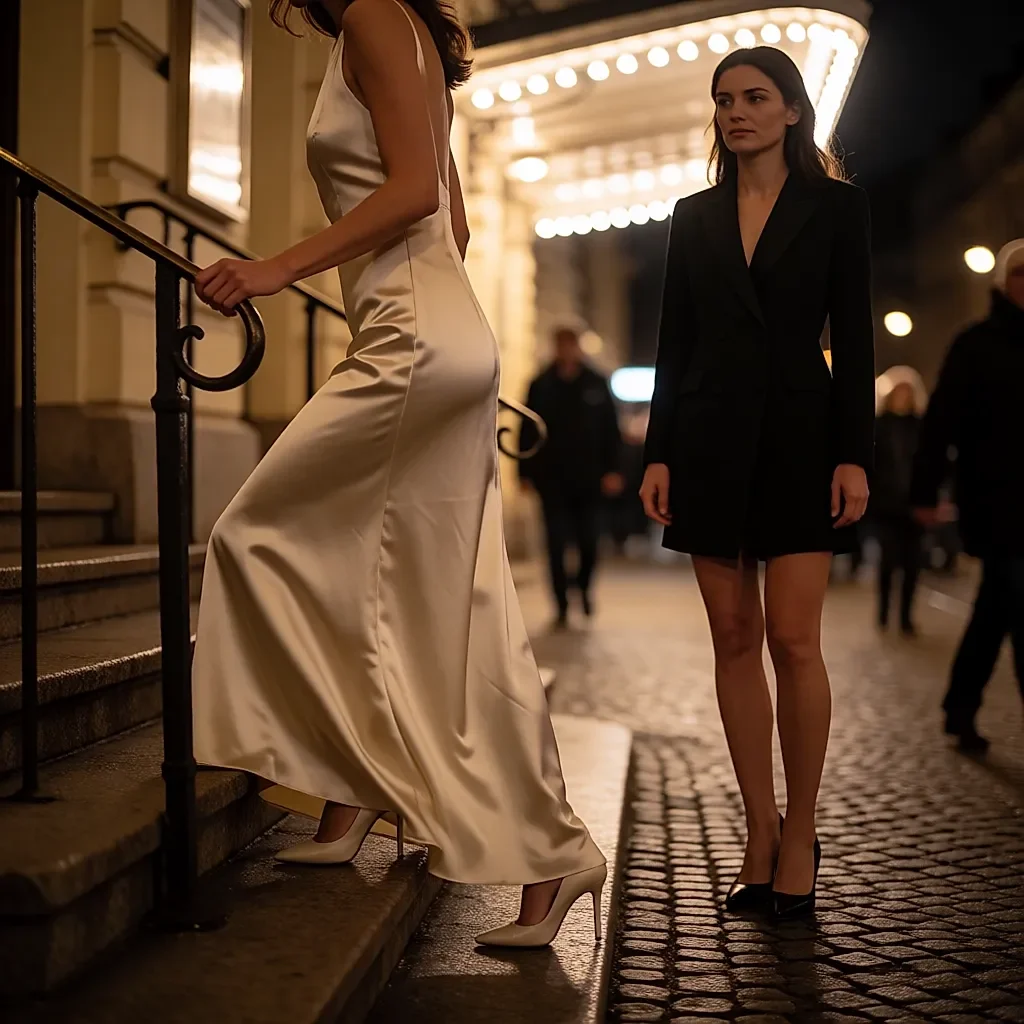
Between the two lies the most treacherous grey zone in the wardrobe: the knee, the calf, the famous "just below the knee" that shortens almost everyone while claiming to flatter. If you are wavering, commit. A vague length does not forgive, and it is often that — not your body — that has you taking a dress off after ten minutes.
Another detail that gets underestimated: a long dress does not have to be fluid to work. A crisp, almost rigid drape — a fabric that holds its shape instead of collapsing — does an enormous amount of work. Before you look at the print, look at the drape.
Structure rather than volume
Third instinct: sculpt rather than inflate. A defined shoulder, a waist shaped by the cut rather than by a belt added on, seams that hold the bust. Structure in eveningwear means discreet boning, a lining that stops the dress losing its shape when you sit down, a shoulder that stays where it should when you raise an arm.
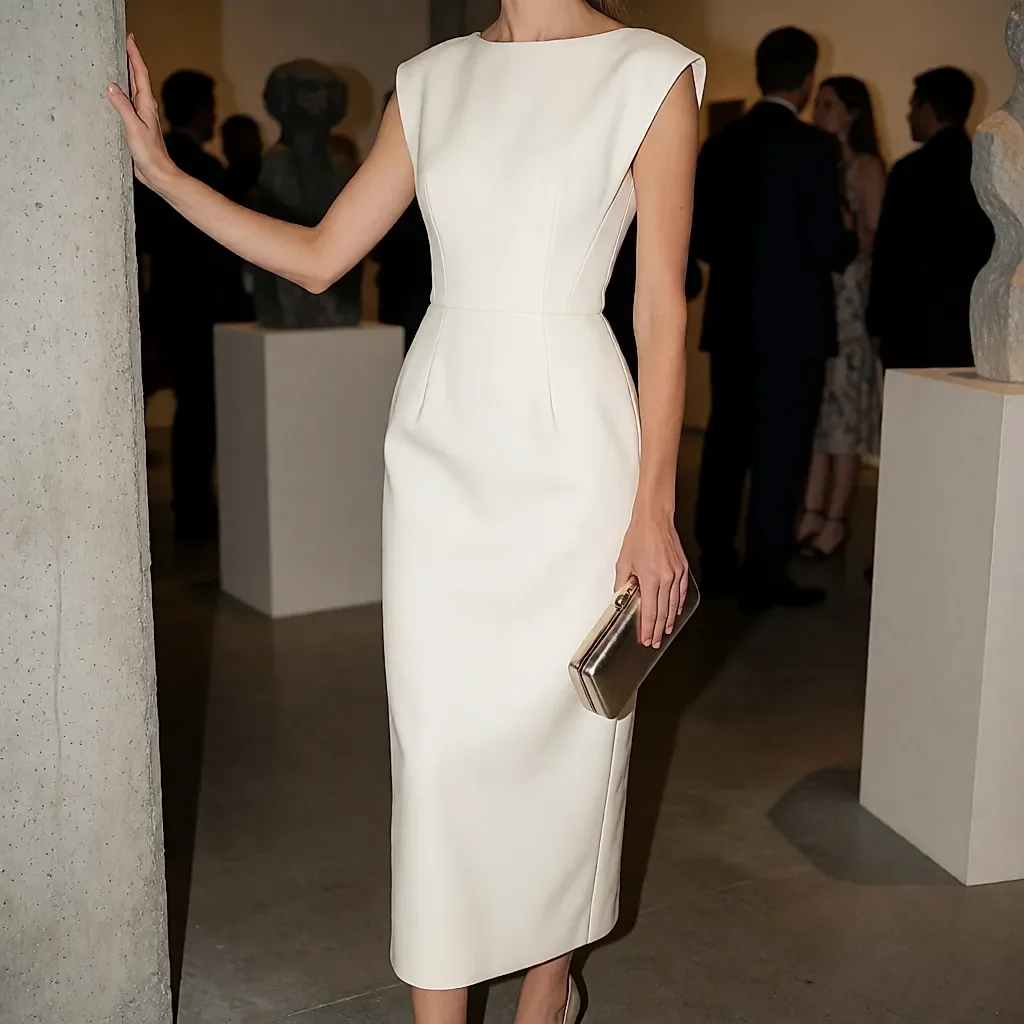
That is why some evening outfits look simple when they are in fact highly constructed. Nothing to do with the price tag: a well-cut piece in a slightly heavier cotton or in cool wool can hold a silhouette better than a light, shiny dress. Check the synthetic fibre content on the label before you fall for the colour. On the natural side, silk, heavy cotton and wool all do the job well.
Then there is comfort, which we forget far too quickly. Structure that pinches is not structure, it is tension. If you cannot raise an arm to greet the person welcoming you, it is not the right dress.
Putting it to work on a real evening
The principle comes down to three questions asked in front of the wardrobe. Which line do you want to show? Just one: a shoulder, a waist, a leg. Is your piece structured enough to hold that line until midnight? And what can you take off without everything collapsing? The answer is very often "the necklace".
After that, it depends on the evening. Dinner: a column dress or a floor-length dress with a crisp drape, a pair of fine sandals, nothing more. A wedding or a dressy event: a structured bodice, a full high-waisted skirt, one piece of jewellery doing the work on its own. A standing cocktail: the short piece works better — you walk, you sit, you head off again — and a floor-length dress on a staircase is not always your friend.
And for anyone who does not love their arms or their stomach? Structure is precisely the argument. A slightly flared short sleeve, a waistline set higher, a cut that stands away from the body instead of clinging to it. You correct through the cut, not through extra fabric layered on top.
Budget
In practice, for a structured ready-to-wear evening dress on the UK high street, expect roughly £80 to £200, depending on fabric and retailer. These are indicative benchmarks rather than a dated survey: under about £70, the cut is usually the first thing trimmed and the lining the second, which explains a good many fitting-room disappointments.
For a ceremony rental, reckon on around £40 to £130 for two or three days, again as a guide: a serious option if the piece will not be worn again. And do not underestimate alterations: taking in a waist or shortening a hem usually costs between £15 and £50 at a local seamstress, still an order of magnitude, and it is exactly what turns a passable dress into one that hangs properly. For second-hand, budget the same, sometimes a little more. The best saving remains the shoes you already own: nobody looks at them twice.
The three-step test. Put the outfit on, walk three steps, sit down, stand up. If the line does not shift and you have nothing to hold on to with one hand, the piece is a good one. If you have to tug at a hem or pull a bodice back up, it will not last until midnight.
One obvious thing gets forgotten in the rush of "I have nothing to wear": a successful evening outfit starts with a decision, not with an accessory. Choose your line, hold it, leave the rest at home. And the next time you pull up the zip, you will know exactly why you chose that dress — and that shows.

Comments
Your opinion matters: rate the article, react and reply to comments.
Comments are moderated; AI-assisted comments are flagged. Text emoticons (8-), :-), <3…) are automatically shown as images.