
Getting a wool coat back into shape without the dry cleaner
October does its usual trick: one chilly morning, a coat pulled down from the wardrobe, and that musty, shut-in smell coming straight off the collar. The crease across the shoulders has been there since March, a fine film of dust has settled into the lapels, and the question answers itself before you've asked it: dry cleaner or not? Not necessarily. Wool recovers remarkably well from a summer spent folded up — as long as you go about it in the right order, and don't drown the thing in sprays.
Air it out before you touch anything else
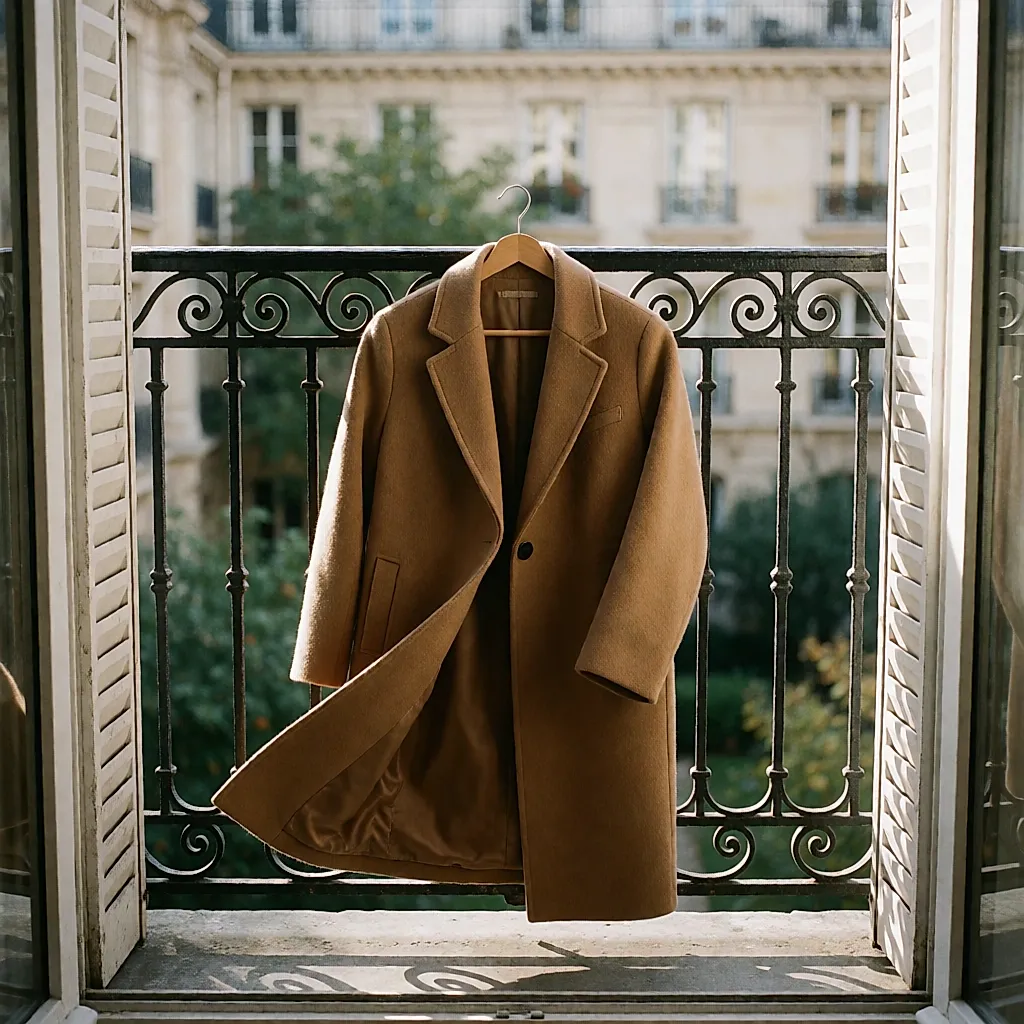
The first step is also the one most of us skip: hang the coat where air can move around it for several hours, ideally overnight. A broad hanger that matches the shoulder width — not a wire one, which puts a peak exactly where there wasn't one. A sheltered balcony, a room with a through draught, and no direct sun: wool doesn't like being baked, and dark colours fade without warning.

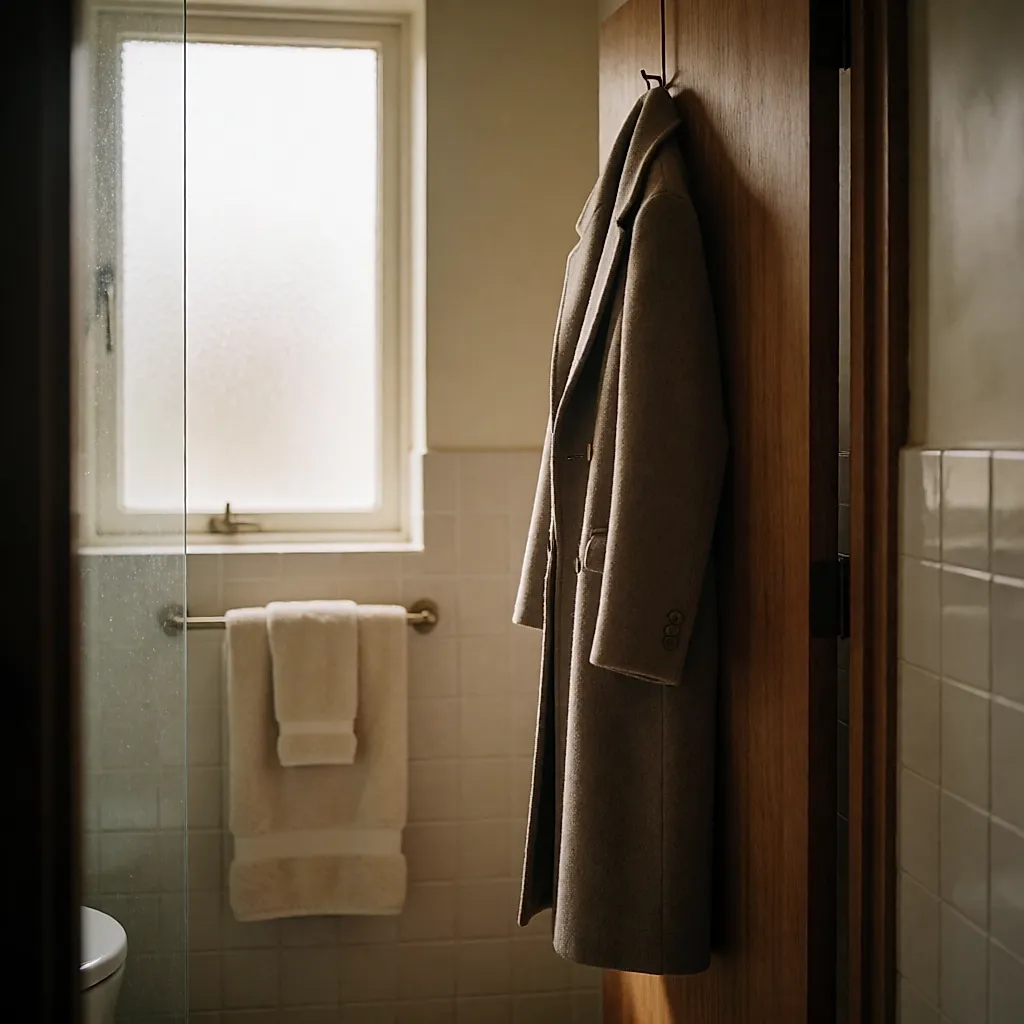
Air does most of the work: the wardrobe smell, the trapped damp, some of the creasing. For the stubborn ones, the steam in a bathroom after a shower works well, so long as the coat hangs a decent distance from the water. Skip room sprays and "freshness" mists, though: they mask the smell for a while and leave a film that draws dust in. If the coat has come out of a box or a loft, another day outside costs you nothing.
The brush does more than the dry cleaner
Now brush with the nap. A soft-bristled brush, natural if you have one, long strokes from the top down, no pressing. The aim isn't to scrub but to lift dust, pollution residue and the faint fuzz that dulls wool after a season in storage. Turn the coat inside out and go over the inner seams and the top of the back as well: that's where dust settles quietly.
On a stain, resist the urge to reach for a soaking sponge. Blot with a barely damp cloth, working from the edge inwards to limit the ring, then dry flat, well away from the radiator. Grease, ink, red wine? Stop there and hand the coat to a professional: keep going and you'll most likely set the mark instead.
The four-point check, coat in hand
Turn it inside out like a tailored jacket, and always inspect in this order. The lining first: it wears thin under the arms and at the armholes, where the friction never lets up. Look for pulled threads, small tears, and places where it hangs lower than the hem. Then the seams — shoulders, centre back, armholes: a seam that's come open can be stitched, a seam that has torn the fabric tells a different story.

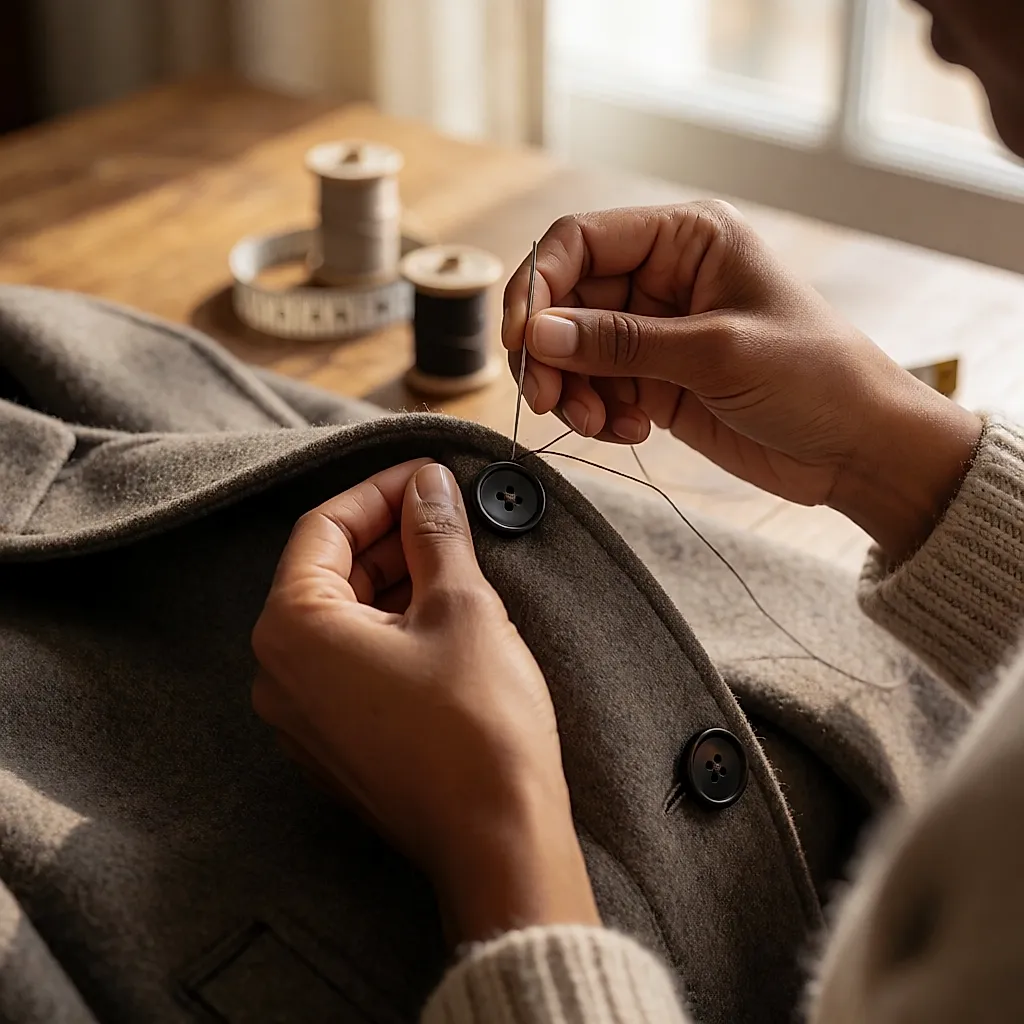
Next, the buttons — and count them. A button hanging by a single thread takes minutes to re-sew, with a little slack behind it so it can breathe. Last, and the most revealing: put the coat on in front of a full-length mirror and look at the drape. The shoulders should sit without a stepped crease, the sleeves should end at the wrist or just above, the hem should fall straight. A coat that pulls at the buttons, gapes at the back or rides up at the front is often one alteration away from right — sometimes one size away.
What can be saved, what can't
Let's be straight about it: not everything is salvageable. A clean tear, an open seam, a missing button, a lining seam that's come away, a hem that's dropped: these are routine repairs, often invisible once done. A shiny patch left behind by a previous dry clean can sometimes be eased out with steam — no guarantees, so try it and don't push it.
Moth holes right across the front, wool felted by a wash that went wrong (the fibres mat together and won't separate again) or a lining that needs replacing entirely on a budget piece — those change the maths. And if the structure has shifted — shoulders distorted, fabric that's lost its body — no alteration will give the coat back its original line.
Alter or replace: run the numbers
An honest tailor will tell you straight: on a well-made coat, a refresh usually costs less than a like-for-like new one, and the coat goes on for several more winters. On a budget piece, the same bill can land above the value of the garment. That's the moment to accept the replacement rather than pay for a repair that won't last the season.

Before you commit, take a look at second-hand as well: charity shops, vintage shops and resale apps turn up dense wool at prices that make you think twice, provided you check the composition label (be wary of the synthetic content) and run the four-point check before you buy.
Budget
On price, expect roughly £15–30 for a standard dry clean, £10–20 for re-sewing buttons, £20–45 for a sleeve hem, £40–80 for a partial lining repair and more like £90–180 for a full lining replacement, depending on length and quality. These ranges are our own rough guide rather than a quotation: they vary considerably by city, by how fiddly the job is and by the finish you ask for.
Where to go? The local alterations tailor is usually the best value for small jobs, the dry cleaner's for cleaning, and the repair service recommended by the brand when the coat is a valuable one. Always ask for a quote first: it's free, and it saves an unpleasant surprise at collection.
For the next time you store it: a broad hanger, a cotton bag rather than plastic (wool needs to breathe), and a few cedar blocks or sheets of tissue paper rather than scented balls. A coat folded into a sealed bag spends the summer picking up creases it will take ages to lose.
In the end, a wool coat is never really finished: it gets looked after, mended, almost handed on. So this year, before you write it off, give it a night in the air, a few minutes with the brush and an honest look in the mirror. If it still suits you, you've just saved yourself a coat — and, incidentally, a shopping trip in the November rain.



Comments
Your opinion matters: rate the article, react and reply to comments.
Comments are moderated; AI-assisted comments are flagged. Text emoticons (8-), :-), <3…) are automatically shown as images.