
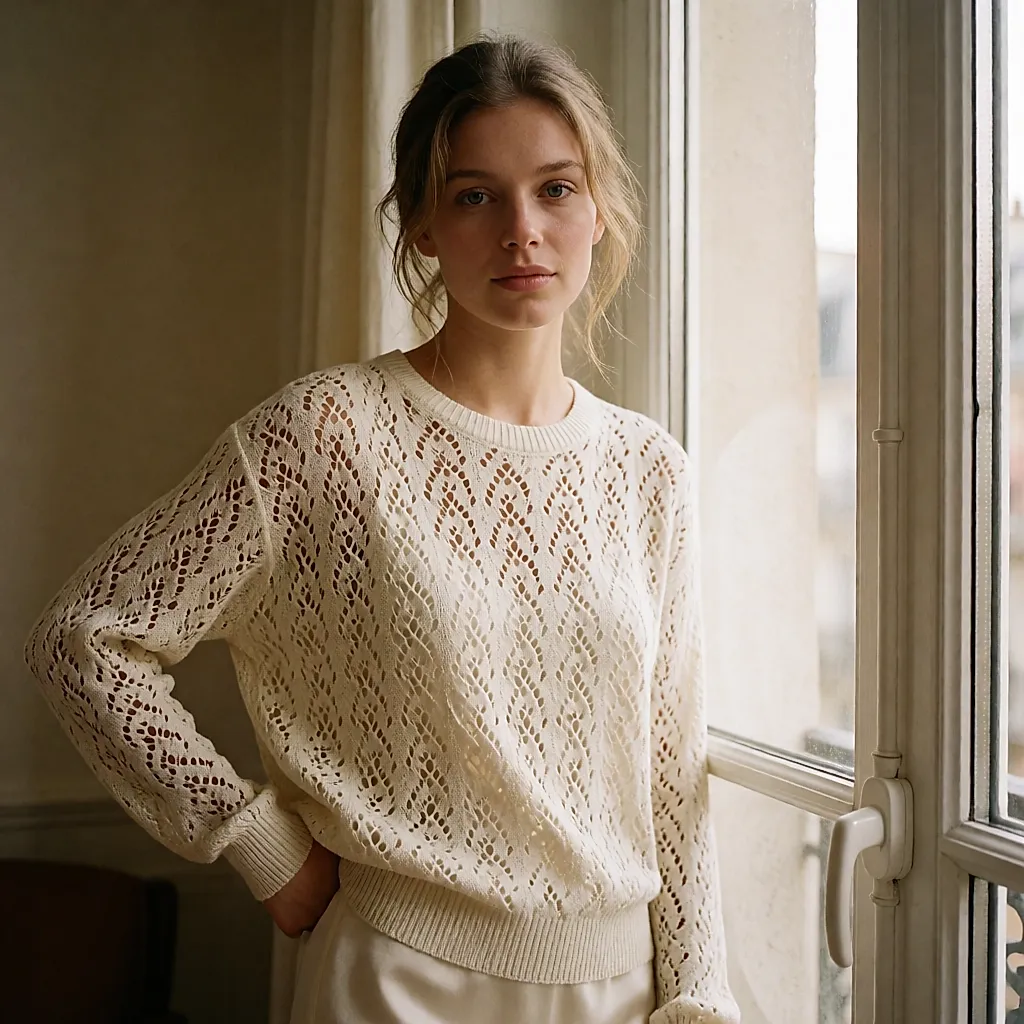
There are pieces that pass the bedroom mirror and get lost in daylight. Openwork knitwear is one of them: delicious on its own, slightly sheer under evening lamplight, and much more talkative at midday on the street. We love its pattern, its open stitches, the way it lets an autumn outfit breathe—but you still need to know what to wear underneath. And that's where everything is decided.
A piece that should stand alone, in theory
Pointelle, mesh, fine crochet, knitted lace: these knits owe their charm to what they don't show. A tight gauge gives a discreet texture, almost a raised effect; a looser mesh lets skin and the colour of your base layer show through—and sometimes much more than both. It isn't the style of the piece that decides; it's the density of the knit, and the light you wear it in.
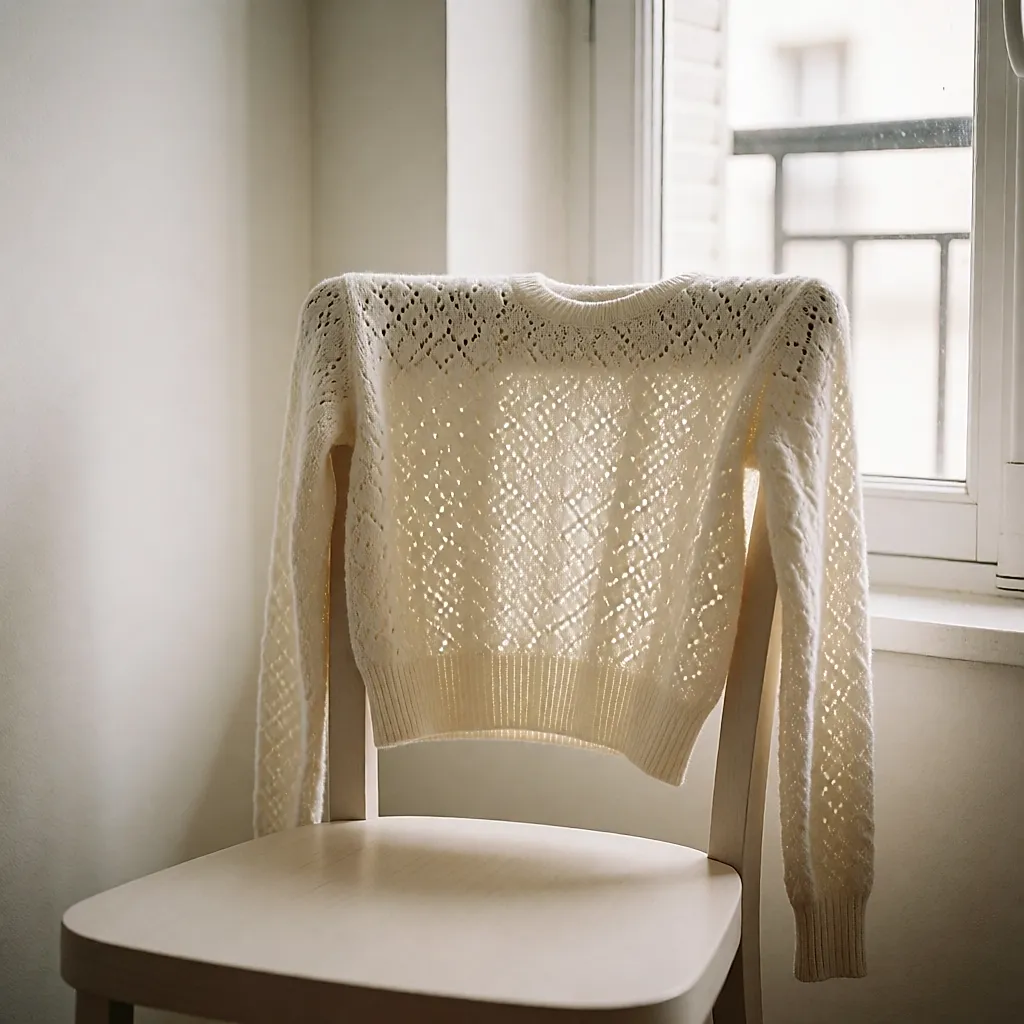
Hence a simple habit, to adopt in the fitting room and in front of your wardrobe: the lamp test. Hold the piece up to a light source, then to a window. If you can guess the colour of your hand, you'll guess the colour of your T-shirt too. No one else will do it for you, and no one will hold it against you.
What to wear underneath: density decides everything
First rule: your base layer isn't a garment, it's a backdrop. Silk camisole, satin vest top, finely knit T-shirt—anything that stays close to the body and doesn't create folds. Slip a slightly loose shirt under an openwork knit and the whole thing becomes a mille-feuille: delicious in a patisserie, questionable on the shoulders.
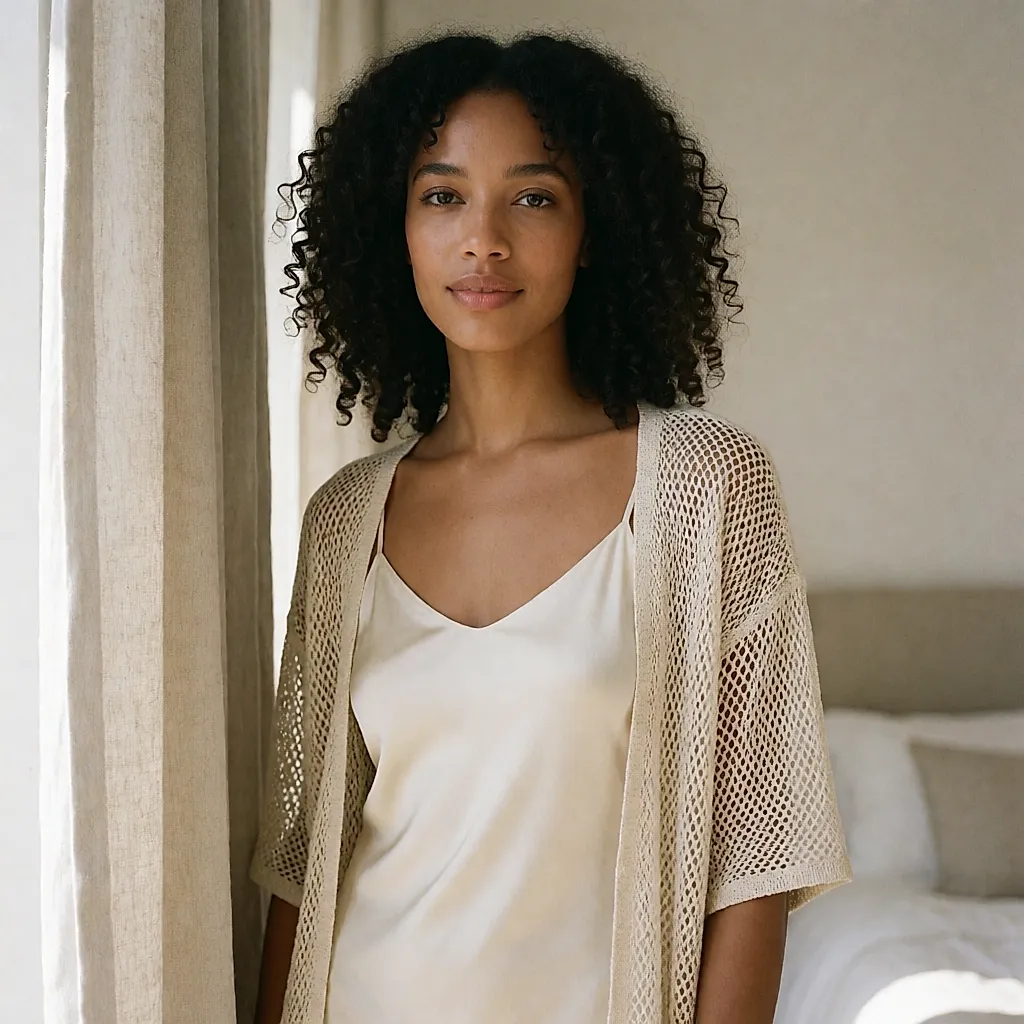
Then there's density. The more open the knit, the more coverage your base layer needs. A fine pointelle can take a slightly translucent base; a wide mesh demands satin or a firmly opaque jersey, otherwise the net effect sets in and won't let go. The layer underneath should behave like a second skin: no strap showing, no seam marking through the holes, no shiny fabric under a matte knit.
Tone-on-tone or contrast: two moods
Tone-on-tone is the most elegant, and the most forgiving. A cream camisole under a cream knit, a nude under beige: the eye doesn't see two garments, it sees a clean veil laid over matte skin. It's the option to choose for lunch, a relaxed office, a day when you don't want to negotiate with your outfit.
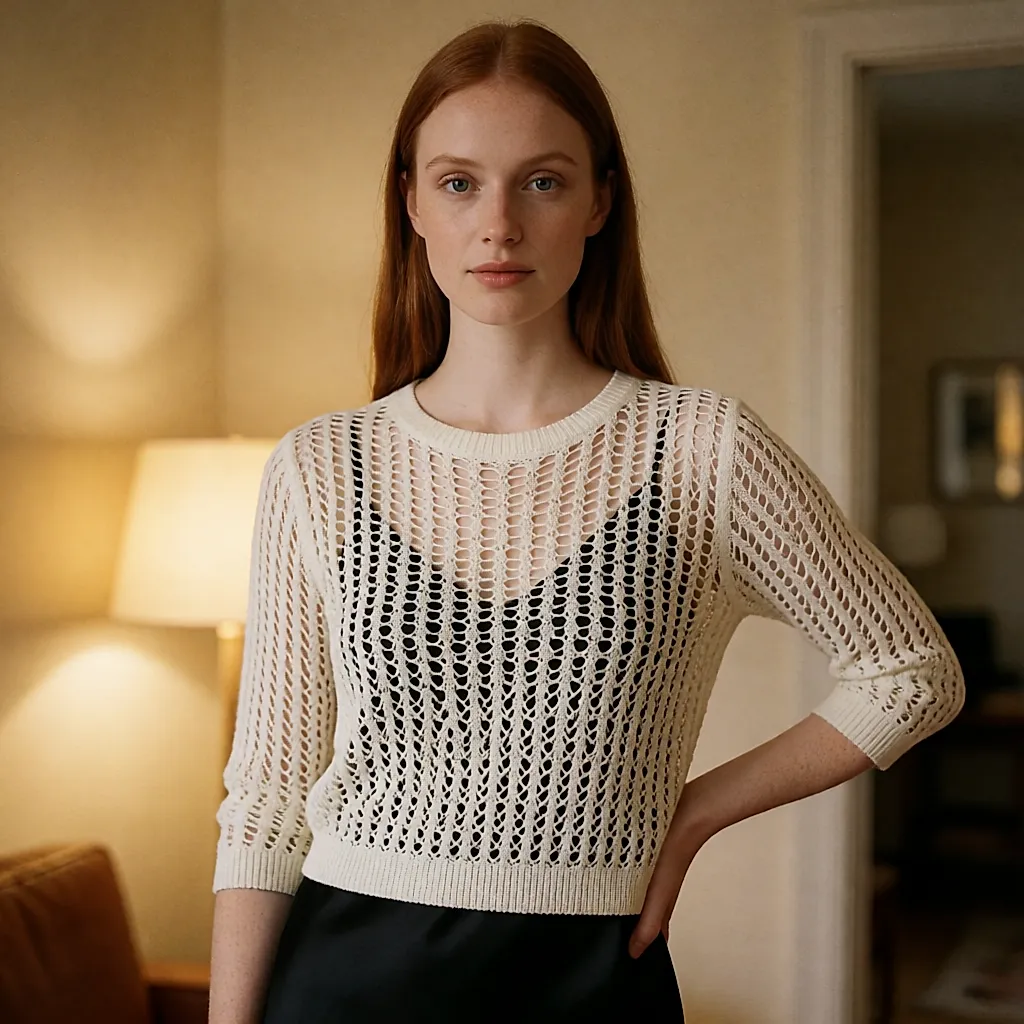
Contrast tells a different story. A black base under an ivory knit draws lines, structures the silhouette, gives a little authority to a piece that doesn't have much. Very good in the evening, under a blazer, with wide-leg trousers. A small caveat: strong contrast draws the eye to the base layer, and therefore to what's underneath—if your camisole has seen better days, it will show. Contrast in texture works too, without playing colour opposites: openwork cotton over matte silk, fine wool over satin. Same colour family, two textures, and the outfit gains depth.
The weight of the outer layer, or the art of drape
This is where many silhouettes lose their line. Openwork knit is fluid, almost liquid: add another soft, bulky layer and the whole thing starts to live its own life, slipping and bunching at the waist. Conversely, a slightly structured outer layer—wool blazer, trench, cropped wool jacket—holds the silhouette and lets the knit do its thing.
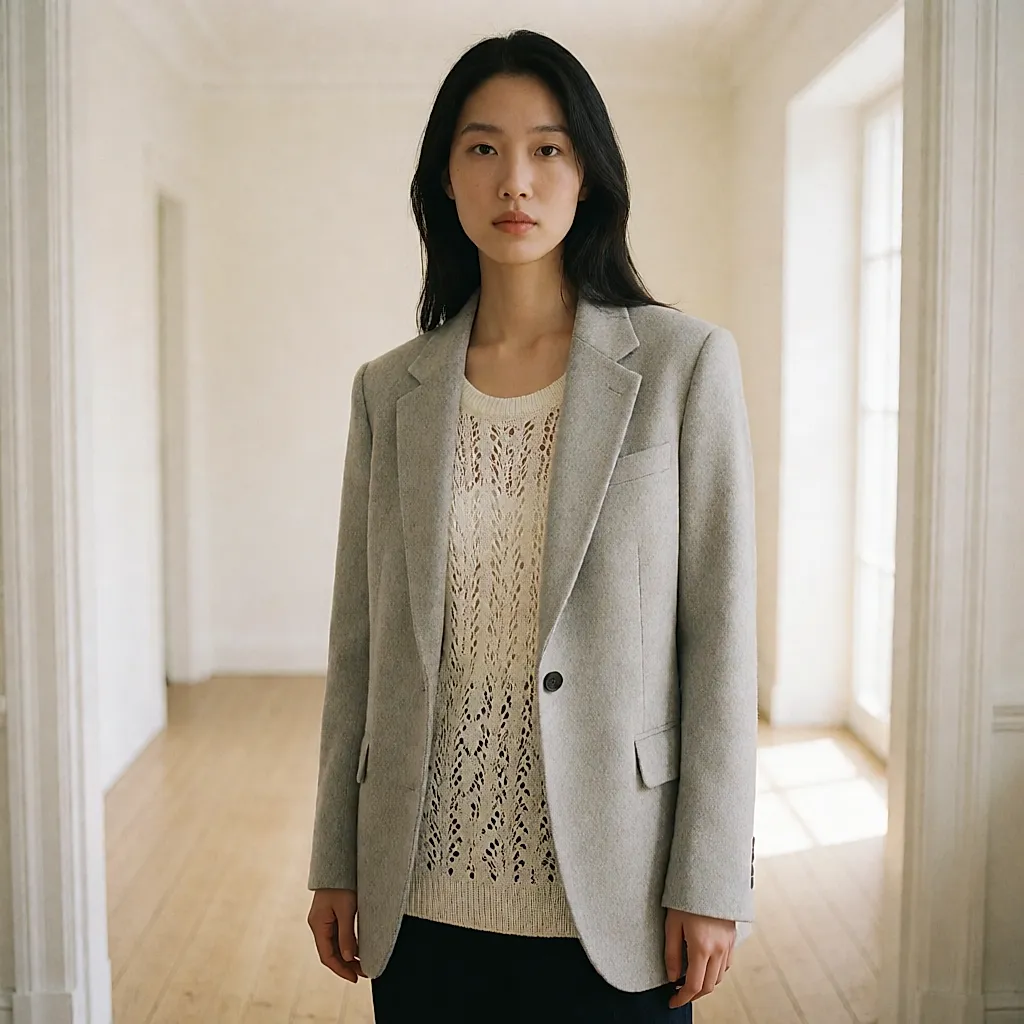
If you prefer an all-fluid look, stick to one fabric that moves. A satin slip dress under an openwork knit, yes—as long as the base layer stays fine and the overall bulk stays light. Two soft volumes stacked and you go from layering to a mess in one stride—or one scarf. Before you leave, raise your arms, sit down, walk: what rides up, gapes or bunches will tell you more than a mirror.
What it costs
Openwork knitwear isn't the most bank-breaking piece in your wardrobe: expect to pay around £30–£70 for a fine cotton or merino wool jumper or cardigan on the high street, £70–£180 for a branded piece with more intricate knitting, and more if you move into cashmere or real lace. Base layers stay affordable: £10–£25 for an organic cotton vest top, £30–£80 for a silk camisole. In charity shops and on resale platforms, vintage knits often go for £10–£35—a real find when the yarn is good quality.
When it comes to care, openwork knitwear needs a little tenderness: hand-wash or use a mesh laundry bag on a delicate cycle, dry flat, never hang it up wet unless you want it longer than you planned. A quick look at the care label doesn't hurt either; the fibre composition says a lot about how it will hold up over time.
The three-move test: hold the piece up to a window (transparency), raise your arms (does it ride up?), sit for five minutes (does it bunch?). Three checks and you'll know whether your layering will last the day.
So there it is: successful openwork knitwear is never a transparency stunt, it's a well-tuned stack. Density of the base layer, chosen tone, weight of the outer layer, drape of the whole look—four dials, and you go from a piece that feels fragile to one that holds its own until evening. If you remember one thing: get the base right first, the rest follows. And when a cream camisole meets a cream open-knit jumper, that's usually a winning combination.
Comments
Your opinion matters: rate the article, react and reply to comments.
Comments are moderated; AI-assisted comments are flagged. Text emoticons (8-), :-), <3…) are automatically shown as images.