

It's 7.12am, the alarm has caught you out by a quarter of an hour, and the November sky is dithering between drizzle and the faint promise of brightness. In front of the wardrobe, the same question lands as it does every morning: puffer or trench? Long sleeves or a light jacket? You know how this ends — you leave the house wrapped up, come home sweltering on an overheated train, and the coat ends up knotted around your waist like an admission of defeat.
Three labels are tackling the problem head-on this season, each with its own grammar. Detachable sleeves, removable linings, layers you can shed by mid-afternoon: clothing that adapts instead of just gritting its teeth. It might be the smartest idea of the season. So we took a closer look at what these pieces are really worth — and what they'll set you back.
The wardrobe that comes apart and still looks sharp
At Moncler, this is nothing new: the house built its reputation on the down jacket, and Moncler Genius — the capsule collections in which guest designers reinterpret the codes of the down jacket — drives the point home. The principle is the same as any modular wardrobe: one piece in the morning, a lighter one in the afternoon, without a detour to the wardrobe. The drape stays clean and the silhouette holds — that's the whole point, because a badly built transformable piece mostly transforms into a shapeless gilet.
Marine Serre, meanwhile, has made reassembly its signature. The house, founded by its eponymous designer, a winner of the 2017 LVMH Prize, builds part of its wardrobe around hybrid pieces. Jackets with overlapping panels, sleeves that come off: the logic isn't a gimmick, it's a second life for the garment. A piece you keep for longer because it can be worn another way is already a form of restraint.
And then there's COS, quieter still. The London brand, owned by the Swedish H&M group, doesn't shout "transformable" on its labels — it simply designs wool and cotton pieces with generous cuts, made for layering rather than for calling attention. A lined jacket you can open, a coat that floats over a fine knit: this is layering, not a performance. The clothes lose some of the spectacle; they gain a lot in usefulness.
What to check in the fitting room
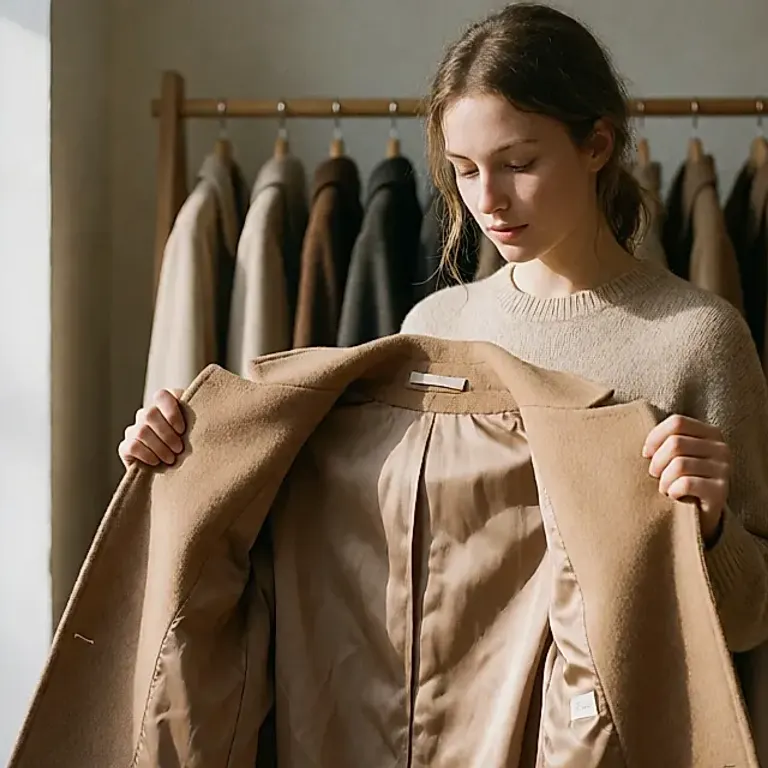
A detachable sleeve is charming on a catwalk and much less charming when you have a meeting in ten minutes. So look closely. The movement matters: a zip that glides with one thumb, poppers that clip without a fight, a lining you can pull out with a flick of the wrist — or, on the other side, a six-point fastening system that leaves you in your shirtsleeves a little longer than you'd planned.
The real test is still how the piece drapes with the sleeves off. Some models hold up impeccably, with a clean armhole and a line that doesn't collapse. Others, once stripped of their extra layer, reveal a lining that dangles and a volume that gapes at the armholes — the promise of two garments in one, but when you unpack it, you mostly get one garment and an involuntary scarf.
When it comes to fabrics, checking matters even more on a complex piece. A jacket in wool, merino or recycled wool will age better than a synthetic-heavy construction, whose channels and fastenings wear out quickly from all the handling — though everything depends on the quality of the piece and the care you give it. Look at the share of synthetic fibres on the label: if the detachable lining is stuffed with them, modularity won't save much.
Who it works for (and who it doesn't)
Let's be honest about it: the transformable piece isn't a universal answer. It shines for people whose days span wildly different temperatures — the 21°C office, the 8°C street, the commuter train with questionable air conditioning, the evening out without a stop at home first. A piece that lightens as the day goes on is genuine comfort, not a mere indulgence.
It's less suited to you if you want a proper winter coat, one that can take driving rain without complaint. The detachable lining then turns out to be a luxury you'll never use, and you're paying a premium for the system. And if your shape likes a defined waist, watch out for pieces that stack two layers: layering can pad out the silhouette rather than flatter it.
In other words, trying it on isn't enough. You need to try it on in both configurations, then look at the price and ask yourself honestly how often you'll actually take the sleeve off. If the answer is "once a season, when the office is too warm", a good classic jacket will do the same job for less.
What it costs
Prices vary mainly by material, and the gap is significant. Expect roughly £100 to £220 for a transformable jacket in cotton or a wool blend from mid-range brands — Sandro, Maje, COS and labels like them — and more like £220 to £420 once the piece is fully lined in wool. Moncler is another category entirely: down jackets with hoods or detachable linings usually sit well above those bands, with big variations depending on the model and the collection.
The smart move is second-hand: a Moncler jacket with a detachable hood holds its value and turns up on specialist resale platforms; for vegetable-tanned leather or wool pieces, luxury resale sites are worth a look. Check the composition before you commit, too: that's what will decide how long the piece lasts.
The test that never lies: in the fitting room, detach the sleeve or the lining, give the piece a shake, and watch how it falls in the mirror. A system that comes together in three movements and a silhouette that stays clean — that's the one to pick. The rest is just decoration.
Underneath it all, these three houses are saying the same thing without comparing notes. The piece you keep isn't necessarily the most expensive or the most striking: it's the one that adapts to your days, not the other way round. Our verdict: yes to days that span the temperature range, forget it if you're after a winter coat and nothing more.


Comments
Your opinion matters: rate the article, react and reply to comments.
Comments are moderated; AI-assisted comments are flagged. Text emoticons (8-), :-), <3…) are automatically shown as images.