
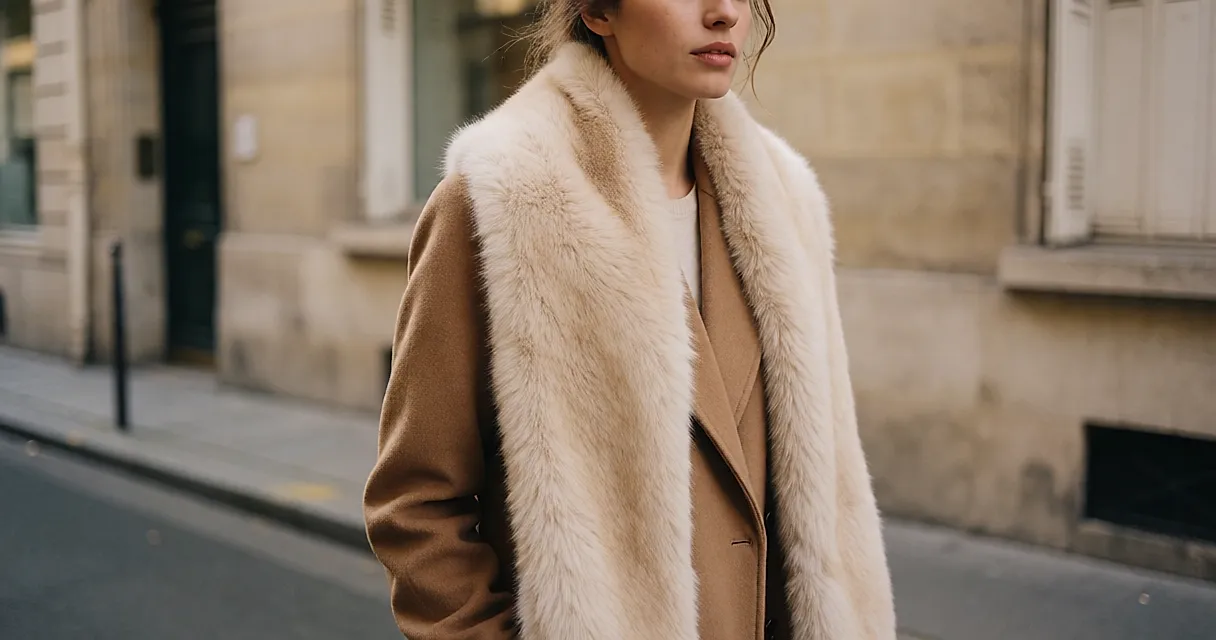
November, 7.40am, and you are putting on the same camel coat as last Monday. It is a very good coat — it took a month of deliberation and two returns to get it right. It has just become a little bit of a uniform. This is exactly where a faux fur scarf comes in: thirty seconds, and the silhouette tells a different story.
The coat stays the same, the look shifts
We used to buy outfits. Now we buy gestures: a piece that sits over what you already own, warms your neck and redraws the shoulder without a full wardrobe overhaul. The faux fur scarf belongs to that family. It does not replace anything; it adds — volume where the coat lies flat, texture where the wool is understated. Which coat could not use a little volume at the shoulder?
In practice, keep the plain coat you wear from September to March. Black, camel, charcoal grey, navy: the best candidates are the plainest, because it is the contrast of textures that does the work. A fluffy scarf over smooth wool, and the eye registers a look, not a garment.
Length, density and drape: the three things to look for
Length first. Too short, and it strangles the collar and looks like a cat curled around your neck. In practice, look for a stole that falls clearly over the bust — long enough for one full loop and two panels hanging down in front. It is that front panel that lengthens the silhouette.
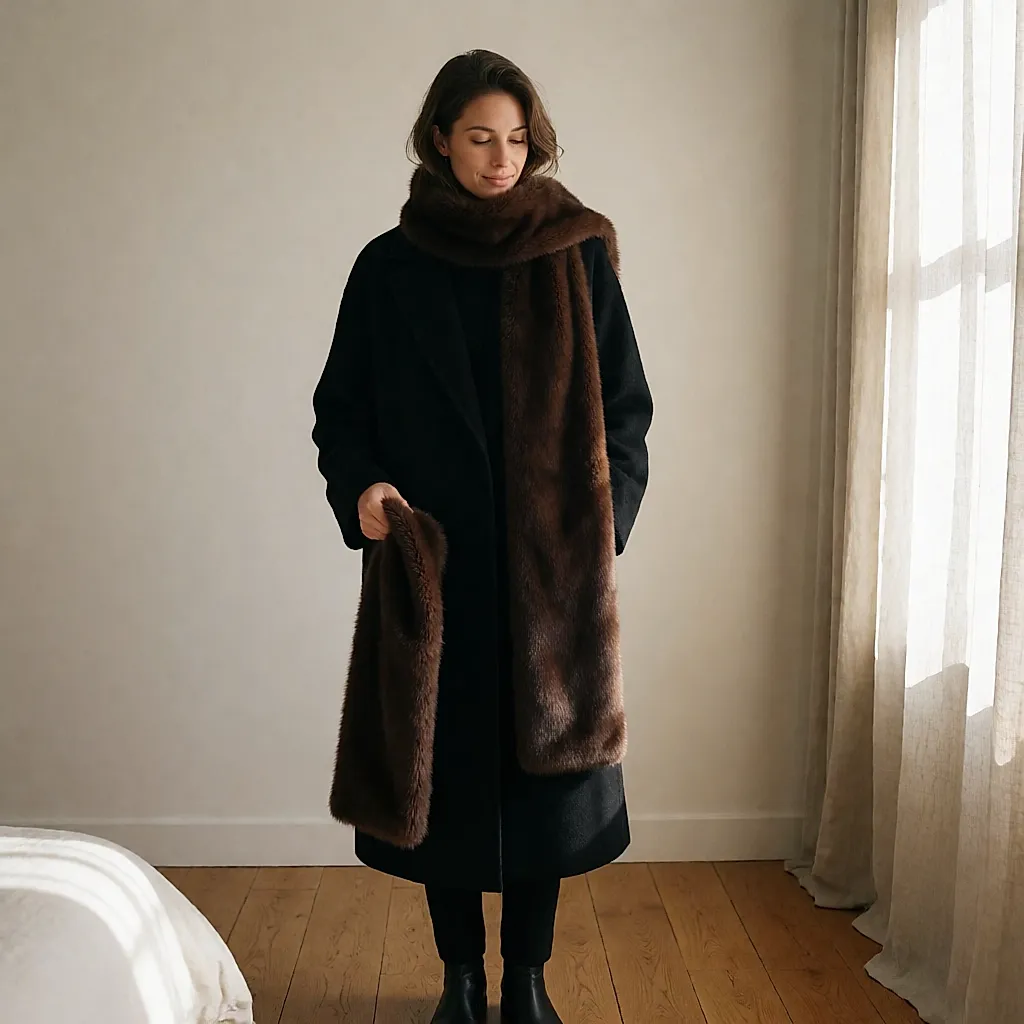
Density next: dense enough to keep you warm, supple enough not to turn you into a snowman. Run your hand over it — if it crackles like cardboard, it will stand up on the shoulder and you will look like a shop-window prop. The decisive test is drape: how the scarf slips and sinks when you put it on. It should follow the shoulder, not stand up on it like a flag.
What it does for a plain coat
Drape it over your shoulders without tying it, and the most ordinary coat looks as if you are going somewhere. The gesture is almost too simple: let it fall to one side, lift one panel onto the shoulder, tighten the coat belt over it if the piece is supple enough. And there it is — the whole look works without a second thought about your outfit.
Mind the collar, though. A high collar, puffer or hood does not take kindly to a thick stole: everything ends up fighting for space around your face. In that case, choose a shorter scarf worn under the collar, or a fine style that slips inside. A chunky beanie on top? Stop there — one statement piece at a time, otherwise it is an accessory parade, and nobody wins.
An honest warning: faux fur is usually synthetic. The sensible reflex is not to collect three a winter, but to choose one that will last several seasons, and to look at what already exists. Check the lining and seams while you are at it: that is often where these pieces age badly.
Second-hand is where it gets interesting
It is one of those accessories where the resale market is generous. Faux fur scarves and stoles are exactly the kind of thing bought on impulse, worn for two winters and sold on without a second thought — sometimes with the tag still attached. You will find long styles, collars, leopard print, cream tones and deep browns, at prices that leave room for the rest. This is often where the best find is.
How to sort without getting it wrong? Three moves are enough. Shake the piece to see if it sheds, stroke the pile the wrong way to judge softness, check the fastening or press stud if there is one. In charity shops, at car boot sales or on resale apps, it pays to know your measurements: length and width decide everything, and a photo never shows them very well.
Budget
As a rough guide, expect to pay around £10–£30 for a decent stole second-hand, sometimes less at the end of the season in charity shops; £30–£70 for a new mid-range piece that will last a few winters; and beyond £80 you are mainly paying for labour and the finish of the lining. In high-street fashion chains and supermarkets, styles often sit between £20 and £40 — check the inside before you fall for one. The price rises with the size of the piece, the quality of the backing (the base to which the faux fur is attached) and where you buy it: in London, the same stole can command more than elsewhere in the UK.
The favourite-coat test. Before you buy, picture the scarf on the coat you wear most often — not on the perfect outfit on the website. If it works with that one, it will work with the rest. If it only works with the coat you never wear, you know how that ends.
Ultimately, the best buy is not the most spectacular scarf: it is the one that makes you bring out a coat you were wearing out of habit. One piece, one gesture, and the silhouette changes without your bank card really suffering. That should see you through to February.



Comments
Your opinion matters: rate the article, react and reply to comments.
Comments are moderated; AI-assisted comments are flagged. Text emoticons (8-), :-), <3…) are automatically shown as images.