
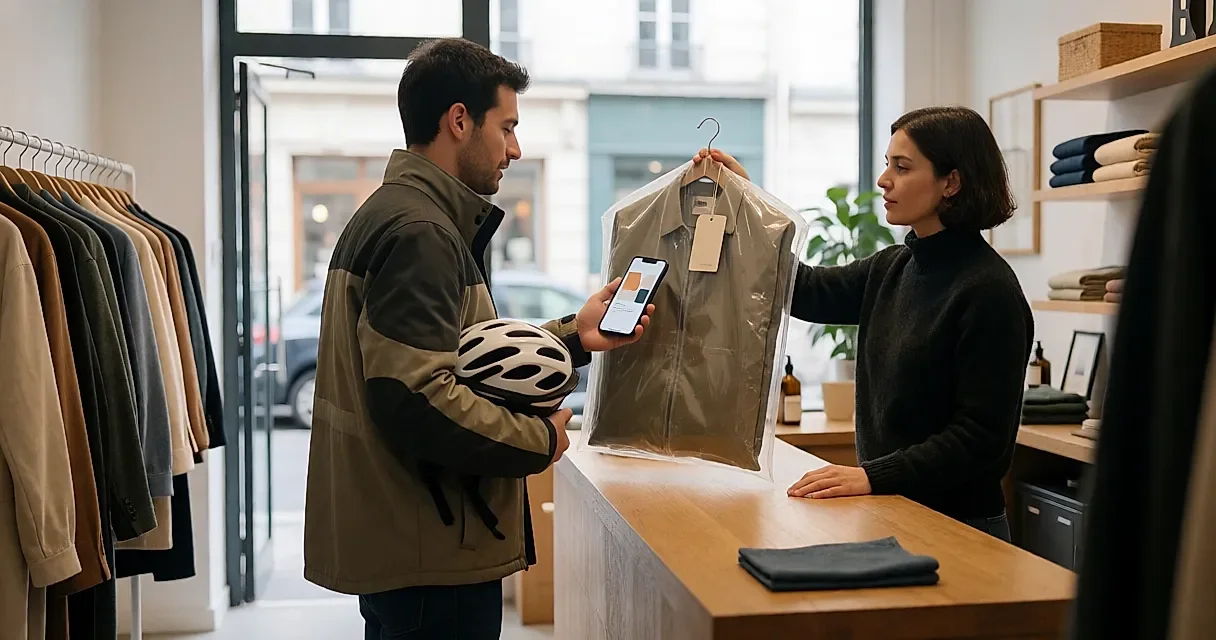
The luxury of 2026 isn't owning the piece: it's not having to choose it. The idea of a courier walking into a shop to collect the item you've already picked has obvious appeal. Uber Eats or another delivery app could plausibly run this kind of service; with no official announcement to point to, we're covering it here as a possibility, not an established reality. The fact remains that choosing is the real cost of a purchase — and the courier doesn't do it for you.
The courier no longer rings your bell, they go and fetch
In a service like this, the whole thing fits on three screens. You open the app, type "beige trench, size M": a courier heads to the partner shop, asks for the piece, pays for it and brings it round. No fitting room, no shop assistant, no "do I take it in black or camel?" to settle in front of a mirror.
On paper, that solves a very real problem: the Saturday afternoon that vanishes in a queue for the fitting rooms, the piece you want that's only left online, the parcel you can't face opening. Except that a courier is fulfilling an order: they don't advise. A size 10 in one brand isn't the size 10 your neighbour buys, a wool that looks soft in a photo can itch, camel can turn mustard. Whatever you save in time, you sometimes pay for in returns.
The choosing part nobody charges you for
Here's the real issue. The price tag has never been the only cost of a purchase: there's the time spent comparing, the try-on, the dithering, the return. A piece that's "almost" right costs more than an expensive one worn three times a week — we all know it, and we forget it every season.
So what can you delegate? Restocking, yes: the same basic, the same bag, a second pair of the style you already wear. No decision to make there, just logistics. A first purchase, on the other hand, deserves your presence: how something hangs, how thick it is, a seam that pulls — you judge that in three seconds in front of a mirror, not on a product page. Linen that looks chic in a photo can look like a crumpled sheet when you wake up — and no app will tell you that.
Before handing an order to a courier, three questions are worth more than one regret: are you re-buying something you already know? Is the exact size on the label of the one you own? And is the return free — if not, check what it costs before you confirm.
Budget
The in-store courier service described here is still hypothetical: with no official offering, no real price can be quoted for the trip or the return. If such a service does come your way, ask for the full price before confirming — any fees and the cost of a return should be set out clearly. Personal shoppers' rates vary by city, by time and by number of pieces: again, get a written quote. It's a budget to keep for a specific occasion — an interview, a wedding — rather than for a white T-shirt.
Next time you're torn between ordering and going out, remember that you don't pay for a garment so it arrives, but so it gets worn. The courier doesn't know your wardrobe, your crooked bedroom mirror or your Monday morning. You do.

Comments
Your opinion matters: rate the article, react and reply to comments.
Comments are moderated; AI-assisted comments are flagged. Text emoticons (8-), :-), <3…) are automatically shown as images.