

You've done the maths before, one evening, in the bathroom. Waxing every three weeks, the razor that leaves bumps, the cream that stings — and that little idea of laser hair removal that returns every spring, as skirts and swimsuits come back around. Except the real question isn't "does it work?": we know it does, on certain hairs and certain skin types. The right question is who it's for, at what cost, and with what risks. Suffice to say the topic deserves a proper look, before you sign up to any package.
What the laser actually does to the hair
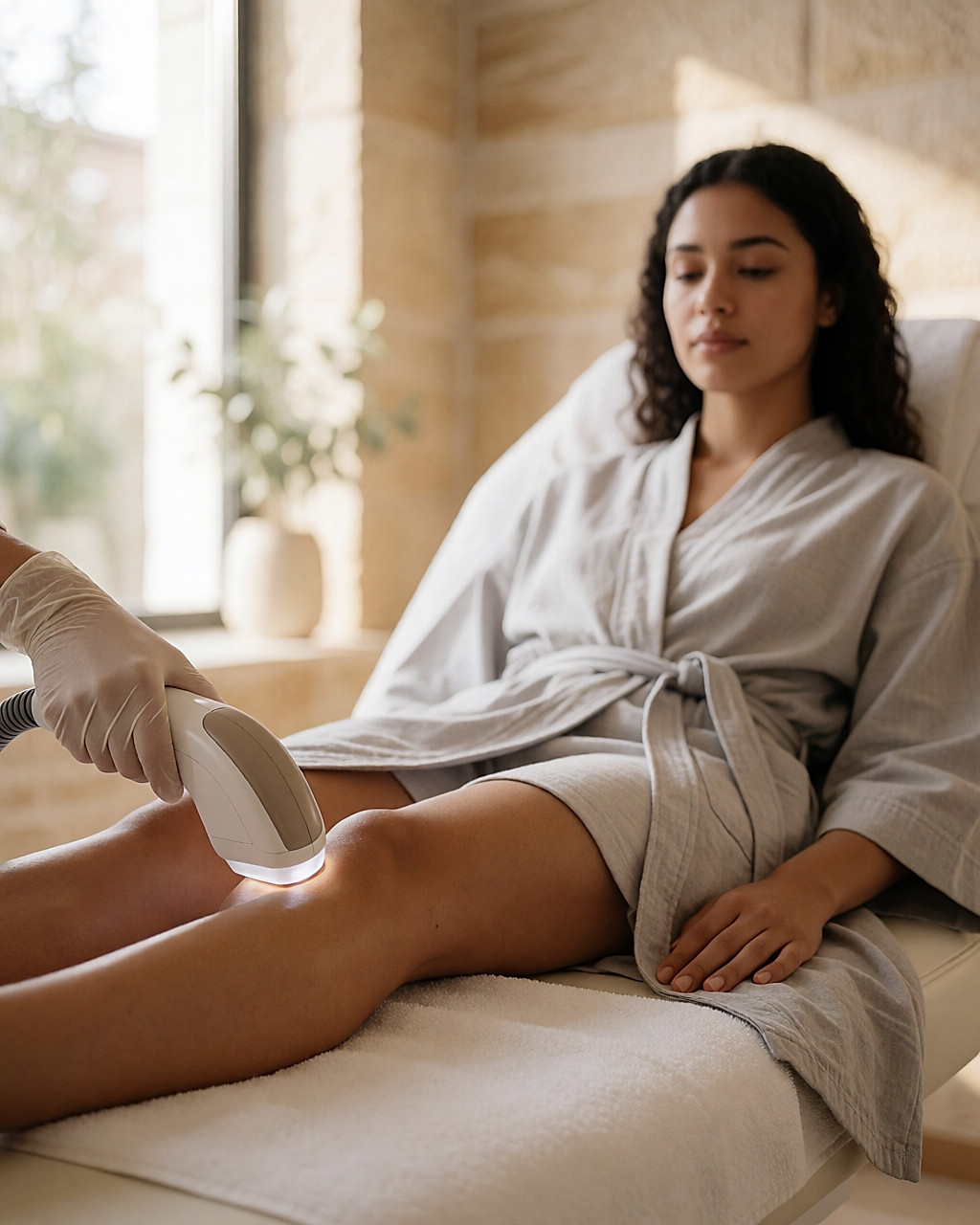
The principle is easy to grasp: the laser light is absorbed by melanin, the pigment that colours the hair. The heat then travels down to the follicle and damages its ability to regrow. You'll immediately spot the rule practitioners repeat over and over in consultations: the more contrast between your hair and your skin, the better the chances of a clear result. Dark hair on fair skin is the ideal ground, the scenario where the technique gives its best.

Conversely, blonde, red, white or grey hair: too little melanin, and effectiveness becomes distinctly limited. It's not about brand or budget, it's physics. And on darker skin, where you can certainly give it a go, an Nd:YAG laser and a genuinely experienced practitioner are preferable — because the risk of burns or pigmentation rises markedly when the skin itself absorbs part of the light. A note of caution, though: reading about it doesn't mean you can skip medical advice, and we come back to that below.
What you gain
Let's be honest: waxing and razors have their loyal fans, and we're not going to throw the former under the bus. But the laser does offer a real benefit: a lasting reduction in hair density. Hair grows back finer, sparser, more slowly — which changes everything for those who find their regrowth quick and heavy. On delicate areas (bikini line, underarms, face), you also escape the mechanical irritation of waxing and the ingrown hairs from shaving, which can leave their own little marks for summer.
Practically, no need to repeat a beauty marathon every week: sessions are spaced out, and on small areas, it's quick. In reality? On the budget side, the package weighs upfront — more on that below — but it spreads the cost over several months, which makes the bill easier to digest. And then there's that very concrete freedom: heading to the pool in July without a second thought, neither that morning nor the night before. Nothing spectacular, but genuine comfort.

The limits, before you sign
Let's say it straight away: this isn't a promise of 100% smooth skin for life. It often takes six to ten sessions, sometimes more, then regular top-ups — some follicles resist, that's just how it is. Hormones play their part too: PCOS, pregnancy, menopause and thyroid issues can all trigger regrowth, and well-conducted removal can go off track on a disrupted hormonal landscape. It's frustrating, but it's part of the limits worth knowing before you invest.
On the risk side, let's take two minutes to list what you'd rather never discover in the treatment room: elastic-band-like pain during the session, redness, swelling, folliculitis, even blisters, burns, infection, light or dark patches. These effects are often temporary, but not always. Among the clearly identified risk factors: freshly tanned skin, photosensitising treatments or retinoids, and above all the lack of a prior test. In short, don't book on a whim straight off the beach! And in all cases, talk to a dermatologist: they're the one who'll confirm the technique AND the follow-up best suited to your skin.

Before you book
On preparation, a few steps to remember, and they're not optional. Start with a test on a small area: it's the only way to see how your skin reacts and to check the practitioner knows their equipment. Shave the day before — but forget waxing and tweezers for at least four weeks beforehand, so the hair is well in place by the time of the session. No sun or UV in the two weeks before, and again for two weeks after. It's not overkill: it's what prevents nasty surprises.
Another reflex to adopt: ask precise questions. Which device is being used? Is it actually laser, or pulsed light marketed under the same name?! Who actually performs the session — the dermatologist themselves, a technician, a trained beauty therapist? How many sessions are genuinely needed for your area? That transparency is what makes the difference between serious care and a cut-price package. An unusually low price should also warn you off: it's often pulsed light, not medical laser, and the results don't compare.

The step that changes everything, just after your session: for 24 to 48 hours, your skin stays a sensitive area. Skip the sauna, the steam room, intense exercise, perfumed deodorant and, of course, the sun. On the formula side, go for a light gel or lotion, fragrance- and alcohol-free, applied in a thin layer — a simple gesture that soothes and moisturises without irritating. On the eco side, a certified organic aloe vera gel (look for COSMOS or Soil Association certification), in a glass jar or cardboard tube, cuts down on packaging. A quick ingredient check: make sure aloe appears at the top of the ingredient list, not just as a front-of-pack claim.
Budget
In the UK, expect around £15 to £35 per session for the upper lip, £25 to £60 for underarms, £35 to £80 for a basic bikini line, £60 to £130 for a full bikini, £70 to £160 for half legs and £130 to £260 for full legs. Usually you don't book per session: packages of six sessions come in at £160 to £400 for underarms, £350 to £800 for the bikini area, and £800 to £1,600 for full legs. Wide ranges, which move according to city, the device used, the practitioner's experience and the number of sessions actually needed for your particular hair.
Where can you get these treatments? In a dermatology clinic for maximum safety, at a specialist laser centre, at a salon — where it's often pulsed light, so ask first — or through certain online booking platforms. And for context, bear in mind that laser-treated skin is often less prone to ingrown hairs and shaving-related irritation: a little extra comfort to keep in mind when you're hesitating. Whatever the option, ask for a written quote before paying anything, and never let yourself be swept up by a package that no one can break down for you.


Comments
Your opinion matters: rate the article, react and reply to comments.
Comments are moderated; AI-assisted comments are flagged. Text emoticons (8-), :-), <3…) are automatically shown as images.