
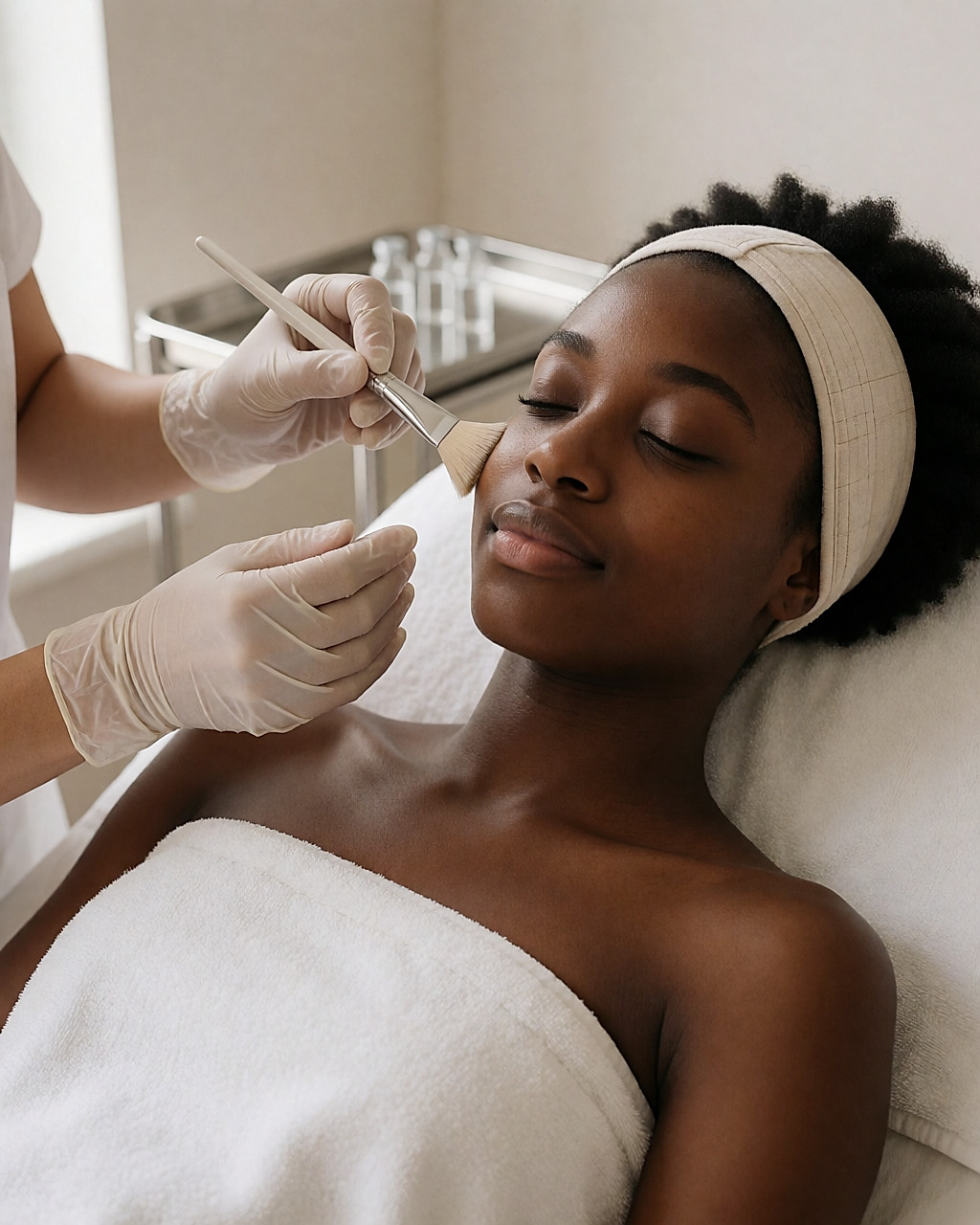
Your complexion lacks radiance, your pores look enormous, and that little acne scar on your cheek sends you straight back ten years? You've almost certainly scrolled past one of those videos of skin peeling off in sheets, filmed in a bathroom. Behind the drama is a genuine medical treatment: the dermatological peel. It's the step that can change everything — provided you know what's being offered, and what it costs.
The principle, in plain English
The word comes from to peel. In theory, the logic is simple: after several weeks of preparation, a doctor applies an acid solution to your skin to trigger controlled exfoliation. Dead cells come away, skin renews itself, collagen production gets going again. What can you expect? A brighter complexion, softened fine lines, faded pigment patches, refined skin texture, and blurring of acne marks or stretch marks — with no guarantee of complete removal, because every skin reacts differently.

Careful: we're not talking about a bathroom scrub turned up to eleven. This is a medical protocol, with preparation, follow-up, and sometimes a few days of peeling to own in front of colleagues and the postman.
Three depths, three uses
Superficial. It only reaches the stratum corneum of the epidermis. This is the radiance boost for people in their 20s and 30s: first fine lines, minor breakouts, pregnancy mask. In formulation terms, it usually uses fruit acids (AHAs) or glycolic acid, for light peeling over a few days.

Medium. It goes deeper to correct: pronounced wrinkles, established pigmentation. Protocols vary, often using trichloroacetic acid (TCA). The after-effects are more obvious, with a full week to factor in — best to plan a few days without social commitments.
Deep. Phenol-based, it targets mature skin (45 and over) with deep wrinkles or marked scarring. Results develop gradually, but this protocol is rarely used today because of systemic risks.
The ritual, step by step
Success starts with preparation. Three to four weeks beforehand, your dermatologist prescribes a cream to even out your skin. On the day, application takes 10 to 30 minutes; you feel heat, sometimes tingling. Good news: most light peels don't need anaesthetic.

Afterwards, redness and peeling are more or less noticeable depending on depth: allow three to seven days for a superficial peel, around ten for a medium one. And one non-negotiable point: SPF 50 sunscreen every morning, a hat, and no direct sun — even if the sky is grey, your skin in recovery doesn't want to negotiate.
A peel is not a DIY project. Forget homemade acid formulas and improvised salon sessions for a medium or deep peel. Find a dermatologist, ask which acids, what concentration, what depth. A sunbathing session just before or just after? Postpone it, no debate.
Who should avoid it
Pregnancy, breastfeeding, an active skin infection, a herpes outbreak: postpone the session, without hesitation. Another key point: on medium to dark skin tones, the risk of post-inflammatory pigmentation is higher. Specific preparation over several weeks and adapted concentrations then become essential.
Recent treatment with isotretinoin or retinoids is also a barrier. In reality, your dermatologist will assess your skin case by case — that's precisely their role, not a TikTok video's.
Budget
For a superficial peel at a beauty salon, expect around £50 to £100 per session. In a dermatology clinic, more like £130 to £350 depending on the area treated and the depth; a deep peel sits above that, in a strict medical setting.
What pushes the price up? The city, the practitioner's reputation, the size of the area, and above all the number of sessions — often three to five for a visible result. As for reimbursement, in the vast majority of cases cosmetic peels are not covered by the NHS and remain private: ask for a quote before booking to avoid nasty surprises.
Also be prepared to make a judgement call: a single session sold as an 'express peel' will have little in common with a real, prepared, spaced-out, monitored protocol. It's rarely the place to cut costs.
Sources
- British Association of Dermatologists (BAD) — Information on chemical peels
- NHS — Cosmetic procedures
- Care Quality Commission (CQC) — Checking cosmetic treatment providers



Comments
Your opinion matters: rate the article, react and reply to comments.
Comments are moderated; AI-assisted comments are flagged. Text emoticons (8-), :-), <3…) are automatically shown as images.