

An anti-wrinkle patch is a small translucent square — soft silicone or serum-soaked fabric — that looks a bit like a plaster and costs more per square centimetre than a decent pastry. You stick it under your eye, sometimes at the corners of your mouth, and it promises to work while you sleep. The real question isn't whether it's cute (it is, just about), but what it actually gets up to overnight — and what it doesn't replace.
What a patch really does overnight
Its main selling point comes down to one word: occlusion. Stuck to the skin, the patch limits evaporation and keeps the area damp. The surface layer soaks up water, skin feels more supple when you wake up, and fine dehydration lines look less pronounced. That's a surface effect, not a deep-down treatment: a patch won't erase an established line, and that's absolutely fine — it was never invented for that.

What it doesn't do is replace your evening skincare. A night cream goes over the whole face, nourishes, soothes, sometimes treats; a patch covers a few square centimetres. Using it as your only step is like lighting a room with a torch. Where it earns its place is as a clever add-on: your usual cream everywhere else, a patch on the area that bothers you, and off to bed.
And what about an "active-infused" patch? Hyaluronic acid, glycerine, plant extracts: it delivers a local top-up, often pleasant, but we're still firmly in cosmetic territory. So nothing transformative in the sachet — just a well-hydrated patch of skin and an excuse to leave the rest of your routine alone.
Reusable silicone or serum-soaked fabric?
Reusable silicone is the patch you keep. Flexible, washable in warm water with a mild soap and left to air-dry, it recovers its stick and can be reused for weeks if you look after it. It's the more sustainable choice — and often the cheaper one per use, even though the first pair costs more than a disposable sachet. Bonus: no individual wrapping, no serum to bin. Hard, though, to put a precise figure on how many uses you'll get: it depends on the material, the care and your skin.
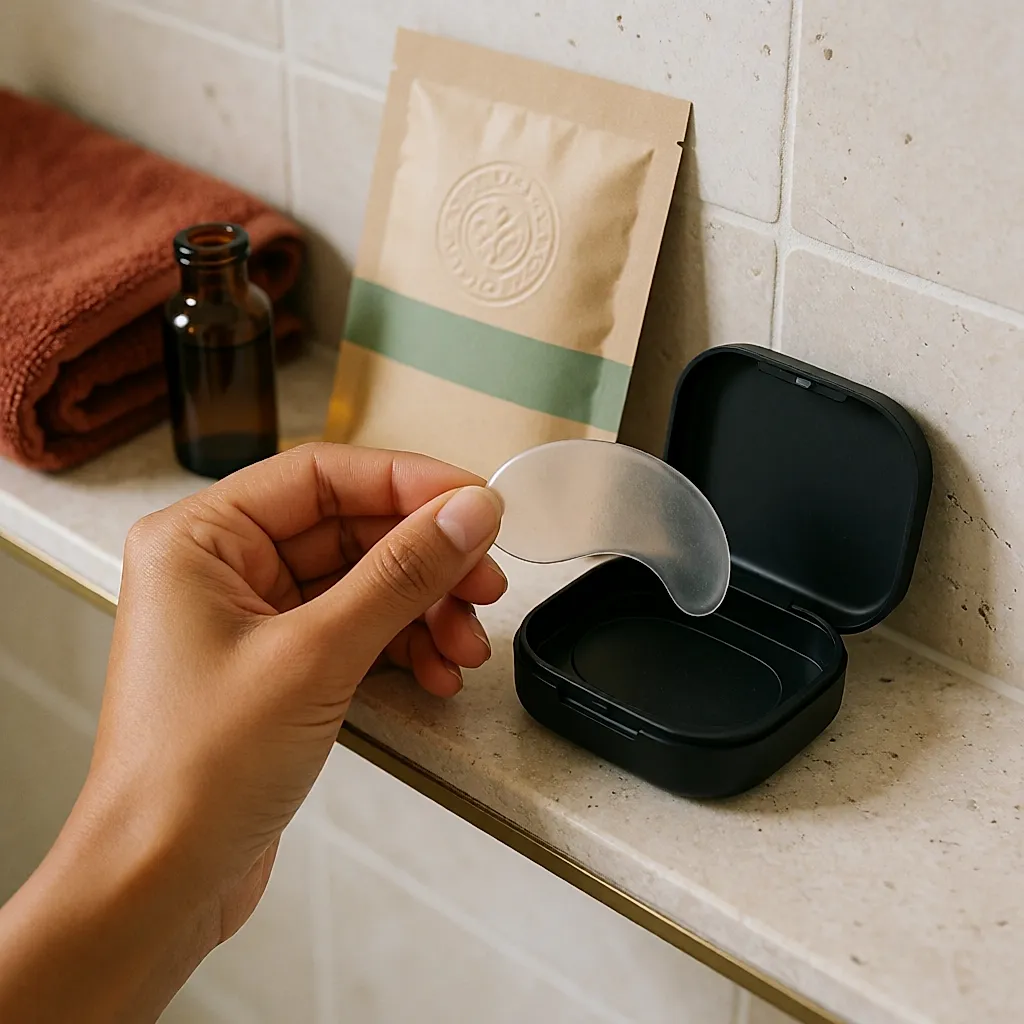
Fabric patches, by contrast, are single-use. Soaked in serum, they won't hold once peeled off, so they go in the bin, sachet and all. Very comfortable and handy for one specific night — the eve of something that matters, a weekend, a bit of self-care — they quickly turn into a budget line and a small pile of waste if you use them constantly. A sensible compromise: disposables for occasions, silicone for the routine.
The adhesive that can spoil the whole thing
The skin around the eye is thin, and an adhesive that's too strong makes itself felt the moment you peel it off: tugging, redness and a sudden urge never to stick anything to your face again. Look for a gentle adhesive, a patch that lifts away without a fight, and patch-test on your forearm before going anywhere near your eye. If it stings, burns or pulls, stop: no patch is worth a damaged skin barrier.

Storage is simple but decisive. An infused patch stays in its sealed sachet, away from heat, until the moment you use it; silicone lives in its box or case, clean and dry. A steamy bathroom isn't their friend — or yours, for that matter, if that's where you keep your cosmetics.
What it costs
Expect to pay roughly £15–£40 for a pair of reusable silicone patches, depending on the brand and format, from a pharmacy, a beauty retailer or the brands' own websites. Serum-soaked fabric patches usually sit at around £15–£35 for a box of four to eight pairs in pharmacies and larger high-street retailers, with premium versions climbing higher; the novelty sachets drop below £10 without promising much.
The real calculation isn't the price on the label but the cost per night: well-maintained silicone often works out cheaper than a box you buy again every month. And if you're still hesitating, start small — one pair, one box — and see whether the step fits into your week. That's the only judge worth trusting.
The step that matters: clean, dry skin, the patch laid completely flat with no creases, and your usual cream everywhere else. The patch replaces nothing: it's an extra, applied locally, for one night.
So, does a patch replace your evening skincare? No — and that's no bad thing: it does something else. Choose your material to suit your rhythm — disposable for the nights that count, silicone for ordinary weeks — and keep your cream as the base. The one routine that still works when you've only got five minutes? A pea-sized amount of moisturiser over your face, a patch under the eye, and lights out.



Comments
Your opinion matters: rate the article, react and reply to comments.
Comments are moderated; AI-assisted comments are flagged. Text emoticons (8-), :-), <3…) are automatically shown as images.