
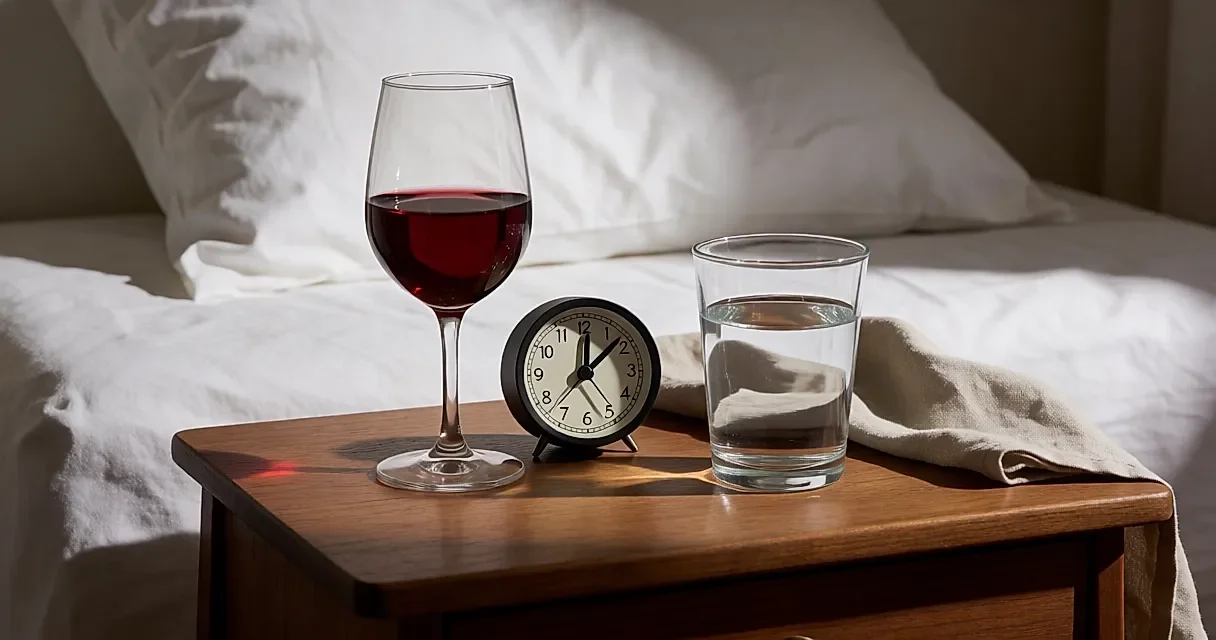
Guidelines on how much alcohol to drink exist, but they say nothing about the hour at which you drink it. And that is where a good part of the night is decided.
What alcohol actually does to your sleep
A glass of wine often helps you get to sleep faster — it is one of the effects most readily associated with alcohol. Alcohol is a sedative: it slows brain activity, and the slide into sleep happens without negotiation. Except that falling asleep quickly does not mean sleeping well. Alcohol can fragment the second half of the night and reduce REM sleep; its effect on deep sleep is harder to sum up in a sentence. You go under, then you come back up.
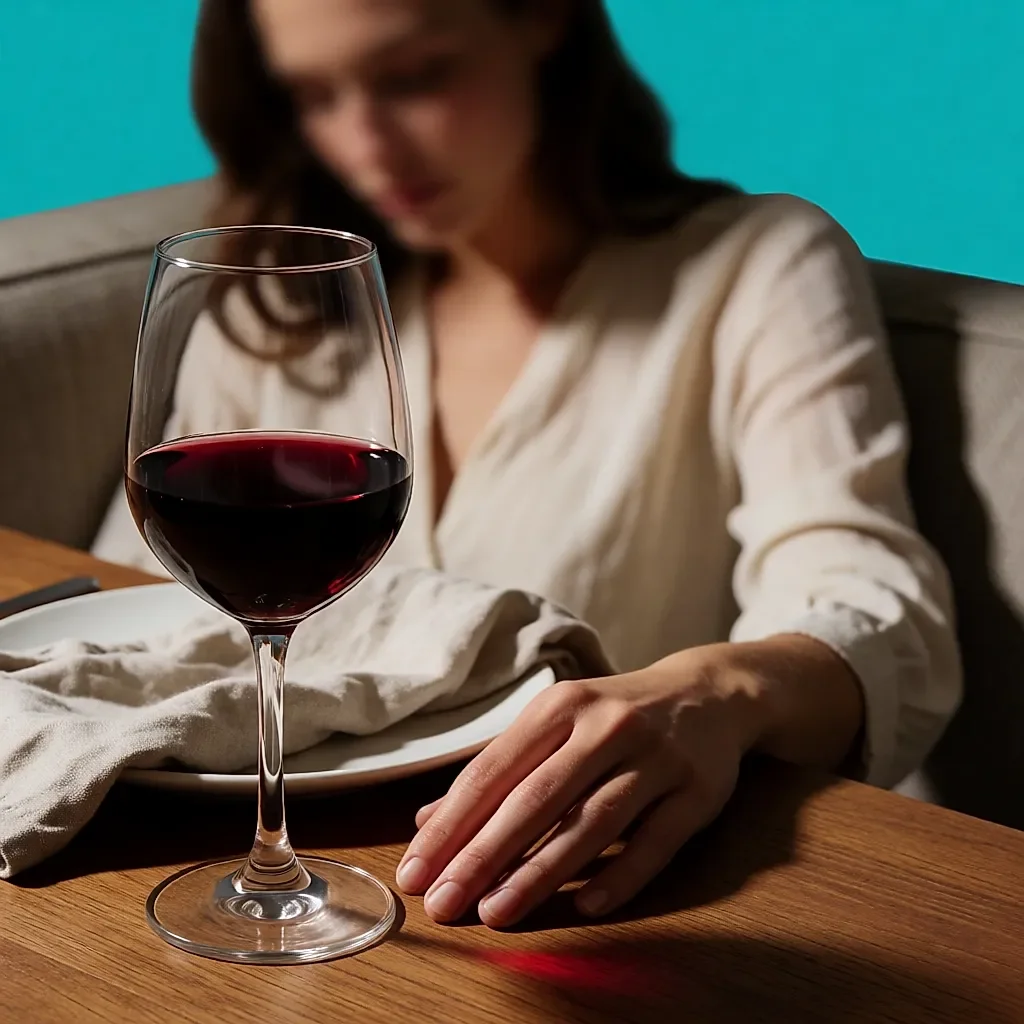
Around 3am, sleep has become light enough that the smallest thing wakes you: a radiator clanking, a neighbour, a thought going round in circles. Some people surface properly; others drift between two states without understanding why. Alcohol can also make snoring worse and, in some people, aggravate sleep apnoea — enough to spoil the night of the person sharing the bed, and yours by extension.
Why the wake-up often lands in the middle of the night
There is a logic to it: the body clears alcohol slowly, at a rate that varies from person to person — weight, sex, food, genetics. A drink taken at 9pm therefore does not act the same way at 11pm — but its influence on the architecture of sleep can carry on well beyond that.
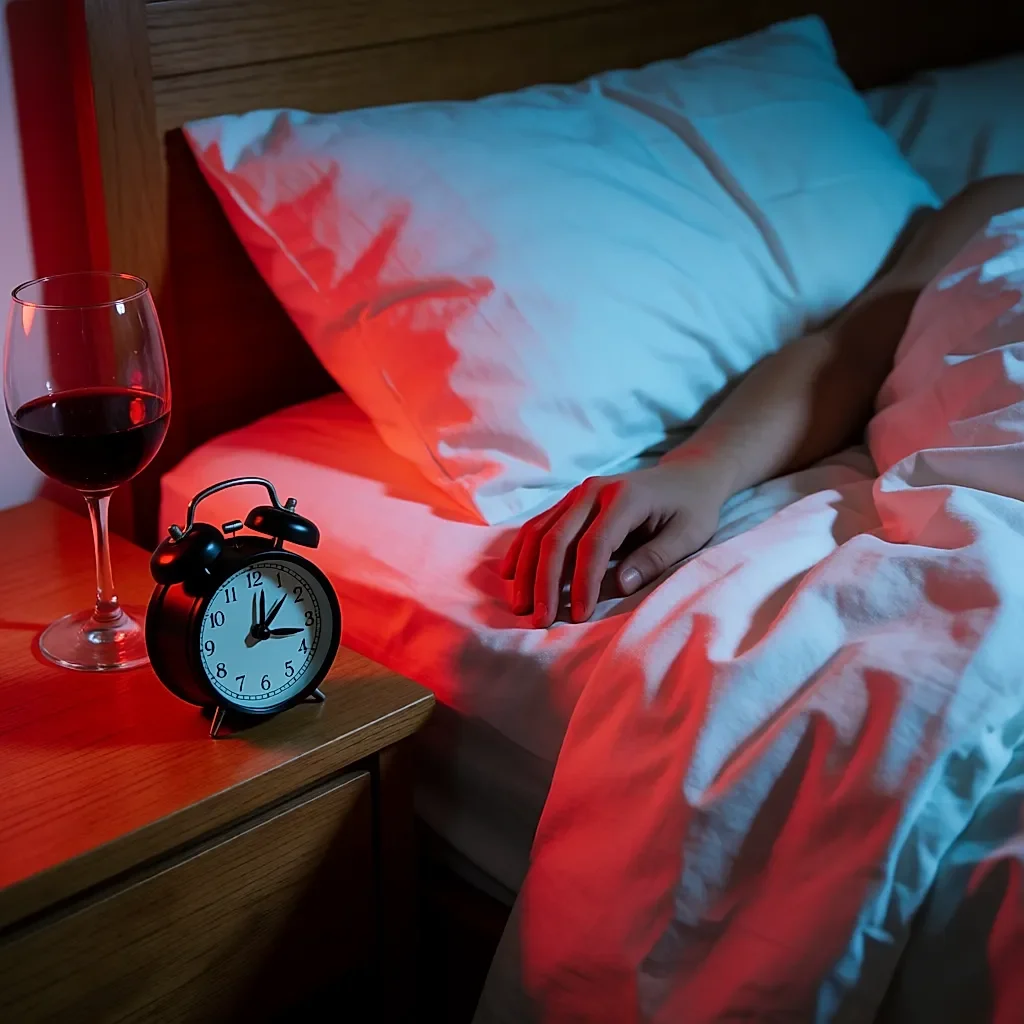
Add to that a set of quieter disruptors: thirst, your bladder, body temperature that regulates poorly, a brain coming back down. The famous 3am wake-up is nothing mystical: it falls in the part of the night when sleep is at its most fragile. Shift the glass earlier or later and the wake-up shifts with it. An essential nuance: that does not mean it disappears.
The timing of the glass matters too
The trade-off is there, and it is nothing like a ban. A glass at 7.30pm, with a dinner that drags on, has a different fate from one knocked back at 10.45pm in front of a series. Between the two there is time for the body to get to work — and that time is yours to give it.
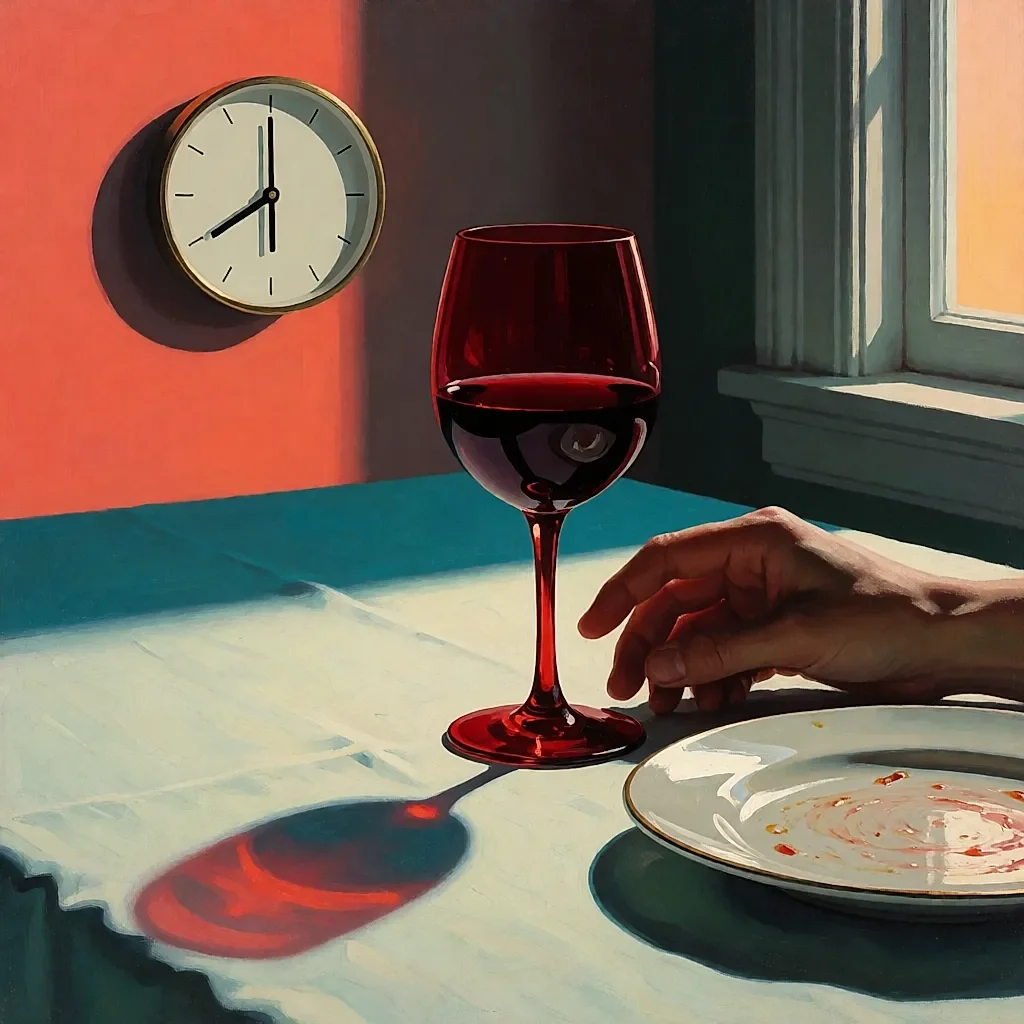
In practice, many sleep professionals advise leaving at least two hours between your last drink and bedtime. It is a rule of thumb, not a biological law: it guarantees nothing, it simply lowers the odds of alcohol still being active at the point when your sleep is at its lightest. So the question of timing is worth asking too.
Three ways to shift it earlier without giving anything up
- Have your glass while you are cooking dinner or at the table, never afterwards, when the evening stretches out in front of a screen.
- Alternate with a large glass of water: it slows the pace and takes the edge off night-time thirst.
- If you wake around 3am, note down the time of your last drink and the time you went to bed for a week. The link often jumps out, and it says more than a long lecture.
How next-day tiredness plays on appetite
This is the part that touches on weight, and it starts in the morning. A broken night does not just deepen the shadows under your eyes: it can also change the way you eat. Too little sleep can, in some people, come with a stronger appetite, particularly for sweet and fatty foods, and a less clear sense of fullness. There is nothing moral in that, and nothing mechanical either: tiredness and eating sometimes influence each other, without it being possible to make a rule for everyone.
The scenario is a familiar one: an average night, a difficult morning, a sugary breakfast to keep going, a slump at 3pm, more sugar, dinner pushed back, a glass of wine to unwind. And the loop closes. What is not yet known with certainty is the exact weight of each factor in that loop — alcohol, tiredness, timing, environment. What is clear is that sleep can play a part in regulating what we eat, and that it responds to practical steps rather than willpower alone.
When to get it checked
If you are waking several nights a week and have been for months, if you snore loudly, if you nod off at the wheel or in front of a film in the middle of the afternoon, the wine at dinner is probably not the only explanation. Those signals deserve a professional opinion: speak to your GP, who can refer you to a sleep specialist if needed.
The practical takeaway: alcohol can send you off quickly and wake you early, and the timing of the glass counts — though it cannot be said to weigh as much as the quantity. The marker to remember is simple — two hours between your last drink and your pillow — and it replaces neither medical advice nor one honest question: is it the wine you are after, or the ritual? A stemmed glass, soft lighting, ten minutes without a screen sometimes do the same job. Worth testing, without banning anything.
Comments
Your opinion matters: rate the article, react and reply to comments.
Comments are moderated; AI-assisted comments are flagged. Text emoticons (8-), :-), <3…) are automatically shown as images.