
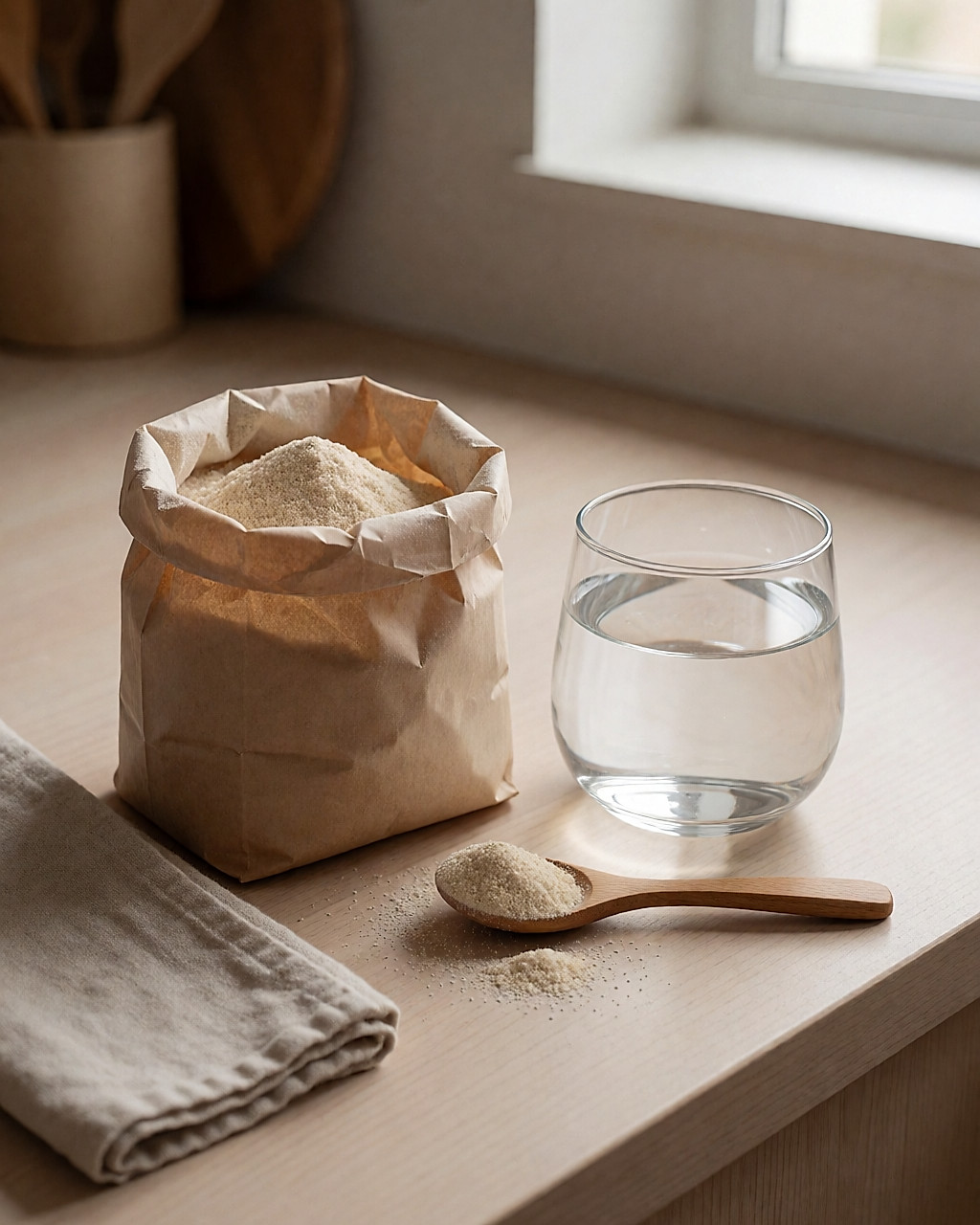
There are things that creep back in through the side door, and this one, frankly, we didn't see coming. For years, we were sold slimness by subtraction — less sugar, less fat, fewer meals. In 2026, the pendulum is swinging gently the other way, and we're adding again. What we're adding to our evening glass is soluble fibre: psyllium, acacia gum, inulin, now bought by the spoonful, loose, from the local health food shop.
To be completely honest, I'm only covering psyllium and similar fibres here: I haven't taken them for long enough to promise you anything on my own behalf. So we'll stick to what the sources say, and nothing more.
What 'soluble' actually means
Let's take the word seriously, because it makes all the difference. A soluble fibre has a rather fascinating property: when it meets water, it swells and forms a gel. That gel doesn't just sit in the stomach — it slows gastric emptying, takes up a little space, and smooths the rise in blood sugar after a meal. Nothing spectacular, as you'll have gathered: this is digestive mechanics, not magic chemistry. Insoluble fibres — wheat bran, vegetable skins, seeds — act more on transit. The two families complement each other on the plate, but they're not the same tools, and confusing them helps no one.
France's ANSES recommends at least 30 g of fibre a day. In practice? Most of us fall well short, very short indeed. The idea isn't to sprinkle a magic powder over a vegetable-free plate, but to fill a real gap — a meal that's a little too pale, a day that's too rushed. The spoonful before dinner is a catch-up, not a magic wand.
The one gesture that changes everything: powder in a large glass of water
The method itself doesn't change, and that's perhaps the most reassuring part. You tip the powder into a large glass of water, stir, and drink it straight away. That's the only step that really matters. If you leave it for even two minutes, the mixture thickens, takes on a gel-like texture that isn't exactly inviting, and becomes genuinely unpleasant to swallow. Suffice to say that haste, here, is a virtue.
For the dose, when to take it and how to build up, the safest approach is to follow the product instructions and ask your doctor or pharmacist — especially if you're taking medication, are pregnant or breastfeeding.

Never dry. A spoonful swallowed without enough water can swell in the oesophagus, and that's a genuine risk factor, not an urban legend. If you have a digestive history (obstruction, stenosis), are under medical supervision, take daily medication, or are pregnant or breastfeeding, ask your doctor or pharmacist before starting — and for medicines, ask how long to leave between the two. A diagnosis of a digestive disorder isn't made in the powder aisle.
Loose, sticks, powder: what each format involves
When it comes to packaging, there's plenty to weigh up, and each option involves a small compromise. Loose is the best value for quantity and uses the least packaging: you buy 200–300 g in a paper bag or straight into your own jar. The catch is the approximate dosing — and the risk of getting into the habit of 'a slightly heaped spoonful', which ends up being 8 g instead of 5. A small kitchen scale accurate to 1 g solves the problem once and for all.

Sticks and sachets, found mainly in pharmacies, cost more per gram, but they slip into a bag and dose themselves — handy when you're living at a hundred miles an hour. On the other hand, the packaging is rarely recyclable and often mixed plastic: that's the compromise you accept with your eyes open. In between, powder in a glass jar or resealable kraft bag is a good middle ground, provided you check that the closure actually closes. A sachet that opens in your handbag, and powder gets everywhere.
On quality, look for a precise origin and species — Plantago ovata for psyllium is the name to remember — an organic certification if possible, and a mention of contaminant testing. Good to know: plant fibres can concentrate certain substances drawn up by the plant from the soil, so this isn't a detail.
How to choose according to your tolerance
Not all soluble fibres behave the same way in the gut, and that's where your comfort comes into play. Psyllium is the most 'all-round' option: it gels quickly and ferments little, which often makes it less likely to cause bloating. Inulin, by contrast, ferments a lot — that's precisely what feeds the gut microbiome, but it's also what can cause gas in the first few days, let's admit.

Acacia gum, which is rarer, is often better tolerated: gentler, with a more discreet effect, but also more expensive. The rule, in every case, stays the same: start small, follow the product instructions, and ask a doctor or pharmacist for advice on the dose and how to build up. And drink water throughout the day — otherwise your bowel movements can grind to a halt, and that's no laughing matter.
Budget
If you want to give it a go, expect to pay around £5–£12 for 200–300 g of loose psyllium in a health food shop or refill store. Acacia gum climbs quickly: more like £10–£18, because it's rarer and more expensive to produce. In pharmacies, boxes of sticks or sachets often sit between £12 and £25 for around twenty or thirty doses — handy, yes, but noticeably more expensive per gram. Online, the differences are wide and sometimes suspicious: check the net weight rather than the advertised price, and be wary of cut-price 500 g tubs with no stated origin.
What it won't do
Let's be blunt: it's not an appetite suppressant, still less a meal replacement. It's a little helping hand for satiety — you eat a little more slowly, you stay fuller a little longer into the evening, you snack less out of boredom. On the scales, the effect is modest, and it depends entirely on the rest of your plate. Without vegetables, protein and sleep, the spoon won't make up for anything: it's the condition, not the recipe.
So yes, the spoonful before dinner has something appealing in its simplicity. But keep in mind that it complements a meal, never replaces it. The real luxury, perhaps, is less the powder itself than the glass of water you take the time to drink calmly before sitting down to eat!
Sources
- ANSES — Update of dietary guidelines for adults for the future PNNS, 2019 (recommendation of at least 30 g of fibre per day).
- Regulation (EU) No 432/2012 — list of authorised health claims, including those relating to psyllium and barley beta-glucans.
- Assurance Maladie — Dietary fibre, ameli.fr.
Food supplements do not replace a varied, balanced diet and a healthy lifestyle.

Comments
Your opinion matters: rate the article, react and reply to comments.
Comments are moderated; AI-assisted comments are flagged. Text emoticons (8-), :-), <3…) are automatically shown as images.